



 Chat with AI
Exam 23: Metabolism and Energy Production

Exam 1: Chemistry in Our Lives40 Questions
Exam 2: Chemistry and Measurements70 Questions
Exam 3: Matter and Energy77 Questions
Exam 4: Atoms and Elements83 Questions
Exam 5: Nuclear Chemistry64 Questions
Exam 6: Ionic and Molecular Compounds83 Questions
Exam 7: Chemical Reactions and Quantities96 Questions
Exam 8: Gases84 Questions
Exam 9: Solutions84 Questions
Exam 10: Reaction Rates and Chemical Equilibrium52 Questions
Exam 11: Acids and Bases72 Questions
Exam 12: Introduction to Organic Chemistry: Hydrocarbons105 Questions
Exam 13: Alcohols, Phenols, Thiols, and Ethers49 Questions
Exam 14: Aldehydes and Ketones44 Questions
Exam 15: Carbohydrates54 Questions
Exam 16: Carboxylic Acids and Esters55 Questions
Exam 17: Lipids70 Questions
Exam 18: Amines and Amides60 Questions
Exam 19: Amino Acids and Proteins66 Questions
Exam 20: Enzymes and Vitamins68 Questions
Exam 21: Nucleic Acids and Protein Synthesis55 Questions
Exam 22: Metabolic Pathways for Carbohydrates58 Questions
Exam 23: Metabolism and Energy Production51 Questions
Exam 24: Metabolic Pathways for Lipids and Amino Acids56 Questions
Select questions type


Which of the following compounds in the citric acid cycle undergoes oxidative decarboxylation?
(Multiple Choice)
4.9/5  (84)
(84) Which is the best choice for the box labeled "Answer" in the illustration below?
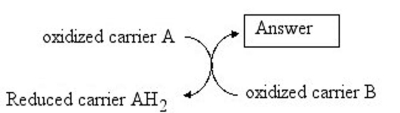
(Multiple Choice)
4.8/5 (90)
(90) The reduced coenzyme ________ provides 1.5 ATP via electron transport.
(Multiple Choice)
4.7/5 (68)
(68) In the chemiosmotic model of oxidative phosphorylation, ATP is synthesized as
(Multiple Choice)
4.8/5 (76)
(76) When oxygen is in plentiful supply in the cell, pyruvate is converted to
(Multiple Choice)
4.7/5 (77)
(77) The transformation of citrate to isocitrate in the citric acid cycle requires a(n)________ reaction.
(Multiple Choice)
4.7/5 (77)
(77) The energy released during electron transport is used to produce
(Multiple Choice)
4.9/5 (74)
(74) In the oxidation of succinate to fumarate in the citric acid cycle, the coenzyme is
(Multiple Choice)
4.9/5 (85)
(85)  is called
The citric acid cycle reaction that removes the first  molecule is a(n)
 (Multiple Choice)
4.9/5 (99)
(99) In reaction 7 of the citric acid cycle, fumarate is converted to malate by a ________ reaction.
(Multiple Choice)
4.9/5 (80)
(80)  participates in reactions that produce
The complete oxidation of glucose produces ________ ATP molecules.
(Multiple Choice)
4.9/5 (79)
(79) 
Filters
- Essay(0)
- Multiple Choice(0)
- Short Answer(0)
- True False(0)
- Matching(0)