



 Chat with AI
Exam 10: Reaction Rates and Chemical Equilibrium

Exam 1: Chemistry in Our Lives40 Questions
Exam 2: Chemistry and Measurements70 Questions
Exam 3: Matter and Energy77 Questions
Exam 4: Atoms and Elements83 Questions
Exam 5: Nuclear Chemistry64 Questions
Exam 6: Ionic and Molecular Compounds83 Questions
Exam 7: Chemical Reactions and Quantities96 Questions
Exam 8: Gases84 Questions
Exam 9: Solutions84 Questions
Exam 10: Reaction Rates and Chemical Equilibrium52 Questions
Exam 11: Acids and Bases72 Questions
Exam 12: Introduction to Organic Chemistry: Hydrocarbons105 Questions
Exam 13: Alcohols, Phenols, Thiols, and Ethers49 Questions
Exam 14: Aldehydes and Ketones44 Questions
Exam 15: Carbohydrates54 Questions
Exam 16: Carboxylic Acids and Esters55 Questions
Exam 17: Lipids70 Questions
Exam 18: Amines and Amides60 Questions
Exam 19: Amino Acids and Proteins66 Questions
Exam 20: Enzymes and Vitamins68 Questions
Exam 21: Nucleic Acids and Protein Synthesis55 Questions
Exam 22: Metabolic Pathways for Carbohydrates58 Questions
Exam 23: Metabolism and Energy Production51 Questions
Exam 24: Metabolic Pathways for Lipids and Amino Acids56 Questions
Select questions type


In a catalyzed chemical reaction, one function of a catalyst is to

Free
(Multiple Choice)
4.7/5  (72)
(72) Correct Answer: Verified
A
The ________ is the energy difference between reactants and products in a chemical reaction.
Free
(Multiple Choice)
4.9/5 (82)
(82) Correct Answer:Verified
VerifiedB


The equilibrium constant for the reaction for the decomposition of  to chlorine and
 at a certain temperature is 0.042 .
 If the equilibrium concentrations are
 what is the value of

to chlorine and at a certain temperature is 0.042 .
If the equilibrium concentrations are what is the value of (Multiple Choice)
4.7/5 (74)
(74) Iron metal reacts with oxygen gas to produce iron(III) oxide. What will be the effect of increasing concentration of oxygen gas in a closed reaction vessel?
(Multiple Choice)
4.7/5 (83)
(83) For the following reaction, the equilibrium constant  is 0.60 at a certain temperature. If the concentration of NO(g) and NOBr(g) are both 0.50 M ,at equilibrium, what is the concentration of


is 0.60 at a certain temperature. If the concentration of NO(g) and NOBr(g) are both 0.50 M ,at equilibrium, what is the concentration of
(Multiple Choice)
4.9/5 (87)
(87) For the following reaction, the equilibrium constant  is 2.0 . If the concentration of both products is 0.10 M at equilibrium, what is the concentration of NOBr?
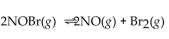
is 2.0 . If the concentration of both products is 0.10 M at equilibrium, what is the concentration of NOBr?
(Multiple Choice)
4.8/5 (90)
(90) The equation for the formation of ammonia from nitrogen and hydrogen is shown below. What is the form of the equilibrium expression?

(Multiple Choice)
4.9/5 (80)
(80)  For the reaction at equilibrium, if the concentration of
 is increased, will the equilibrium shift in the direction i reactants, products, or stay the same?
For the reaction at equilibrium, if the concentration of is increased, will the equilibrium shift in the direction i reactants, products, or stay the same? (Multiple Choice)
4.8/5 (75)
(75) The equilibrium constant for the production of carbon dioxide from carbon monoxide and oxygen is  This means that the reaction mixture at equilibrium is likely to consist of
 (Multiple Choice)
4.7/5 (73)
(73)  For the reaction at equilibrium, if
 is removed, the amount of
 present will
For the reaction at equilibrium, if is removed, the amount of present will (Multiple Choice)
4.9/5 (72)
(72) 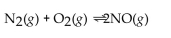 For the reaction at equilibrium, if the volume of the container is decreased, the amount of NO present will
 (Multiple Choice)
4.9/5 (80)
(80) The activation energy of a chemical reaction is the energy that
(Multiple Choice)
4.8/5 (82)
(82) The reaction for the decomposition of  to chlorine and
 is shown below.
 If the equilibrium concentrations are
 what is the value of the equilibrium constant?
to chlorine and is shown below.
If the equilibrium concentrations are
what is the value of the equilibrium constant? (Multiple Choice)
4.9/5 (86)
(86) The physiological equilibrium system that keeps the temperature of the body constant is called
(Multiple Choice)
4.8/5 (80)
(80) 
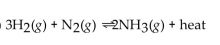 For the reaction at equilibrium, if the volume is increased, will the equilibrium shift in the direction of reactants, products, or stay the same?
 (Multiple Choice)
4.8/5 (95)
(95) The rule or principle that describes the effect of changing reaction conditions on an equilibrium is known as
________ principle.
(Essay)
4.9/5 (88)
(88) 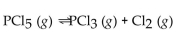 For the reaction at equilibrium, if the volume of the container is increased, the amount of PCl5 present will
 (Multiple Choice)
4.8/5 (90)
(90) 
Filters
- Essay(0)
- Multiple Choice(0)
- Short Answer(0)
- True False(0)
- Matching(0)