



 Chat with AI
Exam 3: The Fundamental Economic Problem: Scarcity and Choice

Exam 1: What Is Economics254 Questions
Exam 2: The Economony: Myth and Reality184 Questions
Exam 3: The Fundamental Economic Problem: Scarcity and Choice278 Questions
Exam 4: Supply and Demand: an Initial Look297 Questions
Exam 5: Consumer Choice: Individual and Market Demand213 Questions
Exam 6: Demand and Elasticity247 Questions
Exam 7: Production, Inputs, and Cost: Building Blocks for Supply Analysis246 Questions
Exam 8: Output, Price, and Profit: the Importance of Marginal Analysis232 Questions
Exam 9: The Financial Markets and the Economy: the Tail That Wags the Dog225 Questions
Exam 10: The Firm and the Industry Under Perfect Competition219 Questions
Exam 11: The Case for Free Markets: the Price System251 Questions
Exam 12: Monopoly236 Questions
Exam 13: Between Competition and Monopoly248 Questions
Exam 14: Limiting Market Power: Antitrust and Regulation152 Questions
Exam 15: The Shortcomings of Free Markets210 Questions
Exam 16: The Economics of the Environment, and Natural Resources218 Questions
Exam 17: Taxation and Resource Allocation218 Questions
Exam 18: Pricing the Factors of Production230 Questions
Exam 19: Labor and Entrepreneurship: the Human Inputs267 Questions
Exam 20: Poverty, Inequality, and Discrimination167 Questions
Exam 21: An Introduction to Macroeconomics212 Questions
Exam 22: The Goals of Macroeconomic Policy212 Questions
Exam 23: Economic Growth: Theory and Policy226 Questions
Exam 24: Aggregate Demand and the Powerful Consumer216 Questions
Exam 25: Demand-Side Equilibrium: Unemployment or Inflation215 Questions
Exam 26: Bringing in the Supply Side: Unemployment and Inflation228 Questions
Exam 27: Managing Aggregate Demand: Fiscal Policy207 Questions
Exam 28: Money and the Banking System222 Questions
Exam 29: Monetary Policy: Conventional and Unconventional208 Questions
Exam 30: The Financial Crisis and the Great Recession64 Questions
Exam 31: The Debate Over Monetary and Fiscal Policy216 Questions
Exam 32: Budget Deficits in the Short and Long Run214 Questions
Exam 33: The Trade-Off Between Inflation and Unemployment218 Questions
Exam 34: International Trade and Comparative Advantage215 Questions
Exam 35: The International Monetary System: Order or Disorder216 Questions
Exam 36: Exchange Rates and the Macroeconomy215 Questions
Exam 37: Contemporary Issues in the Useconomy23 Questions
Select questions type


Karl Marx was critical of markets on the grounds that they are not efficient.
(True/False)
4.7/5  (91)
(91) An optimal decision is one that chooses the most desirable from among all possibilities that are available.
(True/False)
4.9/5 (81)
(81) Adam Smith's discussion of the production in a pin factory illustrates the law of comparative advantage.
(True/False)
4.8/5 (95)
(95) During World War II, Hitler would often order his army to hold a particular town or river "at all costs." Was this rational? If so, explain.If not, indicate which economic idea it violated.
(Essay)
4.8/5 (63)
(63) Whenever two individuals trade with each other, one will benefit and the other will lose.
(True/False)
4.8/5 (88)
(88) Figure 3-3
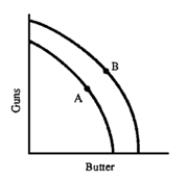 -In Figure 3-3, a shift from A to B seems most consistent with which of the following scenarios?
 (Multiple Choice)
4.8/5 (76)
(76) If you discover that the opportunity cost of raising your economics grade is zero, you
(Multiple Choice)
4.7/5 (79)
(79) The concavity or bowed-out shape of the production possibilities frontier is the result of
(Multiple Choice)
4.9/5 (82)
(82) In early 1996, the upper Midwest suffered record cold, with wind chills of 50° below zero or worse.Yet, grocery stores stocked fresh citrus fruit (which was clearly not grown locally).Why did grocers stock the fruit?
(Multiple Choice)
4.9/5 (85)
(85) In the Wealth of Nations, Adam Smith wrote about how countries could increase their consumption of goods and services through specialization and trade with other countries.
(True/False)
4.8/5 (68)
(68) Draw a production possibilities frontier for an economy, with the axes labeled "military goods" and "peace goods." Indicate the region that is attainable and the region that is not.Explain the shape of the curve.What assumptions did you make in drawing it?
(Essay)
4.9/5 (69)
(69) The statement "Resources employed in producing X are better suited to making Y" is another way of saying resources
(Multiple Choice)
4.8/5 (73)
(73) Which of the following does not determine the position and shape of a society's production possibilities frontier?
(Multiple Choice)
4.8/5 (75)
(75) The total amount of consumption of a society can be increased if
(Multiple Choice)
4.8/5 (82)
(82) You have invested $1,000 in a stock whose price is increasing at 10 percent a year.Your stock broker, who is never wrong, recommends a stock rising at 20 percent a year.Assuming the broker earns 4 percent of the stock's value on any purchase or sale of the stock, should you take his or her recommendation?
(Essay)
5.0/5 (81)
(81) In his concept of "the invisible hand," Adam Smith explains that
(Multiple Choice)
4.9/5 (87)
(87) Is increased capital spending the only way for an economy to expand its production possibilities frontier?
(Multiple Choice)
4.7/5 (83)
(83) The fact that resources tend to be specialized is one reason the production possibilities frontier is drawn
(Multiple Choice)
4.9/5 (86)
(86) All actions and purchases, even those of wealthy people, involve a sacrifice.
(True/False)
4.7/5 (77)
(77) 
Filters
- Essay(0)
- Multiple Choice(0)
- Short Answer(0)
- True False(0)
- Matching(0)