



 Chat with AI
Exam 5: Consumer Choice: Individual and Market Demand

Exam 1: What Is Economics254 Questions
Exam 2: The Economony: Myth and Reality184 Questions
Exam 3: The Fundamental Economic Problem: Scarcity and Choice278 Questions
Exam 4: Supply and Demand: an Initial Look297 Questions
Exam 5: Consumer Choice: Individual and Market Demand213 Questions
Exam 6: Demand and Elasticity247 Questions
Exam 7: Production, Inputs, and Cost: Building Blocks for Supply Analysis246 Questions
Exam 8: Output, Price, and Profit: the Importance of Marginal Analysis232 Questions
Exam 9: The Financial Markets and the Economy: the Tail That Wags the Dog225 Questions
Exam 10: The Firm and the Industry Under Perfect Competition219 Questions
Exam 11: The Case for Free Markets: the Price System251 Questions
Exam 12: Monopoly236 Questions
Exam 13: Between Competition and Monopoly248 Questions
Exam 14: Limiting Market Power: Antitrust and Regulation152 Questions
Exam 15: The Shortcomings of Free Markets210 Questions
Exam 16: The Economics of the Environment, and Natural Resources218 Questions
Exam 17: Taxation and Resource Allocation218 Questions
Exam 18: Pricing the Factors of Production230 Questions
Exam 19: Labor and Entrepreneurship: the Human Inputs267 Questions
Exam 20: Poverty, Inequality, and Discrimination167 Questions
Exam 21: An Introduction to Macroeconomics212 Questions
Exam 22: The Goals of Macroeconomic Policy212 Questions
Exam 23: Economic Growth: Theory and Policy226 Questions
Exam 24: Aggregate Demand and the Powerful Consumer216 Questions
Exam 25: Demand-Side Equilibrium: Unemployment or Inflation215 Questions
Exam 26: Bringing in the Supply Side: Unemployment and Inflation228 Questions
Exam 27: Managing Aggregate Demand: Fiscal Policy207 Questions
Exam 28: Money and the Banking System222 Questions
Exam 29: Monetary Policy: Conventional and Unconventional208 Questions
Exam 30: The Financial Crisis and the Great Recession64 Questions
Exam 31: The Debate Over Monetary and Fiscal Policy216 Questions
Exam 32: Budget Deficits in the Short and Long Run214 Questions
Exam 33: The Trade-Off Between Inflation and Unemployment218 Questions
Exam 34: International Trade and Comparative Advantage215 Questions
Exam 35: The International Monetary System: Order or Disorder216 Questions
Exam 36: Exchange Rates and the Macroeconomy215 Questions
Exam 37: Contemporary Issues in the Useconomy23 Questions
Select questions type


Which of the following scenarios could be an example of increasing marginal utility?
(Multiple Choice)
4.8/5  (71)
(71) The slope of the budget line is determined only by the prices of the commodities purchased.
(True/False)
5.0/5 (65)
(65) A consumer will consume the combination of goods at the crossing point of a budget line and indifference curve.
(True/False)
4.8/5 (80)
(80) 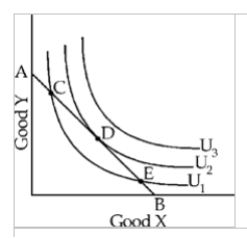 -In Figure 5-13, the consumer is better off
Figure 5-16 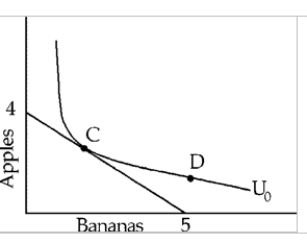 -Figure 5-16 shows Adam's purchases of bananas and apples when apples cost $5 each and bananas $4 each.The information implies that Adam's income
 (Multiple Choice)
4.8/5 (89)
(89) Which of the following is not a characteristic of indifference curves?
(Multiple Choice)
4.9/5 (88)
(88) Economic theory has traditionally focused on optimality in decision making.
(True/False)
4.9/5 (78)
(78) Indifference curves show all combinations of commodities that are equally desirable to the consumer.
(True/False)
4.9/5 (79)
(79) When drawn correctly and preferences are consistent, indifference curves do not intersect.
(True/False)
4.9/5 (67)
(67) If total utility declines as an additional unit of a commodity is purchased,
(Multiple Choice)
4.9/5 (89)
(89) Rolls-Royce may actually sell fewer cars at lower prices due to the "snob effect."
(True/False)
4.8/5 (69)
(69) The resolution of Adam Smith's diamond-water puzzle is based on the distinction between marginal and total utility.
(True/False)
5.0/5 (78)
(78) A change in the price of one good, such as staples, may affect the quantity demanded of another good, such as rubber bands.
(True/False)
4.8/5 (69)
(69) If you go to a bar tonight and have three beers before going home to study economics, will you likely receive some consumer's surplus? Explain why or why not.
(Essay)
4.8/5 (76)
(76) The host at a party offers Justin a sixth beer.Justin says, "No thanks, man.The marginal utility of that fifth beer was, like, 20 cents, but the marginal utility of the sixth would be minus 10 cents." From his comments, we deduce that Justin
(Multiple Choice)
4.7/5 (85)
(85) Total utility can be objectively measured in numbers that indicate usefulness or benefit to the consumer.
(True/False)
4.9/5 (71)
(71) 
Filters
- Essay(0)
- Multiple Choice(0)
- Short Answer(0)
- True False(0)
- Matching(0)