



 Chat with AI
Exam 10: The Firm and the Industry Under Perfect Competition

Exam 1: What Is Economics254 Questions
Exam 2: The Economony: Myth and Reality184 Questions
Exam 3: The Fundamental Economic Problem: Scarcity and Choice278 Questions
Exam 4: Supply and Demand: an Initial Look297 Questions
Exam 5: Consumer Choice: Individual and Market Demand213 Questions
Exam 6: Demand and Elasticity247 Questions
Exam 7: Production, Inputs, and Cost: Building Blocks for Supply Analysis246 Questions
Exam 8: Output, Price, and Profit: the Importance of Marginal Analysis232 Questions
Exam 9: The Financial Markets and the Economy: the Tail That Wags the Dog225 Questions
Exam 10: The Firm and the Industry Under Perfect Competition219 Questions
Exam 11: The Case for Free Markets: the Price System251 Questions
Exam 12: Monopoly236 Questions
Exam 13: Between Competition and Monopoly248 Questions
Exam 14: Limiting Market Power: Antitrust and Regulation152 Questions
Exam 15: The Shortcomings of Free Markets210 Questions
Exam 16: The Economics of the Environment, and Natural Resources218 Questions
Exam 17: Taxation and Resource Allocation218 Questions
Exam 18: Pricing the Factors of Production230 Questions
Exam 19: Labor and Entrepreneurship: the Human Inputs267 Questions
Exam 20: Poverty, Inequality, and Discrimination167 Questions
Exam 21: An Introduction to Macroeconomics212 Questions
Exam 22: The Goals of Macroeconomic Policy212 Questions
Exam 23: Economic Growth: Theory and Policy226 Questions
Exam 24: Aggregate Demand and the Powerful Consumer216 Questions
Exam 25: Demand-Side Equilibrium: Unemployment or Inflation215 Questions
Exam 26: Bringing in the Supply Side: Unemployment and Inflation228 Questions
Exam 27: Managing Aggregate Demand: Fiscal Policy207 Questions
Exam 28: Money and the Banking System222 Questions
Exam 29: Monetary Policy: Conventional and Unconventional208 Questions
Exam 30: The Financial Crisis and the Great Recession64 Questions
Exam 31: The Debate Over Monetary and Fiscal Policy216 Questions
Exam 32: Budget Deficits in the Short and Long Run214 Questions
Exam 33: The Trade-Off Between Inflation and Unemployment218 Questions
Exam 34: International Trade and Comparative Advantage215 Questions
Exam 35: The International Monetary System: Order or Disorder216 Questions
Exam 36: Exchange Rates and the Macroeconomy215 Questions
Exam 37: Contemporary Issues in the Useconomy23 Questions
Select questions type


Figure 10-2
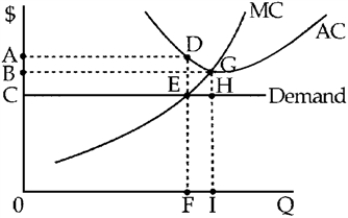 -Figure 10-2 shows demand and short-run cost curves for a perfectly competitive firm.In the short run, this firm would
 (Multiple Choice)
4.9/5  (86)
(86) Regardless of quantity in long-run equilibrium, the industry price cannot exceed the
(Multiple Choice)
5.0/5 (87)
(87) If a firm sells its output at a price greater than AVC, it will earn economic profit.
(True/False)
5.0/5 (83)
(83) In the long run, any firm may enter or leave a perfectly competitive market.
(True/False)
4.9/5 (81)
(81) Figure 10-6
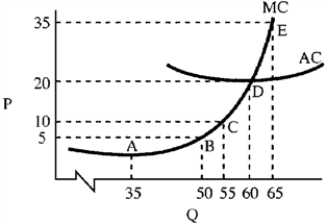 -At its long-run equilibrium level of output, the demand curve facing an individual perfectly competitive firm is tangent to its
 (Multiple Choice)
4.8/5 (76)
(76) It is relatively easy for a firm to enter a perfectly competitive market.
(True/False)
4.9/5 (73)
(73) Figure 10-4
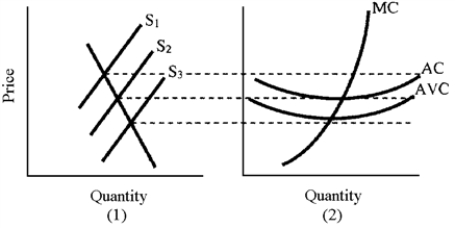 -For a competitive firm, if at least some portion of its short-run average cost curve lies below the price of the product, we can conclude that the firm
 (Multiple Choice)
5.0/5 (67)
(67) In long-run equilibrium in perfect competition, every firm is producing at minimum average cost.
(True/False)
4.9/5 (70)
(70) Firms in a perfectly competitive market produce at minimum average cost in the short run and the long run.
(True/False)
4.9/5 (88)
(88) Subsidizing firms that pollute will reduce pollution in the long run.
(True/False)
4.8/5 (67)
(67) Which of the following characteristics does not fit a perfectly competitive market?
(Multiple Choice)
4.7/5 (97)
(97) Figure 10-7
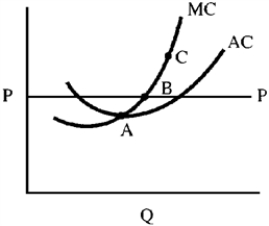 -In the short run, the firm in Figure 10-8 will shut down if the price falls below
 (Multiple Choice)
4.9/5 (78)
(78) It pays the firm to produce only if total variable costs exceed total revenue.
(True/False)
4.8/5 (84)
(84) Figure 10-6
-In Figure 10-6, the price at long-run equilibrium is
-In Figure 10-6, the price at long-run equilibrium is (Multiple Choice)
4.8/5 (74)
(74) Perfectly competitive firms ____ earn zero economic profit in long-run equilibrium because ____.
(Multiple Choice)
4.8/5 (80)
(80) A perfectly competitive firm should continue to expand output whenever
(Multiple Choice)
4.7/5 (84)
(84) The market for a perfectly competitive industry clears at a price of $3, and the minimum average cost for all firms is $2.50.In the long run, we would expect an increase in
(Multiple Choice)
4.8/5 (67)
(67) 
Filters
- Essay(0)
- Multiple Choice(0)
- Short Answer(0)
- True False(0)
- Matching(0)