



 Chat with AI
Exam 15: The Shortcomings of Free Markets

Exam 1: What Is Economics254 Questions
Exam 2: The Economony: Myth and Reality184 Questions
Exam 3: The Fundamental Economic Problem: Scarcity and Choice278 Questions
Exam 4: Supply and Demand: an Initial Look297 Questions
Exam 5: Consumer Choice: Individual and Market Demand213 Questions
Exam 6: Demand and Elasticity247 Questions
Exam 7: Production, Inputs, and Cost: Building Blocks for Supply Analysis246 Questions
Exam 8: Output, Price, and Profit: the Importance of Marginal Analysis232 Questions
Exam 9: The Financial Markets and the Economy: the Tail That Wags the Dog225 Questions
Exam 10: The Firm and the Industry Under Perfect Competition219 Questions
Exam 11: The Case for Free Markets: the Price System251 Questions
Exam 12: Monopoly236 Questions
Exam 13: Between Competition and Monopoly248 Questions
Exam 14: Limiting Market Power: Antitrust and Regulation152 Questions
Exam 15: The Shortcomings of Free Markets210 Questions
Exam 16: The Economics of the Environment, and Natural Resources218 Questions
Exam 17: Taxation and Resource Allocation218 Questions
Exam 18: Pricing the Factors of Production230 Questions
Exam 19: Labor and Entrepreneurship: the Human Inputs267 Questions
Exam 20: Poverty, Inequality, and Discrimination167 Questions
Exam 21: An Introduction to Macroeconomics212 Questions
Exam 22: The Goals of Macroeconomic Policy212 Questions
Exam 23: Economic Growth: Theory and Policy226 Questions
Exam 24: Aggregate Demand and the Powerful Consumer216 Questions
Exam 25: Demand-Side Equilibrium: Unemployment or Inflation215 Questions
Exam 26: Bringing in the Supply Side: Unemployment and Inflation228 Questions
Exam 27: Managing Aggregate Demand: Fiscal Policy207 Questions
Exam 28: Money and the Banking System222 Questions
Exam 29: Monetary Policy: Conventional and Unconventional208 Questions
Exam 30: The Financial Crisis and the Great Recession64 Questions
Exam 31: The Debate Over Monetary and Fiscal Policy216 Questions
Exam 32: Budget Deficits in the Short and Long Run214 Questions
Exam 33: The Trade-Off Between Inflation and Unemployment218 Questions
Exam 34: International Trade and Comparative Advantage215 Questions
Exam 35: The International Monetary System: Order or Disorder216 Questions
Exam 36: Exchange Rates and the Macroeconomy215 Questions
Exam 37: Contemporary Issues in the Useconomy23 Questions
Select questions type


Individuals cannot buy unemployment insurance for themselves.The most likely reason for this is
(Multiple Choice)
4.7/5  (83)
(83) Public goods could effectively be provided by private markets, but we choose to provide them through government.
(True/False)
4.7/5 (82)
(82) Which of the following term refers to the share of an activity's marginal cost that is paid for by the persons who carry out the activity?
(Multiple Choice)
4.9/5 (66)
(66) A free rider is one who enjoys the benefits of a public good without paying for it.
(True/False)
4.9/5 (61)
(61) In general, monopolies decrease economic efficiency.But in the presence of detrimental externalities, is it possible for a monopoly to be more efficient than a competitive market? Why, or why not?
(Essay)
5.0/5 (68)
(68) Figure 15-1 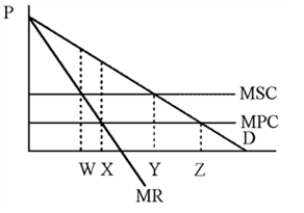 -Figure 15-1 portrays conditions in the monopolized weezil industry.From the diagram, the production of weezils
 (Multiple Choice)
4.8/5 (89)
(89) Figure 15-2 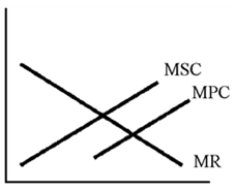 -The firm illustrated in Figure 15-2 is producing
 (Multiple Choice)
4.9/5 (72)
(72) Markets can efficiently handle irreversible decisions without involvement of government.
(True/False)
4.8/5 (70)
(70) An increase in interest rates will generally lead to a(n) ____ in present investment and a(n) ____ in future income and production.
(Multiple Choice)
4.9/5 (90)
(90) Hostile takeovers of corporations have been in the business news for some time now.Several states have passed laws making it harder for out-of-state corporations to acquire firms headquartered in their states.Several corporations have established "golden parachutes" to give executives high payoffs in case of hostile takeover.What market imperfection is likely to be worsened by these actions? Explain.
(Essay)
4.9/5 (90)
(90) Private ownership of rivers and lakes will halt all water pollution.
(True/False)
4.9/5 (72)
(72) Figure 15-1
-Figure 15-1 describes conditions in the monopolized weezil industry.In the absence of government intervention, the monopolist will produce an output equal to
-Figure 15-1 describes conditions in the monopolized weezil industry.In the absence of government intervention, the monopolist will produce an output equal to (Multiple Choice)
4.9/5 (86)
(86) A commodity is ____ if it is used up when someone consumes it.
(Multiple Choice)
4.8/5 (68)
(68) Land on both sides of the border of Brazil and Venezuela has long been occupied by the Yanomamo people.These "fierce people" are the last Stone Age tribe left in South America.Following discovery of gold, approximately 45,000 garimpeiros (gold miners) invaded the Yanomamo territory.The mining process pollutes the rivers and scares away game, so traditional Yanomamo sources of food are almost impossible to find now.The Yanomamo are starving.Economists call this problem
(Multiple Choice)
4.9/5 (77)
(77) 
Filters
- Essay(0)
- Multiple Choice(0)
- Short Answer(0)
- True False(0)
- Matching(0)