



 Chat with AI
Exam 32: Budget Deficits in the Short and Long Run

Exam 1: What Is Economics254 Questions
Exam 2: The Economony: Myth and Reality184 Questions
Exam 3: The Fundamental Economic Problem: Scarcity and Choice278 Questions
Exam 4: Supply and Demand: an Initial Look297 Questions
Exam 5: Consumer Choice: Individual and Market Demand213 Questions
Exam 6: Demand and Elasticity247 Questions
Exam 7: Production, Inputs, and Cost: Building Blocks for Supply Analysis246 Questions
Exam 8: Output, Price, and Profit: the Importance of Marginal Analysis232 Questions
Exam 9: The Financial Markets and the Economy: the Tail That Wags the Dog225 Questions
Exam 10: The Firm and the Industry Under Perfect Competition219 Questions
Exam 11: The Case for Free Markets: the Price System251 Questions
Exam 12: Monopoly236 Questions
Exam 13: Between Competition and Monopoly248 Questions
Exam 14: Limiting Market Power: Antitrust and Regulation152 Questions
Exam 15: The Shortcomings of Free Markets210 Questions
Exam 16: The Economics of the Environment, and Natural Resources218 Questions
Exam 17: Taxation and Resource Allocation218 Questions
Exam 18: Pricing the Factors of Production230 Questions
Exam 19: Labor and Entrepreneurship: the Human Inputs267 Questions
Exam 20: Poverty, Inequality, and Discrimination167 Questions
Exam 21: An Introduction to Macroeconomics212 Questions
Exam 22: The Goals of Macroeconomic Policy212 Questions
Exam 23: Economic Growth: Theory and Policy226 Questions
Exam 24: Aggregate Demand and the Powerful Consumer216 Questions
Exam 25: Demand-Side Equilibrium: Unemployment or Inflation215 Questions
Exam 26: Bringing in the Supply Side: Unemployment and Inflation228 Questions
Exam 27: Managing Aggregate Demand: Fiscal Policy207 Questions
Exam 28: Money and the Banking System222 Questions
Exam 29: Monetary Policy: Conventional and Unconventional208 Questions
Exam 30: The Financial Crisis and the Great Recession64 Questions
Exam 31: The Debate Over Monetary and Fiscal Policy216 Questions
Exam 32: Budget Deficits in the Short and Long Run214 Questions
Exam 33: The Trade-Off Between Inflation and Unemployment218 Questions
Exam 34: International Trade and Comparative Advantage215 Questions
Exam 35: The International Monetary System: Order or Disorder216 Questions
Exam 36: Exchange Rates and the Macroeconomy215 Questions
Exam 37: Contemporary Issues in the Useconomy23 Questions
Select questions type


Figure 32-3
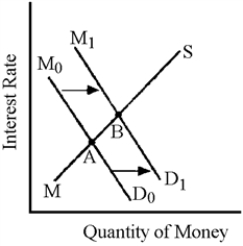 -If budget deficits shift the money demand curve as is illustrated in Figure 32-3, which component of total expenditures will be affected the most?
 (Multiple Choice)
4.8/5  (73)
(73) Figure 32-1
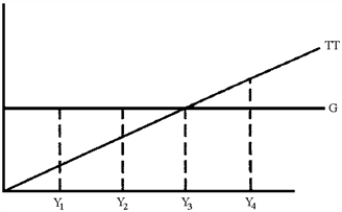 -In Figure 32-1, there are four levels of income.G is government expenditures and TT is taxes less transfers.At which level of income does the official budget produce a surplus?
 (Multiple Choice)
4.9/5 (78)
(78) Increases in government spending or tax cuts normally push interest rates up.
(True/False)
4.9/5 (78)
(78) The structural deficit can be used to estimate the thrust of current fiscal policy.
(True/False)
4.7/5 (87)
(87) If the level of government spending increases at the same time the Fed is pursuing contractionary monetary policy, we know that
(Multiple Choice)
4.9/5 (75)
(75) Until about 1983, almost all of U.S.national debt stemmed from financing wars or from the loss of tax revenues that accompany recessions.
(True/False)
4.7/5 (94)
(94) Suppose that the economy is currently at full employment.All other things being equal, if the government implements expansionary fiscal policy, then the appropriate monetary policy is
(Multiple Choice)
4.8/5 (80)
(80) Figure 32-2
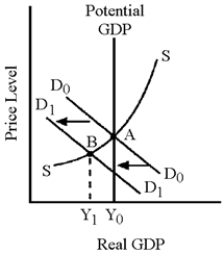 -Assume that a contractionary monetary policy has shifted the aggregate demand curve in Figure 32-2 from D0D0 to D1D1.Fiscal authorities who wish to restore real GDP to the full-employment level will
 (Multiple Choice)
4.8/5 (71)
(71) Which of the following is not true with regard to the burden of the U.S.national debt?
(Multiple Choice)
4.8/5 (67)
(67) If you wanted to measure changes in fiscal policy intentions, you should use the
(Multiple Choice)
4.9/5 (90)
(90) Under a balanced budget policy, a sharp rise in GDP will cause
(Multiple Choice)
4.9/5 (98)
(98) Figure 32-3
-Figure 32-3 shows the impact of deficit spending and the corresponding economic expansion on the demand curve for money.If the Federal Reserve does not want interest rates to rise, it will
-Figure 32-3 shows the impact of deficit spending and the corresponding economic expansion on the demand curve for money.If the Federal Reserve does not want interest rates to rise, it will (Multiple Choice)
4.9/5 (87)
(87) If the U.S.government decides to eliminate a budget surplus by reducing taxes, the most likely effect would be
(Multiple Choice)
4.9/5 (84)
(84) Structural budget surplus is the hypothetical surplus we would have under current fiscal policies if the economy were operating near full employment.
(True/False)
4.9/5 (75)
(75) Figure 32-2
-Suppose that Figure 32-2 shows the effects of reducing the budget deficit by raising taxes.If authorities do not want real GDP to fall, monetary policy must
-Suppose that Figure 32-2 shows the effects of reducing the budget deficit by raising taxes.If authorities do not want real GDP to fall, monetary policy must (Multiple Choice)
4.8/5 (64)
(64) 
Filters
- Essay(0)
- Multiple Choice(0)
- Short Answer(0)
- True False(0)
- Matching(0)