



 Chat with AI
Exam 3: Cycles of the Sun and Moon

Exam 1: Here and Now53 Questions
Exam 2: A Users Guide to the Sky80 Questions
Exam 3: Cycles of the Sun and Moon116 Questions
Exam 4: The Origin of Modern Astronomy109 Questions
Exam 5: Light and Telescopes114 Questions
Exam 6: Atoms and Spectra82 Questions
Exam 7: The Sun101 Questions
Exam 8: The Family of Stars133 Questions
Exam 9: The Formation and Structure of Stars91 Questions
Exam 10: The Deaths of Stars115 Questions
Exam 11: Neutron Stars and Black Holes70 Questions
Exam 12: The Milky Way Galaxy79 Questions
Exam 13: Galaxies: Normal and Active143 Questions
Exam 14: Modern Cosmology73 Questions
Exam 15: The Origin of the Solar System77 Questions
Exam 16: Earth and Moon: Bases for Comparative Planetology74 Questions
Exam 17: Mercury, Venus and Mars80 Questions
Exam 18: The Outer Solar System103 Questions
Exam 19: Meteorites, Asteroids, and Comets67 Questions
Exam 20: Astrobiology: Life on Other Worlds54 Questions
Select questions type


Earth doesn't experience a solar eclipse every month because
(Multiple Choice)
4.8/5  (93)
(93) The ____ of the moon is the period of time for the moon to complete a cycle of the lunar phases and is approximately 29.5 days long.
(Multiple Choice)
4.8/5 (79)
(79) The ____________________ period (or "month") of the moon is the time required for one revolution of the moon around Earth with respect to the stars.
(Short Answer)
4.8/5 (76)
(76) Why have more people seen total lunar eclipses than total solar eclipses?
(Not Answered)
This question doesn't have any answer yet
The ____ moon is visible above the eastern horizon a couple of hours before sunrise.
(Multiple Choice)
4.8/5 (84)
(84) How can tidal forces affect the rotation of celestial bodies and their orbital motion?
(Essay)
4.9/5 (87)
(87) The path of totality for a solar eclipse is swept out by the tip of the moon's umbra as the umbra moves over Earth.
(True/False)
4.9/5 (70)
(70) A(n) ____________________ eclipse occurs when the moon is at its greatest distance from Earth and the moon is new and at a node in its orbit.
(Short Answer)
5.0/5 (84)
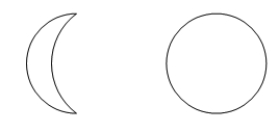
(84) 
If the moon's orbital plane was aligned with the celestial equator we could
(Multiple Choice)
4.9/5 (73)
(73) Precession of Earth's axis causes the date at which perihelion of Earth's orbit occurs to slowly change.
(True/False)
4.8/5 (93)
(93) A lunar eclipse that occurs when the moon moves completely into Earth's umbral shadow is called
(Multiple Choice)
4.8/5 (80)
(80) Explain why people who live close to the equator do not experience major changes in the seasons.
(Not Answered)
This question doesn't have any answer yet
A(n) ____ is a set of beliefs that appears to be based on scientific ideas, but which fails to obey the most basic rules of science.
(Multiple Choice)
4.9/5 (71)
(71) What would you see if you were on the moon and facing Earth when people on Earth saw a total lunar eclipse?
(Short Answer)
4.8/5 (73)
(73) Assume all else is unchanged, and the Earth's rotational axis is perpendicular to the ecliptic. As a result, seasonal variations on the Earth would
(Multiple Choice)
4.8/5 (85)
(85) 
Filters
- Essay(0)
- Multiple Choice(0)
- Short Answer(0)
- True False(0)
- Matching(0)