



 Chat with AI
Exam 19: Meteorites, Asteroids, and Comets

Exam 1: Here and Now53 Questions
Exam 2: A Users Guide to the Sky80 Questions
Exam 3: Cycles of the Sun and Moon116 Questions
Exam 4: The Origin of Modern Astronomy109 Questions
Exam 5: Light and Telescopes114 Questions
Exam 6: Atoms and Spectra82 Questions
Exam 7: The Sun101 Questions
Exam 8: The Family of Stars133 Questions
Exam 9: The Formation and Structure of Stars91 Questions
Exam 10: The Deaths of Stars115 Questions
Exam 11: Neutron Stars and Black Holes70 Questions
Exam 12: The Milky Way Galaxy79 Questions
Exam 13: Galaxies: Normal and Active143 Questions
Exam 14: Modern Cosmology73 Questions
Exam 15: The Origin of the Solar System77 Questions
Exam 16: Earth and Moon: Bases for Comparative Planetology74 Questions
Exam 17: Mercury, Venus and Mars80 Questions
Exam 18: The Outer Solar System103 Questions
Exam 19: Meteorites, Asteroids, and Comets67 Questions
Exam 20: Astrobiology: Life on Other Worlds54 Questions
Select questions type


Iridium is more common in meteorites than in the crust of the Earth.
(True/False)
4.8/5  (90)
(90) What physical processes have led to the creation of stone and iron meteorites from carbonaceous chondrite asteroids?
(Multiple Choice)
4.9/5 (91)
(91) If a large 10-km asteroid or comet struck the Earth in the ocean floor, 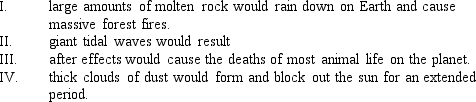
(Multiple Choice)
4.7/5 (81)
(81) Long-period comets are believed to originate in the ____________________.
(Short Answer)
4.9/5 (76)
(76) Most meteors come from comets, but most meteorites come from asteroids. Explain this statement.
(Not Answered)
This question doesn't have any answer yet
Comets falling into the inner solar system from the ____ are called long-period comets.
(Multiple Choice)
4.7/5 (73)
(73) ____ asteroids are the most common and appear to be the source of the most common type of meteorite, the chondrites. They are more common in the inner belt and may be the source of stone meteorites.
(Multiple Choice)
4.7/5 (91)
(91) What processes cause the difference in appearance between gas tails and dust tails in comets?
(Not Answered)
This question doesn't have any answer yet
Carbonaceous chondrites I.contain mostly iron and nickel.
II.contain volatiles.
III.contain chondrules.
IV.are similar in composition to the S-type asteroids
(Multiple Choice)
4.8/5 (68)
(68) Some asteroids show evidence of surface activity such as lava flows.
(True/False)
4.7/5 (83)
(83) Jupiter was probably influential in preventing the formation of a planet at the present location of the asteroid belt.
(True/False)
4.8/5 (65)
(65) The ____________________ of a comet can be up to a million kilometers in diameter.
(Short Answer)
4.8/5 (80)
(80) Stony, chondrite, achondrite, and stony-iron meteorite types are classified according to their
(Multiple Choice)
4.8/5 (69)
(69) A(n) ____ is a stony meteorite that contains no chondrules and no volatiles. They appear to have been melted after they formed and resemble solidified lavas.
(Multiple Choice)
5.0/5 (77)
(77) Describe the observational differences between long-period and short-period comets.
(Not Answered)
This question doesn't have any answer yet
Widmanstätten patterns are found in ____________________ meteorites.
(Short Answer)
4.9/5 (71)
(71) The diagram below is a plot of an asteroid's reflected brightness versus its ultraviolet minus visual color (U-V color; redder to the right and gray to the left). In this diagram, which of the asteroids is most likely an S-type asteroid? 
(Multiple Choice)
4.9/5 (75)
(75) ____ asteroids appear to have nickel-iron compositions and may be the cores of broken asteroids.
(Multiple Choice)
4.7/5 (87)
(87) 
Filters
- Essay(0)
- Multiple Choice(0)
- Short Answer(0)
- True False(0)
- Matching(0)