



 Chat with AI
Exam 32: Animal Behaviour

Exam 1: Light and Life109 Questions
Exam 2: The Cell: an Overview155 Questions
Exam 3: Energy and Enzymes66 Questions
Exam 4: Cell Membranes and Signaling81 Questions
Exam 5: Cellular Respiration61 Questions
Exam 6: Photosynthesis95 Questions
Exam 7: Cell Cycles93 Questions
Exam 8: Genetic Recombination88 Questions
Exam 9: The Chromosomal Basis of Mendelian Inheritance86 Questions
Exam 10: Genetic Linkage, Sex-Linkage, and Other Non-Mendelian Inheritance Mechanisms73 Questions
Exam 11: DNA Structure, Replication, and Repair57 Questions
Exam 12: Gene Structure Expression, and Mutation106 Questions
Exam 13: Regulation of Gene Expression91 Questions
Exam 14: Dna Technologies91 Questions
Exam 15: Genomes53 Questions
Exam 16: Evolution: the Development of the Theory66 Questions
Exam 17: Microevolution: Changes Within Populations83 Questions
Exam 18: Speciation and Macroevolution64 Questions
Exam 19: Systematics and Phylogenetics: Revealing the Tree of Life68 Questions
Exam 20: Humans and Evolution54 Questions
Exam 21: Defining Life and Its Origins55 Questions
Exam 22: Viruses, Viroids, and Prions: Infectious Biological Particles38 Questions
Exam 23: Bacteria and Archaea78 Questions
Exam 24: Protists98 Questions
Exam 25: Fungi81 Questions
Exam 26: Plants80 Questions
Exam 27: Animals171 Questions
Exam 28: Conservation of Biodiversity41 Questions
Exam 29: Population Ecology65 Questions
Exam 30: Species Interactions and Community Ecology70 Questions
Exam 31: Ecosystems68 Questions
Exam 32: Animal Behaviour120 Questions
Exam 33: Organization of the Plant Body69 Questions
Exam 34: Transport in Plants80 Questions
Exam 35: Reproduction and Development in Flowering Plants70 Questions
Exam 36: Plant Nutrition97 Questions
Exam 37: Plant Signals and Responses to the Environment93 Questions
Exam 38: Introduction to Animal Organization and Physiology65 Questions
Exam 39: Animal Nutrition98 Questions
Exam 40: Gas Exchange: the Respiratory System56 Questions
Exam 41: Internal Transport: the Circulatory System72 Questions
Exam 42: Regulation of the Internal Environment: Water, Solutes, and Temperature75 Questions
Exam 43: Control of Animal Processes: Endocrine Control80 Questions
Exam 44: Animal Reproduction168 Questions
Exam 45: Control of Animal Processes: Neural Control253 Questions
Exam 46: Muscles, Skeletons, and Body Movements71 Questions
Select questions type


Use the illustration below to answer the following questions. 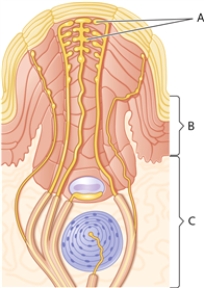 -Which label on the graph represents the sensory nerve terminals on the Eimer's organ of the star-nosed mole?
 (Short Answer)
4.9/5  (83)
(83) What occurs when a territory-holding male zebra finch hears the song of the male zebra finch that has held the neighbouring territory for a long time?
(Multiple Choice)
4.8/5 (72)
(72) Match each description of a mating system with the most appropriate term.
-Female chimpanzees will mate with more than one male, eliciting protective behaviour for her offspring from them all.
(Multiple Choice)
4.8/5 (69)
(69) In an experiment on way-finding, Indigo Buntings were housed in outdoor cages with blotting paper walls and inkpads on the floors. Which of the following facts demonstrated to researchers that the Indigo Bunting uses the positions of stars to orient its migration?
(Multiple Choice)
4.9/5 (87)
(87) Categorize the following learning examples as either classical or operant conditioning.
-A trained dog sits on command and gets a treat.
(Multiple Choice)
4.9/5 (82)
(82) Parent monarch butterflies migrate from Canada to Mexico each year.
(True/False)
4.7/5 (80)
(80) What is the chance that a young child living with one parent and one stepparent would be criminally abused, relative to the chance that children living with both biological parents would be criminally abused?
(Multiple Choice)
4.9/5 (77)
(77) Humans are more likely to abuse children that they know are NOT their own.
(True/False)
4.9/5 (93)
(93) In 1938, Niko Tinbergen arranged pinecones around the nest of a female digger wasp. What happened when he removed these pinecones when the wasp was gone?
(Multiple Choice)
5.0/5 (73)
(73) Figure 32-2  -In Figure 32-2, how will the other bees seek nectar if a honeybee performing the dance in image B moves straight down the comb?
 (Multiple Choice)
4.7/5 (70)
(70) What is a proximate cause of the noncombative behaviour of male African cichlids that do NOT hold territories?
(Multiple Choice)
4.9/5 (79)
(79)  -What does Figure 32-3 illustrate?
The brains of female zebra finches lack the hormonal influences that occur in the brains of males. What changes are seen in the female brains as a result?
(Multiple Choice)
4.7/5 (78)
(78) What would a fiddler crab be prompted to do if a moving object appeared below the midline of its eyes?
(Multiple Choice)
4.9/5 (84)
(84) Most of a mole's cerebral cortex is devoted to processing input from certain body parts. Which are the body parts?
(Multiple Choice)
5.0/5 (87)
(87) 
Filters
- Essay(0)
- Multiple Choice(0)
- Short Answer(0)
- True False(0)
- Matching(0)