



 Chat with AI
Exam 32: Animal Behaviour

Exam 1: Light and Life109 Questions
Exam 2: The Cell: an Overview155 Questions
Exam 3: Energy and Enzymes66 Questions
Exam 4: Cell Membranes and Signaling81 Questions
Exam 5: Cellular Respiration61 Questions
Exam 6: Photosynthesis95 Questions
Exam 7: Cell Cycles93 Questions
Exam 8: Genetic Recombination88 Questions
Exam 9: The Chromosomal Basis of Mendelian Inheritance86 Questions
Exam 10: Genetic Linkage, Sex-Linkage, and Other Non-Mendelian Inheritance Mechanisms73 Questions
Exam 11: DNA Structure, Replication, and Repair57 Questions
Exam 12: Gene Structure Expression, and Mutation106 Questions
Exam 13: Regulation of Gene Expression91 Questions
Exam 14: Dna Technologies91 Questions
Exam 15: Genomes53 Questions
Exam 16: Evolution: the Development of the Theory66 Questions
Exam 17: Microevolution: Changes Within Populations83 Questions
Exam 18: Speciation and Macroevolution64 Questions
Exam 19: Systematics and Phylogenetics: Revealing the Tree of Life68 Questions
Exam 20: Humans and Evolution54 Questions
Exam 21: Defining Life and Its Origins55 Questions
Exam 22: Viruses, Viroids, and Prions: Infectious Biological Particles38 Questions
Exam 23: Bacteria and Archaea78 Questions
Exam 24: Protists98 Questions
Exam 25: Fungi81 Questions
Exam 26: Plants80 Questions
Exam 27: Animals171 Questions
Exam 28: Conservation of Biodiversity41 Questions
Exam 29: Population Ecology65 Questions
Exam 30: Species Interactions and Community Ecology70 Questions
Exam 31: Ecosystems68 Questions
Exam 32: Animal Behaviour120 Questions
Exam 33: Organization of the Plant Body69 Questions
Exam 34: Transport in Plants80 Questions
Exam 35: Reproduction and Development in Flowering Plants70 Questions
Exam 36: Plant Nutrition97 Questions
Exam 37: Plant Signals and Responses to the Environment93 Questions
Exam 38: Introduction to Animal Organization and Physiology65 Questions
Exam 39: Animal Nutrition98 Questions
Exam 40: Gas Exchange: the Respiratory System56 Questions
Exam 41: Internal Transport: the Circulatory System72 Questions
Exam 42: Regulation of the Internal Environment: Water, Solutes, and Temperature75 Questions
Exam 43: Control of Animal Processes: Endocrine Control80 Questions
Exam 44: Animal Reproduction168 Questions
Exam 45: Control of Animal Processes: Neural Control253 Questions
Exam 46: Muscles, Skeletons, and Body Movements71 Questions
Select questions type


Match each term with its definition.
-fixed action patterns
(Multiple Choice)
4.9/5  (80)
(80) Match each term with its definition.
-instinctive behaviour
(Multiple Choice)
4.9/5 (80)
(80) Males and females often differ in their reproductive strategies. What is the male strategy compared to the female strategy?
(Multiple Choice)
4.8/5 (89)
(89) Which cue most likely functions as sign stimuli to trigger smiling in very young babies?
(Multiple Choice)
4.9/5 (83)
(83) Classify each example as one of the three behaviours. The behaviours may be used more than once.
-You donate money anonymously to a charity and tell no one about it.
(Multiple Choice)
4.8/5 (69)
(69) From an evolutionary perspective, why would humans sometimes act charitably toward strangers?
(Essay)
4.9/5 (89)
(89) Why do peahens choose peacocks with the longest, showiest tails, when a long tail might be easily grabbed by a predator?
(Essay)
4.9/5 (79)
(79) The ZENK gene in the finch brain is activated by tactile stimuli.
(True/False)
4.7/5 (83)
(83) Dominant male wild dogs have higher levels of cortisol and other stress-related hormones than submissive wild dogs.
(True/False)
4.8/5 (71)
(71) How do black field crickets detect the ultrasound of predatory bats?
(Multiple Choice)
4.8/5 (87)
(87) Female blackbirds choose a mate primarily by the quality of his plumage.
(True/False)
4.9/5 (87)
(87) Match each physiological response to the hormone that causes the response. A hormone may be selected more than once.
-stimulates genes in brain cells to produce certain proteins that affect nervous system function
(Multiple Choice)
4.8/5 (84)
(84) What is the primary trigger for pecking behaviour in young herring gulls?
(Multiple Choice)
4.9/5 (74)
(74) Figure 32-2 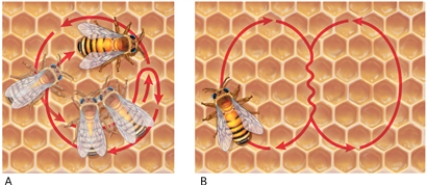 -In Figure 32-2, what does the bee do if the food source being communicated about is close to the hive?
 (Multiple Choice)
4.8/5 (78)
(78) How does a cricket respond when it hears the ultrasonic call of a bat coming from its right side?
(Multiple Choice)
5.0/5 (72)
(72) Match each description of a mating system with the most appropriate term.
-Corals release gametes into the open sea.
(Multiple Choice)
4.9/5 (78)
(78) The following passages contain novel information describing real animal and human behaviours. Use the choices to classify the type of learning exemplified by each passage. A learning type may be used once, more than once, or not at all.
-Wild ravens note the passage of a garbage collection truck and fly off to raid trash cans before the truck arrives to empty them.
(Multiple Choice)
4.9/5 (82)
(82) Bees surrounding a dancing bee produce a brief acoustical signal that stimulates the dancer to regurgitate a sample of the new food.
(True/False)
4.8/5 (89)
(89) Which of the following is correctly matched with its meaning?
(Multiple Choice)
4.7/5 (79)
(79) Sociologists have noted that women in different environments seem to find different types of men attractive. For example, a physically weak but professionally successful man may be admired by women in New York City; while in rural Wyoming, the rugged cowboys are most popular. Explain this phenomenon from the perspective of an evolutionary view of human social behaviour.
(Essay)
4.8/5 (83)
(83) 
Filters
- Essay(0)
- Multiple Choice(0)
- Short Answer(0)
- True False(0)
- Matching(0)