



 Chat with AI
Exam 32: Animal Behaviour

Exam 1: Light and Life109 Questions
Exam 2: The Cell: an Overview155 Questions
Exam 3: Energy and Enzymes66 Questions
Exam 4: Cell Membranes and Signaling81 Questions
Exam 5: Cellular Respiration61 Questions
Exam 6: Photosynthesis95 Questions
Exam 7: Cell Cycles93 Questions
Exam 8: Genetic Recombination88 Questions
Exam 9: The Chromosomal Basis of Mendelian Inheritance86 Questions
Exam 10: Genetic Linkage, Sex-Linkage, and Other Non-Mendelian Inheritance Mechanisms73 Questions
Exam 11: DNA Structure, Replication, and Repair57 Questions
Exam 12: Gene Structure Expression, and Mutation106 Questions
Exam 13: Regulation of Gene Expression91 Questions
Exam 14: Dna Technologies91 Questions
Exam 15: Genomes53 Questions
Exam 16: Evolution: the Development of the Theory66 Questions
Exam 17: Microevolution: Changes Within Populations83 Questions
Exam 18: Speciation and Macroevolution64 Questions
Exam 19: Systematics and Phylogenetics: Revealing the Tree of Life68 Questions
Exam 20: Humans and Evolution54 Questions
Exam 21: Defining Life and Its Origins55 Questions
Exam 22: Viruses, Viroids, and Prions: Infectious Biological Particles38 Questions
Exam 23: Bacteria and Archaea78 Questions
Exam 24: Protists98 Questions
Exam 25: Fungi81 Questions
Exam 26: Plants80 Questions
Exam 27: Animals171 Questions
Exam 28: Conservation of Biodiversity41 Questions
Exam 29: Population Ecology65 Questions
Exam 30: Species Interactions and Community Ecology70 Questions
Exam 31: Ecosystems68 Questions
Exam 32: Animal Behaviour120 Questions
Exam 33: Organization of the Plant Body69 Questions
Exam 34: Transport in Plants80 Questions
Exam 35: Reproduction and Development in Flowering Plants70 Questions
Exam 36: Plant Nutrition97 Questions
Exam 37: Plant Signals and Responses to the Environment93 Questions
Exam 38: Introduction to Animal Organization and Physiology65 Questions
Exam 39: Animal Nutrition98 Questions
Exam 40: Gas Exchange: the Respiratory System56 Questions
Exam 41: Internal Transport: the Circulatory System72 Questions
Exam 42: Regulation of the Internal Environment: Water, Solutes, and Temperature75 Questions
Exam 43: Control of Animal Processes: Endocrine Control80 Questions
Exam 44: Animal Reproduction168 Questions
Exam 45: Control of Animal Processes: Neural Control253 Questions
Exam 46: Muscles, Skeletons, and Body Movements71 Questions
Select questions type


Match each physiological response to the hormone that causes the response. A hormone may be selected more than once.
-changes production based on outcomes of conflicts
(Multiple Choice)
4.8/5  (86)
(86) Which of the following species are known to engage in altruistic behaviour?
(Multiple Choice)
4.8/5 (85)
(85) The presence of which hormone results in the production of more neurons in the higher vocal centre of the brains of male zebra finches but NOT in the brains of female zebra finches?
(Multiple Choice)
4.8/5 (82)
(82) Classify each example as one of the three behaviours. The behaviours may be used more than once.
-You skip class but borrow the notes from a friend, who skips class himself the next week, at which point you lend him your notes.
(Multiple Choice)
4.9/5 (91)
(91) What is haplodiploidy, and how is it related to altruism in honeybees?
(Essay)
4.8/5 (79)
(79) GnRH-producing cells in the brains of male cichlids are larger in territorial individuals.
(True/False)
4.9/5 (71)
(71) Which sentence describes the sounds of young male White-crowned Sparrows that were experimentally raised without ever hearing the sound of their species?
(Multiple Choice)
4.7/5 (75)
(75) Categorize the following learning examples as either classical or operant conditioning.
-Horses hurry to their mangers when the barn door opens.
(Multiple Choice)
5.0/5 (76)
(76) The following passages contain novel information describing real animal and human behaviours. Use the choices to classify the type of learning exemplified by each passage. A learning type may be used once, more than once, or not at all.
-A group of ducklings were experimentally isolated in a room containing only a large cardboard box that researchers rigged to be movable by remote control. The ducklings soon became attached to the box, following it around the enclosure.
(Multiple Choice)
4.7/5 (67)
(67) Categorize the following learning examples as either classical or operant conditioning.
-Captive dolphins jump from the water on command and are rewarded with fish.
(Multiple Choice)
4.8/5 (81)
(81) Match each physiological response to the hormone that causes the response. A hormone may be selected more than once.
-stimulates the production of additional neurons in the higher vocal centre
(Multiple Choice)
4.8/5 (91)
(91) What is an animal using if it finds its way by the type of way-finding known as piloting?
(Multiple Choice)
4.9/5 (83)
(83) Neurons in the higher vocal centre of a male finch's brain are stimulated to proliferate by testosterone.
(True/False)
4.8/5 (93)
(93) Use the illustration below to answer the following questions. 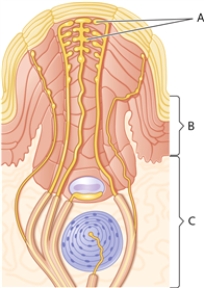 -Which label on the graph represents the epidermis on the Eimer's organ of the star-nosed mole?
 (Short Answer)
4.9/5 (67)
(67) Which function would a worker bee that is about one day old most likely perform in the hive?
(Multiple Choice)
4.7/5 (82)
(82) Use the illustration below to answer the following questions.
-Which label on the graph represents the dermis on the Eimer's organ of the star-nosed mole?
-Which label on the graph represents the dermis on the Eimer's organ of the star-nosed mole? (Short Answer)
4.7/5 (79)
(79) Match each description of a mating system with the most appropriate term.
-Prairie voles choose one mate and stay with that partner for life.
(Multiple Choice)
4.8/5 (89)
(89) 
Filters
- Essay(0)
- Multiple Choice(0)
- Short Answer(0)
- True False(0)
- Matching(0)