



 Chat with AI
Exam 32: Animal Behaviour

Exam 1: Light and Life109 Questions
Exam 2: The Cell: an Overview155 Questions
Exam 3: Energy and Enzymes66 Questions
Exam 4: Cell Membranes and Signaling81 Questions
Exam 5: Cellular Respiration61 Questions
Exam 6: Photosynthesis95 Questions
Exam 7: Cell Cycles93 Questions
Exam 8: Genetic Recombination88 Questions
Exam 9: The Chromosomal Basis of Mendelian Inheritance86 Questions
Exam 10: Genetic Linkage, Sex-Linkage, and Other Non-Mendelian Inheritance Mechanisms73 Questions
Exam 11: DNA Structure, Replication, and Repair57 Questions
Exam 12: Gene Structure Expression, and Mutation106 Questions
Exam 13: Regulation of Gene Expression91 Questions
Exam 14: Dna Technologies91 Questions
Exam 15: Genomes53 Questions
Exam 16: Evolution: the Development of the Theory66 Questions
Exam 17: Microevolution: Changes Within Populations83 Questions
Exam 18: Speciation and Macroevolution64 Questions
Exam 19: Systematics and Phylogenetics: Revealing the Tree of Life68 Questions
Exam 20: Humans and Evolution54 Questions
Exam 21: Defining Life and Its Origins55 Questions
Exam 22: Viruses, Viroids, and Prions: Infectious Biological Particles38 Questions
Exam 23: Bacteria and Archaea78 Questions
Exam 24: Protists98 Questions
Exam 25: Fungi81 Questions
Exam 26: Plants80 Questions
Exam 27: Animals171 Questions
Exam 28: Conservation of Biodiversity41 Questions
Exam 29: Population Ecology65 Questions
Exam 30: Species Interactions and Community Ecology70 Questions
Exam 31: Ecosystems68 Questions
Exam 32: Animal Behaviour120 Questions
Exam 33: Organization of the Plant Body69 Questions
Exam 34: Transport in Plants80 Questions
Exam 35: Reproduction and Development in Flowering Plants70 Questions
Exam 36: Plant Nutrition97 Questions
Exam 37: Plant Signals and Responses to the Environment93 Questions
Exam 38: Introduction to Animal Organization and Physiology65 Questions
Exam 39: Animal Nutrition98 Questions
Exam 40: Gas Exchange: the Respiratory System56 Questions
Exam 41: Internal Transport: the Circulatory System72 Questions
Exam 42: Regulation of the Internal Environment: Water, Solutes, and Temperature75 Questions
Exam 43: Control of Animal Processes: Endocrine Control80 Questions
Exam 44: Animal Reproduction168 Questions
Exam 45: Control of Animal Processes: Neural Control253 Questions
Exam 46: Muscles, Skeletons, and Body Movements71 Questions
Select questions type


How is classical conditioning different from operant conditioning?
(Multiple Choice)
4.8/5  (77)
(77) Which form of communication is likely to be intercepted by an attentive third party?
(Multiple Choice)
4.8/5 (74)
(74) Figure 32-1 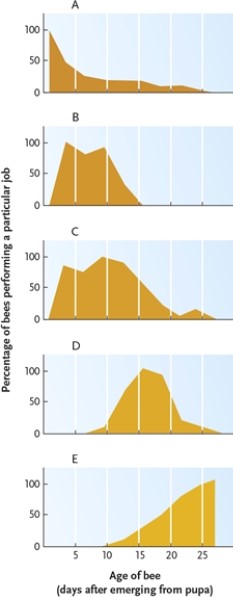 -In Figure 32-1, which graph represents the age span of worker bees primarily occupied by foraging?
 (Multiple Choice)
4.9/5 (80)
(80) Match each description of a mating system with the most appropriate term.
-Male northern fur seals aggressively guard harems of up to 40 females.
(Multiple Choice)
4.9/5 (98)
(98) The following passages contain novel information describing real animal and human behaviours. Use the choices to classify the type of learning exemplified by each passage. A learning type may be used once, more than once, or not at all.
-A teacher gives candy only to the children in her class who finish the assignment on time. The other children receive no reward. The next day, a larger proportion of children finish the work on time.
(Multiple Choice)
4.9/5 (81)
(81) What do young male white-crowned sparrows match their vocal output to when they first begin to sing?
(Multiple Choice)
4.9/5 (73)
(73) Categorize the following learning examples as either classical or operant conditioning.
-A man becomes hungry when he hears the beep of the microwave oven.
(Multiple Choice)
4.9/5 (88)
(88) Laying eggs in another bird's nest is a learned behaviour in honeyguides.
(True/False)
4.9/5 (88)
(88) Classify each example as one of the three behaviours. The behaviours may be used more than once.
-A man stops his car on a deserted road to aid a stranded motorist he does not know.
(Multiple Choice)
4.9/5 (74)
(74) A change in the rate or frequency of movements in response to environmental stimuli is called taxis.
(True/False)
4.8/5 (81)
(81) Under what circumstances does the gene called ZENK become active in zebra finches, and what is its effect?
(Essay)
4.9/5 (69)
(69) What is the ultimate cause of the ability of male zebra finches to discriminate between the songs of established neighbours and those of strangers?
(Multiple Choice)
4.9/5 (80)
(80) Male lizards experimentally dosed with supplemental testosterone were more active, displayed more often, and had a higher rate of death.
(True/False)
4.8/5 (80)
(80) Many insects have a genetically determined preference for plants they eat during their larval stage.
(True/False)
4.8/5 (81)
(81) 
Filters
- Essay(0)
- Multiple Choice(0)
- Short Answer(0)
- True False(0)
- Matching(0)