



 Chat with AI
Exam 25: The Digestive System

Exam 1: Foundations: An Introduction to Anatomy124 Questions
Exam 2: Foundations: The Cell117 Questions
Exam 3: Foundations: Tissues and Early Embryology127 Questions
Exam 4: The Integumentary System127 Questions
Exam 5: The Skeletal System: Osseous Tissue and Skeletal Structure142 Questions
Exam 6: The Skeletal System: Axial Division150 Questions
Exam 7: The Skeletal System: Appendicular Division131 Questions
Exam 8: The Skeletal System: Articulations131 Questions
Exam 9: The Muscular System: Skeletal Muscle Tissue and Muscle Organization145 Questions
Exam 10: The Muscular System: Axial Musculature142 Questions
Exam 11: The Muscular System: Appendicular Musculature135 Questions
Exam 12: Surface Anatomy and Cross-Sectional Anatomy129 Questions
Exam 13: The Nervous System: Neural Tissue127 Questions
Exam 14: The Nervous System: The Spinal Cord and Spinal Nerves131 Questions
Exam 15: The Nervous System: Sensory and Motor Tracts of the Spinal Cord81 Questions
Exam 16: The Nervous System: The Brain and Cranial Nerves132 Questions
Exam 17: The Nervous System: Autonomic Nervous System115 Questions
Exam 18: The Nervous System: General and Special Senses127 Questions
Exam 19: The Endocrine System102 Questions
Exam 20: The Cardiovascular System: Blood71 Questions
Exam 21: The Cardiovascular System: The Heart150 Questions
Exam 22: The Cardiovascular System: Vessels and Circulation129 Questions
Exam 23: The Lymphatic System105 Questions
Exam 24: The Respiratory System128 Questions
Exam 25: The Digestive System132 Questions
Exam 26: The Urinary System135 Questions
Exam 27: The Reproductive System134 Questions
Exam 28: Embryology and Human Development140 Questions
Select questions type


The mucosa of the esophagus contains an abrasion-resistant ________.
(Multiple Choice)
5.0/5  (82)
(82) Structures that unite to form the common bile duct include:
(1)duodenal ampulla
(2)porta hepatis
(3)cystic duct
(4)common hepatic duct
(5)duodenal papilla
(Multiple Choice)
4.9/5 (64)
(64) Circulating levels of carbohydrates, lipids, and amino acids are regulated by which digestive organ?
(Multiple Choice)
4.9/5 (79)
(79) Goblet cells are more abundant in the mucosal epithelium of the large intestine than in the small intestine.
(True/False)
4.8/5 (80)
(80) Which mesenteric fold attaches the liver to the anterior body wall?
(Multiple Choice)
4.8/5 (73)
(73) Figure 25.1
 Identify the labeled structure(s) in each of the following questions.
-Identify the structure(s) indicated by Label F.
Identify the labeled structure(s) in each of the following questions.
-Identify the structure(s) indicated by Label F. (Multiple Choice)
5.0/5 (96)
(96) How do aggregated lymphoid nodules protect the small intestine from infection?
(Essay)
4.9/5 (80)
(80) Contraction of smooth muscle in the ________ alters the shape of the intestinal lumen and moves the epithelial pleats and folds.
(Multiple Choice)
4.9/5 (69)
(69) Stellate macrophages are phagocytes found in which structure(s) ?
(Multiple Choice)
4.7/5 (71)
(71) The inner lining, or submucosa, of the digestive tract consists of a layer of loose connective tissue covered by an epithelium moistened by glandular secretions. The submucosal epithelium may be stratified or simple, depending on the location and the stresses involved.
(True/False)
4.8/5 (71)
(71) Figure 25.2
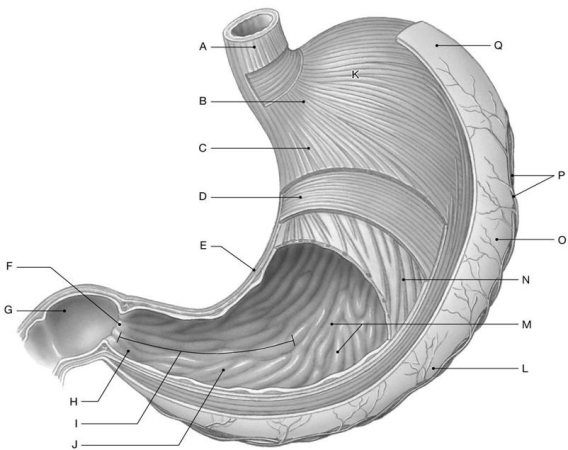 Identify the labeled structure(s) in each of the following questions.
-Identify the structure(s) indicated by Label D.
Identify the labeled structure(s) in each of the following questions.
-Identify the structure(s) indicated by Label D. (Multiple Choice)
4.9/5 (78)
(78) Smooth muscle tone decreases with age. As a result, general motility decreases, and peristaltic contractions are weaker in the digestive system.
(True/False)
4.8/5 (70)
(70) Figure 25.2
Identify the labeled structure(s) in each of the following questions.
-Identify the structure(s) indicated by Label Q.
Identify the labeled structure(s) in each of the following questions.
-Identify the structure(s) indicated by Label Q. (Multiple Choice)
5.0/5 (82)
(82) Which fold of mesentery extends from the liver to the stomach and the first segment of the duodenum?
(Multiple Choice)
4.9/5 (83)
(83) Figure 25.2
Identify the labeled structure(s) in each of the following questions.
-Identify the structure(s) indicated by Label F.
Identify the labeled structure(s) in each of the following questions.
-Identify the structure(s) indicated by Label F. (Multiple Choice)
4.8/5 (83)
(83) Which statement regarding the histology of the large intestine is true?
(Multiple Choice)
4.9/5 (84)
(84) The stomach mucosa contains numerous shallow depressions called ________.
(Multiple Choice)
4.7/5 (66)
(66) Figure 25.2
Identify the labeled structure(s) in each of the following questions.
-Identify the structure(s) indicated by Label C.
Identify the labeled structure(s) in each of the following questions.
-Identify the structure(s) indicated by Label C. (Multiple Choice)
4.7/5 (73)
(73) Which of the following terms describes the movement of organic molecules, electrolytes, vitamins, and water across the digestive epithelium and into the interstitial fluid of the digestive tract?
(Multiple Choice)
4.8/5 (72)
(72) 
Filters
- Essay(0)
- Multiple Choice(0)
- Short Answer(0)
- True False(0)
- Matching(0)