



 Chat with AI
Exam 18: The Nervous System: General and Special Senses

Exam 1: Foundations: An Introduction to Anatomy124 Questions
Exam 2: Foundations: The Cell117 Questions
Exam 3: Foundations: Tissues and Early Embryology127 Questions
Exam 4: The Integumentary System127 Questions
Exam 5: The Skeletal System: Osseous Tissue and Skeletal Structure142 Questions
Exam 6: The Skeletal System: Axial Division150 Questions
Exam 7: The Skeletal System: Appendicular Division131 Questions
Exam 8: The Skeletal System: Articulations131 Questions
Exam 9: The Muscular System: Skeletal Muscle Tissue and Muscle Organization145 Questions
Exam 10: The Muscular System: Axial Musculature142 Questions
Exam 11: The Muscular System: Appendicular Musculature135 Questions
Exam 12: Surface Anatomy and Cross-Sectional Anatomy129 Questions
Exam 13: The Nervous System: Neural Tissue127 Questions
Exam 14: The Nervous System: The Spinal Cord and Spinal Nerves131 Questions
Exam 15: The Nervous System: Sensory and Motor Tracts of the Spinal Cord81 Questions
Exam 16: The Nervous System: The Brain and Cranial Nerves132 Questions
Exam 17: The Nervous System: Autonomic Nervous System115 Questions
Exam 18: The Nervous System: General and Special Senses127 Questions
Exam 19: The Endocrine System102 Questions
Exam 20: The Cardiovascular System: Blood71 Questions
Exam 21: The Cardiovascular System: The Heart150 Questions
Exam 22: The Cardiovascular System: Vessels and Circulation129 Questions
Exam 23: The Lymphatic System105 Questions
Exam 24: The Respiratory System128 Questions
Exam 25: The Digestive System132 Questions
Exam 26: The Urinary System135 Questions
Exam 27: The Reproductive System134 Questions
Exam 28: Embryology and Human Development140 Questions
Select questions type


Which hypothalamic nucleus receives visual inputs and establishes a daily pattern of visceral activity that is tied to the day-night cycle?
(Multiple Choice)
4.8/5  (62)
(62) Figure 18.3
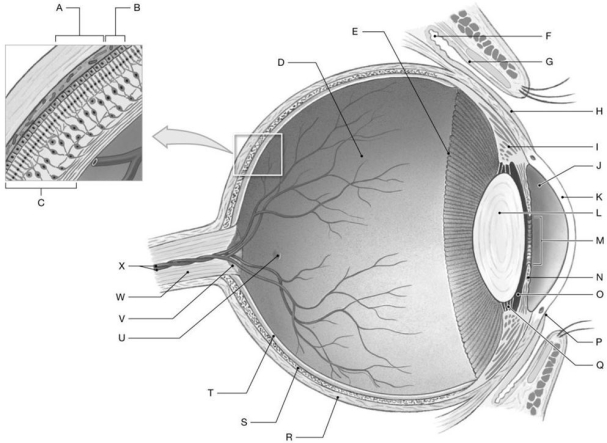 Using the figure above, identify the labeled structure(s) in each of the following questions.
-Identify the structure(s) indicated by Label U.
Using the figure above, identify the labeled structure(s) in each of the following questions.
-Identify the structure(s) indicated by Label U. (Multiple Choice)
4.8/5 (84)
(84) Figure 18.3
Using the figure above, identify the labeled structure(s) in each of the following questions.
-Identify the structure(s) indicated by Label V.
Using the figure above, identify the labeled structure(s) in each of the following questions.
-Identify the structure(s) indicated by Label V. (Multiple Choice)
4.8/5 (78)
(78) The organ of Corti rests on which structure that separates the cochlear duct from the scala tympani?
(Multiple Choice)
4.7/5 (82)
(82) Regarding pathways for auditory sensations, ascending acoustic information travels to which structure?
(Multiple Choice)
4.9/5 (77)
(77) Figure 18.3
Using the figure above, identify the labeled structure(s) in each of the following questions.
-Identify the structure(s) indicated by Label R.
Using the figure above, identify the labeled structure(s) in each of the following questions.
-Identify the structure(s) indicated by Label R. (Multiple Choice)
4.9/5 (79)
(79) Figure 18.3
Using the figure above, identify the labeled structure(s) in each of the following questions.
-Identify the structure(s) indicated by Label X.
Using the figure above, identify the labeled structure(s) in each of the following questions.
-Identify the structure(s) indicated by Label X. (Multiple Choice)
4.9/5 (97)
(97) Figure 18.2
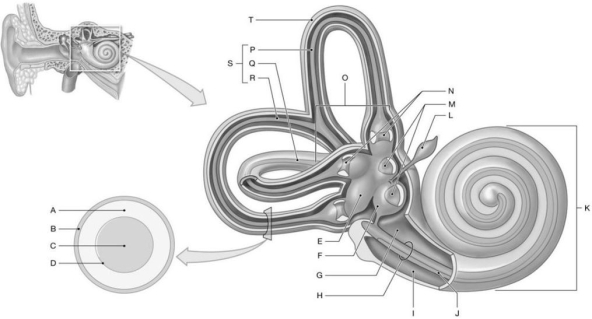 Using the figure above, identify the labeled structure(s) in each of the following questions.
-Identify the structure(s) indicated by Label C.
Using the figure above, identify the labeled structure(s) in each of the following questions.
-Identify the structure(s) indicated by Label C. (Multiple Choice)
4.8/5 (88)
(88) Figure 18.2
Using the figure above, identify the labeled structure(s) in each of the following questions.
-Identify the structure(s) indicated by Label Q.
Using the figure above, identify the labeled structure(s) in each of the following questions.
-Identify the structure(s) indicated by Label Q. (Multiple Choice)
4.8/5 (72)
(72) A person having a heart attack may feel pain along the medial side of the left arm. This pain is known as ________.
(Multiple Choice)
4.9/5 (85)
(85) Figure 18.2
Using the figure above, identify the labeled structure(s) in each of the following questions.
-Identify the structure(s) indicated by Label G.
Using the figure above, identify the labeled structure(s) in each of the following questions.
-Identify the structure(s) indicated by Label G. (Multiple Choice)
4.9/5 (85)
(85) The waxy secretions of the ceruminous glands slow the growth of microorganisms in the external acoustic meatus and reduces the chances of infection.
(True/False)
4.9/5 (62)
(62) Figure 18.3
Using the figure above, identify the labeled structure(s) in each of the following questions.
-Identify the structure(s) indicated by Label A.
Using the figure above, identify the labeled structure(s) in each of the following questions.
-Identify the structure(s) indicated by Label A. (Multiple Choice)
4.7/5 (77)
(77) When a sound vibrates the eardrum, the movements are conducted to the perilymph of the inner ear by the movements of the stapes.
(True/False)
4.9/5 (69)
(69) Olfactory receptor cells can undergo mitosis to replace aged cells.
(True/False)
4.7/5 (75)
(75) Figure 18.2
Using the figure above, identify the labeled structure(s) in each of the following questions.
-Identify the structure(s) indicated by Label A.
Using the figure above, identify the labeled structure(s) in each of the following questions.
-Identify the structure(s) indicated by Label A. (Multiple Choice)
4.8/5 (68)
(68) Figure 18.3
Using the figure above, identify the labeled structure(s) in each of the following questions.
-Identify the structure(s) indicated by Label S.
Using the figure above, identify the labeled structure(s) in each of the following questions.
-Identify the structure(s) indicated by Label S. (Multiple Choice)
4.8/5 (80)
(80) 
Filters
- Essay(0)
- Multiple Choice(0)
- Short Answer(0)
- True False(0)
- Matching(0)