



 Chat with AI
Exam 18: The Nervous System: General and Special Senses

Exam 1: Foundations: An Introduction to Anatomy124 Questions
Exam 2: Foundations: The Cell117 Questions
Exam 3: Foundations: Tissues and Early Embryology127 Questions
Exam 4: The Integumentary System127 Questions
Exam 5: The Skeletal System: Osseous Tissue and Skeletal Structure142 Questions
Exam 6: The Skeletal System: Axial Division150 Questions
Exam 7: The Skeletal System: Appendicular Division131 Questions
Exam 8: The Skeletal System: Articulations131 Questions
Exam 9: The Muscular System: Skeletal Muscle Tissue and Muscle Organization145 Questions
Exam 10: The Muscular System: Axial Musculature142 Questions
Exam 11: The Muscular System: Appendicular Musculature135 Questions
Exam 12: Surface Anatomy and Cross-Sectional Anatomy129 Questions
Exam 13: The Nervous System: Neural Tissue127 Questions
Exam 14: The Nervous System: The Spinal Cord and Spinal Nerves131 Questions
Exam 15: The Nervous System: Sensory and Motor Tracts of the Spinal Cord81 Questions
Exam 16: The Nervous System: The Brain and Cranial Nerves132 Questions
Exam 17: The Nervous System: Autonomic Nervous System115 Questions
Exam 18: The Nervous System: General and Special Senses127 Questions
Exam 19: The Endocrine System102 Questions
Exam 20: The Cardiovascular System: Blood71 Questions
Exam 21: The Cardiovascular System: The Heart150 Questions
Exam 22: The Cardiovascular System: Vessels and Circulation129 Questions
Exam 23: The Lymphatic System105 Questions
Exam 24: The Respiratory System128 Questions
Exam 25: The Digestive System132 Questions
Exam 26: The Urinary System135 Questions
Exam 27: The Reproductive System134 Questions
Exam 28: Embryology and Human Development140 Questions
Select questions type


Figure 18.1
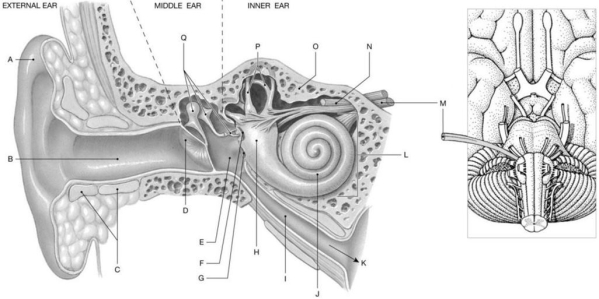 Using the figure above, identify the labeled structure(s) in each of the following questions.
-Identify the structure(s) indicated by Label I.
Using the figure above, identify the labeled structure(s) in each of the following questions.
-Identify the structure(s) indicated by Label I. (Multiple Choice)
4.9/5  (81)
(81) The lateral surface of the malleus attaches to the superior surface of the tympanic membrane at a single point.
(True/False)
5.0/5 (69)
(69) Which of the following is described as a thin, membranous partition that separates the perilymph of the cochlear chambers from the air in the middle ear?
(Multiple Choice)
4.8/5 (75)
(75) Which structure fills the lacrimal groove of the lacrimal bone?
(Multiple Choice)
4.8/5 (75)
(75) Figure 18.3
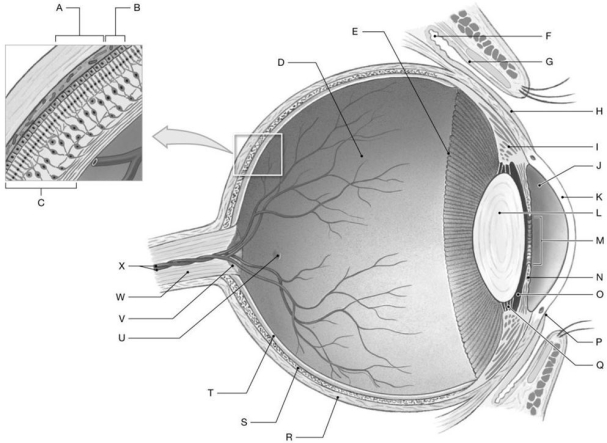 Using the figure above, identify the labeled structure(s) in each of the following questions.
-Identify the structure(s) indicated by Label T.
Using the figure above, identify the labeled structure(s) in each of the following questions.
-Identify the structure(s) indicated by Label T. (Multiple Choice)
4.8/5 (81)
(81) The simplest receptors are the dendrites of sensory neurons, called ________.
(Multiple Choice)
4.8/5 (89)
(89) Figure 18.2
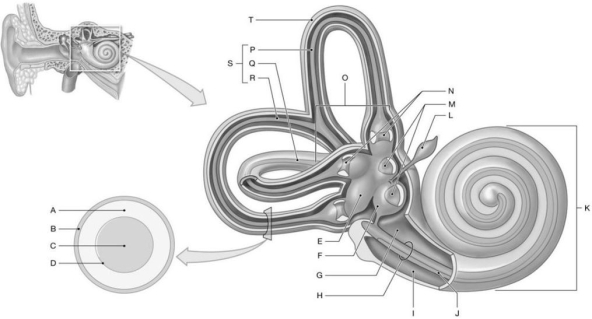 Using the figure above, identify the labeled structure(s) in each of the following questions.
-Identify the structure(s) indicated by Label N.
Using the figure above, identify the labeled structure(s) in each of the following questions.
-Identify the structure(s) indicated by Label N. (Multiple Choice)
4.8/5 (80)
(80) The taste receptors respond most readily to unpleasant rather than to pleasant stimuli.
(True/False)
4.7/5 (83)
(83) Figure 18.2
Using the figure above, identify the labeled structure(s) in each of the following questions.
-Identify the structure(s) indicated by Label J.
Using the figure above, identify the labeled structure(s) in each of the following questions.
-Identify the structure(s) indicated by Label J. (Multiple Choice)
4.9/5 (69)
(69) Figure 18.2
Using the figure above, identify the labeled structure(s) in each of the following questions.
-Identify the structure(s) indicated by Label B.
Using the figure above, identify the labeled structure(s) in each of the following questions.
-Identify the structure(s) indicated by Label B. (Multiple Choice)
4.8/5 (72)
(72) Figure 18.3
Using the figure above, identify the labeled structure(s) in each of the following questions.
-Identify the structure(s) indicated by Label I.
Using the figure above, identify the labeled structure(s) in each of the following questions.
-Identify the structure(s) indicated by Label I. (Multiple Choice)
4.8/5 (76)
(76) Which muscles, when contracted, decrease the diameter of the pupil?
(Multiple Choice)
4.9/5 (78)
(78) Figure 18.3
Using the figure above, identify the labeled structure(s) in each of the following questions.
-Identify the structure(s) indicated by Label D.
Using the figure above, identify the labeled structure(s) in each of the following questions.
-Identify the structure(s) indicated by Label D. (Multiple Choice)
5.0/5 (72)
(72) Figure 18.1
Using the figure above, identify the labeled structure(s) in each of the following questions.
-Identify the structure(s) indicated by Label N.
Using the figure above, identify the labeled structure(s) in each of the following questions.
-Identify the structure(s) indicated by Label N. (Multiple Choice)
4.8/5 (76)
(76) Figure 18.3
Using the figure above, identify the labeled structure(s) in each of the following questions.
-Identify the structure(s) indicated by Label G.
Using the figure above, identify the labeled structure(s) in each of the following questions.
-Identify the structure(s) indicated by Label G. (Multiple Choice)
4.8/5 (71)
(71) What is acute otitis media? How does acute otitis media of bacterial origin differ from a case that is of viral origin?
(Essay)
4.9/5 (85)
(85) Which receptor type is located in the dermis, is sensitive to pressure and vibrations, but is tonically active and shows little if any adaptation?
(Multiple Choice)
4.9/5 (86)
(86) Figure 18.3
Using the figure above, identify the labeled structure(s) in each of the following questions.
-Identify the structure(s) indicated by Label H.
Using the figure above, identify the labeled structure(s) in each of the following questions.
-Identify the structure(s) indicated by Label H. (Multiple Choice)
4.8/5 (62)
(62) 
Filters
- Essay(0)
- Multiple Choice(0)
- Short Answer(0)
- True False(0)
- Matching(0)