



 Chat with AI
Exam 1: Foundations: An Introduction to Anatomy

Exam 1: Foundations: An Introduction to Anatomy124 Questions
Exam 2: Foundations: The Cell117 Questions
Exam 3: Foundations: Tissues and Early Embryology127 Questions
Exam 4: The Integumentary System127 Questions
Exam 5: The Skeletal System: Osseous Tissue and Skeletal Structure142 Questions
Exam 6: The Skeletal System: Axial Division150 Questions
Exam 7: The Skeletal System: Appendicular Division131 Questions
Exam 8: The Skeletal System: Articulations131 Questions
Exam 9: The Muscular System: Skeletal Muscle Tissue and Muscle Organization145 Questions
Exam 10: The Muscular System: Axial Musculature142 Questions
Exam 11: The Muscular System: Appendicular Musculature135 Questions
Exam 12: Surface Anatomy and Cross-Sectional Anatomy129 Questions
Exam 13: The Nervous System: Neural Tissue127 Questions
Exam 14: The Nervous System: The Spinal Cord and Spinal Nerves131 Questions
Exam 15: The Nervous System: Sensory and Motor Tracts of the Spinal Cord81 Questions
Exam 16: The Nervous System: The Brain and Cranial Nerves132 Questions
Exam 17: The Nervous System: Autonomic Nervous System115 Questions
Exam 18: The Nervous System: General and Special Senses127 Questions
Exam 19: The Endocrine System102 Questions
Exam 20: The Cardiovascular System: Blood71 Questions
Exam 21: The Cardiovascular System: The Heart150 Questions
Exam 22: The Cardiovascular System: Vessels and Circulation129 Questions
Exam 23: The Lymphatic System105 Questions
Exam 24: The Respiratory System128 Questions
Exam 25: The Digestive System132 Questions
Exam 26: The Urinary System135 Questions
Exam 27: The Reproductive System134 Questions
Exam 28: Embryology and Human Development140 Questions
Select questions type


Figure 1.2
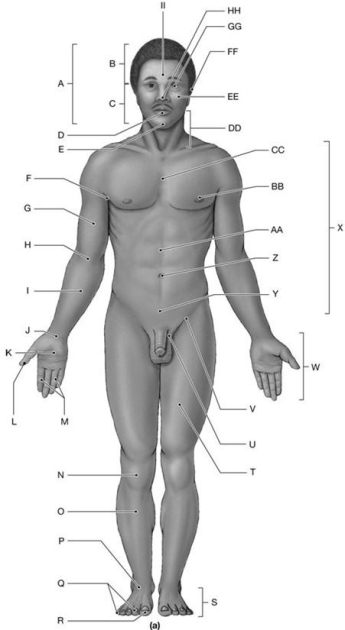 Using the figure above, answer the following questions.
-What is the anatomical term for Label I?
Using the figure above, answer the following questions.
-What is the anatomical term for Label I? (Multiple Choice)
4.9/5  (74)
(74) The process of creating subsequent generations, either unicellular or multicellular, is referred to as ________.
(Multiple Choice)
4.7/5 (87)
(87) Figure 1.5
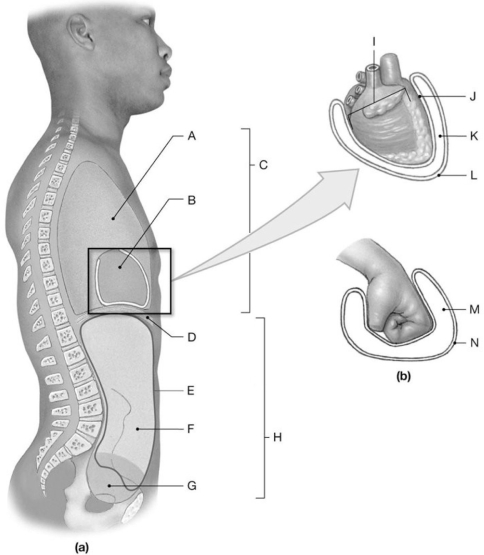 Using the figure above, answer the following questions.
-What is the anatomical term for Label B?
Using the figure above, answer the following questions.
-What is the anatomical term for Label B? (Multiple Choice)
5.0/5 (80)
(80) In general, why must larger organisms have specialized structures to permit some life functions to occur?
(Essay)
4.7/5 (71)
(71) The basic functions performed by all living humans include(s)________.
(Multiple Choice)
4.8/5 (69)
(69) A person lying down in the anatomical position is said to be ________ when lying face up.
(Multiple Choice)
4.9/5 (80)
(80) The serous membrane that covers the outer surface of a lung is called the ________.
(Multiple Choice)
4.9/5 (82)
(82) The ________ abdominopelvic region is sandwiched between the right and left hypochondriac regions.
(Multiple Choice)
4.8/5 (82)
(82) Figure 1.5
Using the figure above, answer the following questions.
-What is the anatomical term for Label G?
Using the figure above, answer the following questions.
-What is the anatomical term for Label G? (Multiple Choice)
4.8/5 (88)
(88) How does the definition of posterior, as it is used in human terminology, differ from the usage with four-legged animals (quadrupeds)?
(Essay)
5.0/5 (70)
(70) Figure 1.1
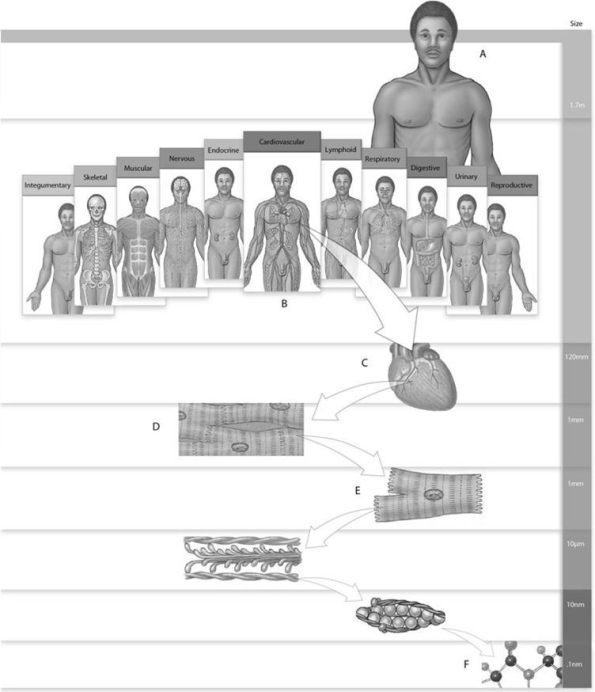 Using the figure above, answer the following questions.
-Label E is which level of organization?
Using the figure above, answer the following questions.
-Label E is which level of organization? (Multiple Choice)
4.7/5 (77)
(77) Figure 1.5
Using the figure above, answer the following questions.
-What is the anatomical term for Label F?
Using the figure above, answer the following questions.
-What is the anatomical term for Label F? (Multiple Choice)
4.9/5 (66)
(66) The study of structures through specialized imaging techniques, such as ultrasounds, x-rays, or other specialized procedures performed on an intact body, is called ________.
(Multiple Choice)
4.7/5 (77)
(77) The study of the early processes during the first two months of development from conception is called ________.
(Multiple Choice)
5.0/5 (83)
(83) Figure 1.2
Using the figure above, answer the following questions.
-What is the anatomical term for Label C?
Using the figure above, answer the following questions.
-What is the anatomical term for Label C? (Multiple Choice)
4.9/5 (89)
(89) Gas exchange is also facilitated by the ________ system, which is responsible for the internal transport of cells and dissolved materials, including nutrients, wastes, and gases.
(Multiple Choice)
4.8/5 (83)
(83) 
Filters
- Essay(0)
- Multiple Choice(0)
- Short Answer(0)
- True False(0)
- Matching(0)