



 Chat with AI
Exam 1: Foundations: An Introduction to Anatomy

Exam 1: Foundations: An Introduction to Anatomy124 Questions
Exam 2: Foundations: The Cell117 Questions
Exam 3: Foundations: Tissues and Early Embryology127 Questions
Exam 4: The Integumentary System127 Questions
Exam 5: The Skeletal System: Osseous Tissue and Skeletal Structure142 Questions
Exam 6: The Skeletal System: Axial Division150 Questions
Exam 7: The Skeletal System: Appendicular Division131 Questions
Exam 8: The Skeletal System: Articulations131 Questions
Exam 9: The Muscular System: Skeletal Muscle Tissue and Muscle Organization145 Questions
Exam 10: The Muscular System: Axial Musculature142 Questions
Exam 11: The Muscular System: Appendicular Musculature135 Questions
Exam 12: Surface Anatomy and Cross-Sectional Anatomy129 Questions
Exam 13: The Nervous System: Neural Tissue127 Questions
Exam 14: The Nervous System: The Spinal Cord and Spinal Nerves131 Questions
Exam 15: The Nervous System: Sensory and Motor Tracts of the Spinal Cord81 Questions
Exam 16: The Nervous System: The Brain and Cranial Nerves132 Questions
Exam 17: The Nervous System: Autonomic Nervous System115 Questions
Exam 18: The Nervous System: General and Special Senses127 Questions
Exam 19: The Endocrine System102 Questions
Exam 20: The Cardiovascular System: Blood71 Questions
Exam 21: The Cardiovascular System: The Heart150 Questions
Exam 22: The Cardiovascular System: Vessels and Circulation129 Questions
Exam 23: The Lymphatic System105 Questions
Exam 24: The Respiratory System128 Questions
Exam 25: The Digestive System132 Questions
Exam 26: The Urinary System135 Questions
Exam 27: The Reproductive System134 Questions
Exam 28: Embryology and Human Development140 Questions
Select questions type


The space that contains organs of the respiratory, cardiovascular, digestive, urine, and reproductive systems is called the ________.
(Multiple Choice)
4.8/5  (74)
(74) Figure 1.5
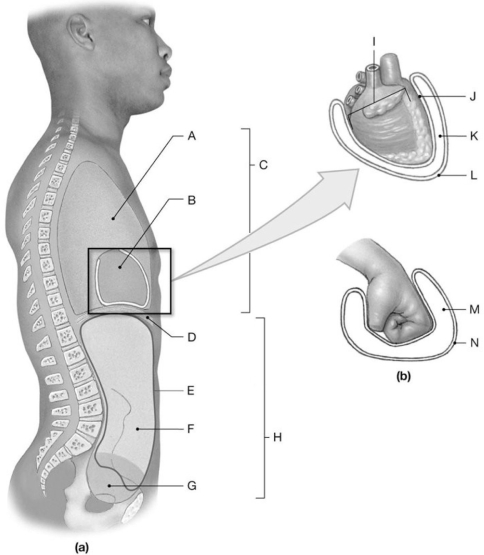 Using the figure above, answer the following questions.
-What is the anatomical term for Label E?
Using the figure above, answer the following questions.
-What is the anatomical term for Label E? (Multiple Choice)
4.9/5 (75)
(75) Figure 1.4
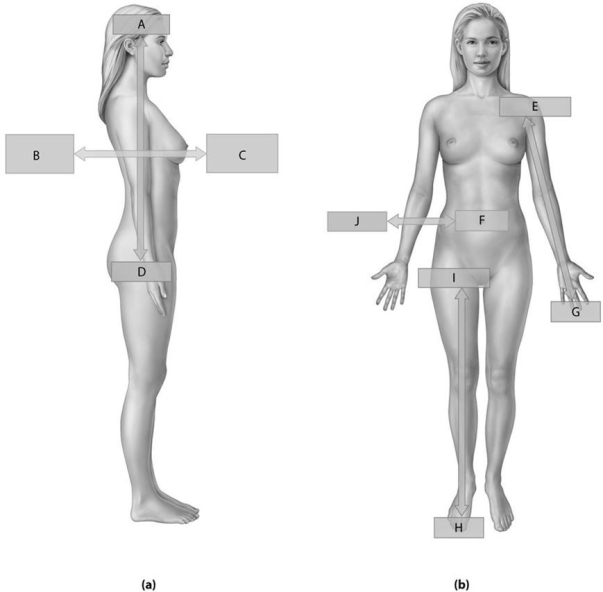 Using the figure above, answer the following questions.
-What is the directional term for Label F?
Using the figure above, answer the following questions.
-What is the directional term for Label F? (Multiple Choice)
4.8/5 (69)
(69) Figure 1.5
Using the figure above, answer the following questions.
-What is the anatomical term for Label C?
Using the figure above, answer the following questions.
-What is the anatomical term for Label C? (Multiple Choice)
4.9/5 (80)
(80) The analysis of the smallest units of life is called ________.
(Multiple Choice)
4.9/5 (71)
(71) Which of the following is the primary function of the thymus in the lymphatic system?
(Multiple Choice)
4.7/5 (78)
(78) The discipline that might examine structural interactions within a sheet of muscle tissue, or groups of specialized cells and cell products that work together to perform specific functions, is called ________.
(Multiple Choice)
4.8/5 (73)
(73) Figure 1.3
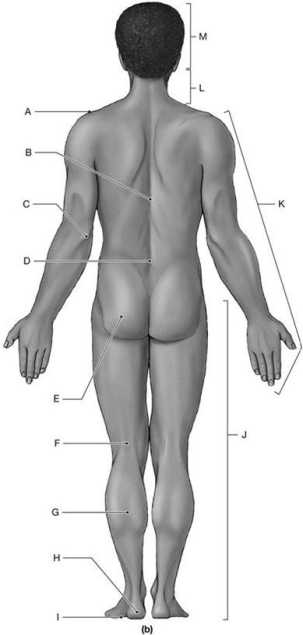 Using the figure above, answer the following questions.
-What is the anatomical term for Label C?
Using the figure above, answer the following questions.
-What is the anatomical term for Label C? (Multiple Choice)
4.7/5 (84)
(84) Figure 1.2
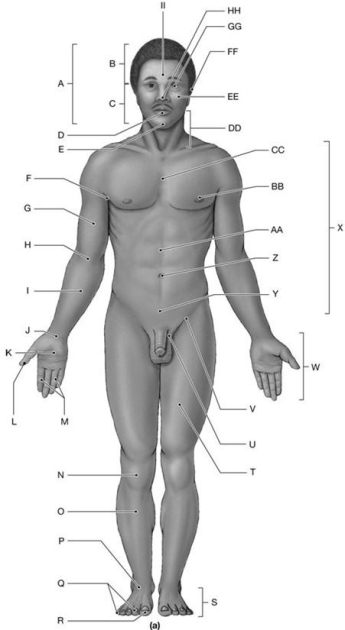 Using the figure above, answer the following questions.
-What is the anatomical term for Label S?
Using the figure above, answer the following questions.
-What is the anatomical term for Label S? (Multiple Choice)
4.8/5 (65)
(65) The study of the heart, blood, and blood vessels is which of the following approaches?
(Multiple Choice)
4.7/5 (82)
(82) Figure 1.5
Using the figure above, answer the following questions.
-What is the anatomical term for Label J?
Using the figure above, answer the following questions.
-What is the anatomical term for Label J? (Multiple Choice)
4.8/5 (79)
(79) What is the basic anatomical pattern that humans and other vertebrate animals share?
(Essay)
4.8/5 (93)
(93) ________ anatomy is a new subspecialty of gross anatomy as new advances, such as computed tomography and spiral CT scans, have emerged.
(Multiple Choice)
4.9/5 (80)
(80) Pain originating from the spleen would most likely be felt in the ________ abdominopelvic quadrant.
(Multiple Choice)
4.8/5 (91)
(91) If a person has peritonitis, which of the following organs will be affected within the peritoneum.
(Multiple Choice)
4.9/5 (93)
(93) Which of the following directional reference pairs consists of anatomical equivalents when referring to the human body?
(Multiple Choice)
4.8/5 (77)
(77) Figure 1.3
Using the figure above, answer the following questions.
-What is the anatomical term for Label I?
Using the figure above, answer the following questions.
-What is the anatomical term for Label I? (Multiple Choice)
4.9/5 (84)
(84) Developmental anatomy refers to the study of changes in form over time.
(True/False)
4.8/5 (85)
(85) 
Filters
- Essay(0)
- Multiple Choice(0)
- Short Answer(0)
- True False(0)
- Matching(0)