



 Chat with AI
Exam 11: Monopoly

Exam 1: What Is Economics?227 Questions
Exam 2: The Economy: Myth and Reality150 Questions
Exam 3: The Fundamental Economic Problem: Scarcity and Choice250 Questions
Exam 4: Supply and Demand: An Initial Look308 Questions
Exam 5: Consumer Choice: Individual and Market Demand202 Questions
Exam 6: Demand and Elasticity209 Questions
Exam 7: Production, Inputs, and Cost: Building Blocks for Supply Analysis216 Questions
Exam 8: Output, Price, and Profit: The Importance of Marginal Analysis189 Questions
Exam 9: Securities: Business Finance, and the Economy: The Tail that Wags the Dog?198 Questions
Exam 10: The Firm and the Industry under Perfect Competition208 Questions
Exam 11: Monopoly203 Questions
Exam 12: Between Competition and Monopoly225 Questions
Exam 13: Limiting Market Power: Regulation and Antitrust152 Questions
Exam 14: The Case for Free Markets I: The Price System220 Questions
Exam 15: The Shortcomings of Free Markets212 Questions
Exam 16: The Market's Prime Achievement: Innovation and Growth110 Questions
Exam 17: Externalities, the Environment, and Natural Resources217 Questions
Exam 18: Taxation and Resource Allocation219 Questions
Exam 19: Pricing the Factors of Production228 Questions
Exam 20: Labor and Entrepreneurship: The Human Inputs223 Questions
Exam 21: Poverty, Inequality, and Discrimination167 Questions
Exam 22: An Introduction to Macroeconomics211 Questions
Exam 23: The Goals of Macroeconomic Policy207 Questions
Exam 24: Economic Growth: Theory and Policy223 Questions
Exam 25: Aggregate Demand and the Powerful Consumer214 Questions
Exam 26: Demand-Side Equilibrium: Unemployment or Inflation?210 Questions
Exam 27: Bringing in the Supply Side: Unemployment and Inflation?223 Questions
Exam 28: Managing Aggregate Demand: Fiscal Policy205 Questions
Exam 29: Money and the Banking System219 Questions
Exam 30: Monetary Policy: Conventional and Unconventional205 Questions
Exam 31: The Financial Crisis and the Great Recession61 Questions
Exam 32: The Debate over Monetary and Fiscal Policy214 Questions
Exam 33: Budget Deficits in the Short and Long Run210 Questions
Exam 34: The Trade-Off between Inflation and Unemployment214 Questions
Exam 35: International Trade and Comparative Advantage226 Questions
Exam 36: The International Monetary System: Order or Disorder?213 Questions
Exam 37: Exchange Rates and the Macroeconomy214 Questions
Select questions type


Adam Smith believed that monopoly is the most efficient market structure.
(True/False)
5.0/5  (80)
(80) Why does perfect competition shun advertising? Does advertising benefit a monopoly?
(Essay)
4.9/5 (83)
(83) Providing medical services for smaller fees to the poor than to the rich is
(Multiple Choice)
4.9/5 (72)
(72) A market structure in which only one firm has survived because of its economies of scale is called a
(Multiple Choice)
4.7/5 (78)
(78) The existence of a natural monopoly stems from the size of the firm relative to the total market demand for the product of that firm.
(True/False)
4.8/5 (68)
(68) A monopolist maximizes profits by producing where which of the following occur?
(Multiple Choice)
4.7/5 (84)
(84) A monopolist can sell 10 wangdoodles if he charges $10 per wangdoodle and 11 wangdoodles if he charges $9.The MR from selling the 11th wangdoodle is
(Multiple Choice)
4.8/5 (81)
(81) How does the monopolist calculate profit per unit, and total profit?
(Essay)
4.8/5 (83)
(83) A monopoly firm always devotes some of its profits to research.
(True/False)
4.9/5 (90)
(90) Which of these contributes to the existence of monopoly power?
(Multiple Choice)
4.9/5 (86)
(86) Figure 11-4
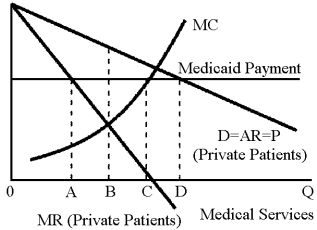 -Physicians have two types of patients: private patients who pay directly or with insurance, and Medicaid patients whose care is paid for by the state.Physicians must lower prices to attract more private patients, but they can add unlimited Medicaid patients at a constant price.The situation facing Dr.Casey is depicted in Figure 11-4.Units of medical service (say, number of patients × number of visits) are measured on the horizontal axis.How many units of medical service will Dr.Casey deliver?
 (Multiple Choice)
4.8/5 (85)
(85) In perfect competition, one result of the model was that there were no economic profits in the long run.In a monopoly, the firm typically earns a positive economic profit.Why is there this difference?
(Essay)
4.9/5 (71)
(71) Under what conditions might a monopoly be more efficient than a perfectly competitive firm?
(Essay)
4.8/5 (77)
(77) Since a monopolist firm will lose some customers when the price is increased, it will make every effort to keep the price as low as possible.
(True/False)
4.8/5 (93)
(93) An increase in fixed cost will, in the short run, alter the industry's output of
(Multiple Choice)
4.9/5 (62)
(62) What is true for monopoly that is not true for perfect competition?
(Multiple Choice)
4.8/5 (76)
(76) 
Filters
- Essay(0)
- Multiple Choice(0)
- Short Answer(0)
- True False(0)
- Matching(0)