



 Chat with AI
Exam 11: Monopoly

Exam 1: What Is Economics?227 Questions
Exam 2: The Economy: Myth and Reality150 Questions
Exam 3: The Fundamental Economic Problem: Scarcity and Choice250 Questions
Exam 4: Supply and Demand: An Initial Look308 Questions
Exam 5: Consumer Choice: Individual and Market Demand202 Questions
Exam 6: Demand and Elasticity209 Questions
Exam 7: Production, Inputs, and Cost: Building Blocks for Supply Analysis216 Questions
Exam 8: Output, Price, and Profit: The Importance of Marginal Analysis189 Questions
Exam 9: Securities: Business Finance, and the Economy: The Tail that Wags the Dog?198 Questions
Exam 10: The Firm and the Industry under Perfect Competition208 Questions
Exam 11: Monopoly203 Questions
Exam 12: Between Competition and Monopoly225 Questions
Exam 13: Limiting Market Power: Regulation and Antitrust152 Questions
Exam 14: The Case for Free Markets I: The Price System220 Questions
Exam 15: The Shortcomings of Free Markets212 Questions
Exam 16: The Market's Prime Achievement: Innovation and Growth110 Questions
Exam 17: Externalities, the Environment, and Natural Resources217 Questions
Exam 18: Taxation and Resource Allocation219 Questions
Exam 19: Pricing the Factors of Production228 Questions
Exam 20: Labor and Entrepreneurship: The Human Inputs223 Questions
Exam 21: Poverty, Inequality, and Discrimination167 Questions
Exam 22: An Introduction to Macroeconomics211 Questions
Exam 23: The Goals of Macroeconomic Policy207 Questions
Exam 24: Economic Growth: Theory and Policy223 Questions
Exam 25: Aggregate Demand and the Powerful Consumer214 Questions
Exam 26: Demand-Side Equilibrium: Unemployment or Inflation?210 Questions
Exam 27: Bringing in the Supply Side: Unemployment and Inflation?223 Questions
Exam 28: Managing Aggregate Demand: Fiscal Policy205 Questions
Exam 29: Money and the Banking System219 Questions
Exam 30: Monetary Policy: Conventional and Unconventional205 Questions
Exam 31: The Financial Crisis and the Great Recession61 Questions
Exam 32: The Debate over Monetary and Fiscal Policy214 Questions
Exam 33: Budget Deficits in the Short and Long Run210 Questions
Exam 34: The Trade-Off between Inflation and Unemployment214 Questions
Exam 35: International Trade and Comparative Advantage226 Questions
Exam 36: The International Monetary System: Order or Disorder?213 Questions
Exam 37: Exchange Rates and the Macroeconomy214 Questions
Select questions type


The U.S.Postal Service enjoys a monopoly position because of patent rights.
(True/False)
4.9/5  (85)
(85) A monopolist will maximize profits by producing a quantity specified by setting marginal revenue equal to marginal cost.
(True/False)
4.7/5 (82)
(82) A monopolist can earn a positive economic profit, even in the long run.
(True/False)
4.9/5 (79)
(79) Which of the following will occur if a natural monopoly is broken into two smaller firms?
(Multiple Choice)
4.8/5 (92)
(92) Table 11-1
Quantity (units) 18 16 14 12 10 4 Price per unit (dollars) 1 2 3 4 5 6 Total cost (dollars) 44 38 32 26 20 14
-Table 11-1 shows demand and total cost schedules for Monopoliteria.At its profit-maximizing level of output, Monopoliteria's profit is
(Multiple Choice)
4.7/5 (79)
(79) Which of the following is true for a profit-maximizing competitive firm in the long run but not a monopolist?
(Multiple Choice)
4.8/5 (82)
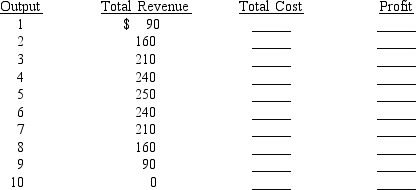
(82) Assume that a firm has measured demand carefully and thinks that the following table accurately displays this.The total cost has been measured and can be given as TC = 20 + Q + Q₂ where Q is the level of output.Complete the table and determine the profit-maximizing level of output.
(Essay)
5.0/5 (79)
(79) The key element in preserving a monopoly is keeping rivals out of the market.
(True/False)
4.9/5 (85)
(85) Figure 11-9
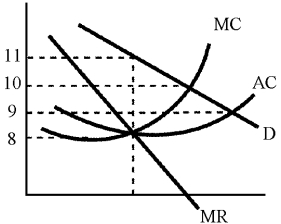 -In Figure 11-9, how much more than the short-run competitive price will the profit-maximizing monopolist charge?
 (Multiple Choice)
4.9/5 (68)
(68) Which of the following is not potentially a barrier to entry into the widget market?
(Multiple Choice)
4.8/5 (67)
(67) Figure 11-7
 -For the firm in Figure 11-7, an unregulated monopolist, profit-maximizing output is below the long-run competitive level by how much?
 (Multiple Choice)
4.9/5 (68)
(68) Although monopoly has lower output than competition, the level of output is efficient.
(True/False)
4.8/5 (84)
(84) 
Filters
- Essay(0)
- Multiple Choice(0)
- Short Answer(0)
- True False(0)
- Matching(0)