



 Chat with AI
Exam 11: Monopoly

Exam 1: What Is Economics?227 Questions
Exam 2: The Economy: Myth and Reality150 Questions
Exam 3: The Fundamental Economic Problem: Scarcity and Choice250 Questions
Exam 4: Supply and Demand: An Initial Look308 Questions
Exam 5: Consumer Choice: Individual and Market Demand202 Questions
Exam 6: Demand and Elasticity209 Questions
Exam 7: Production, Inputs, and Cost: Building Blocks for Supply Analysis216 Questions
Exam 8: Output, Price, and Profit: The Importance of Marginal Analysis189 Questions
Exam 9: Securities: Business Finance, and the Economy: The Tail that Wags the Dog?198 Questions
Exam 10: The Firm and the Industry under Perfect Competition208 Questions
Exam 11: Monopoly203 Questions
Exam 12: Between Competition and Monopoly225 Questions
Exam 13: Limiting Market Power: Regulation and Antitrust152 Questions
Exam 14: The Case for Free Markets I: The Price System220 Questions
Exam 15: The Shortcomings of Free Markets212 Questions
Exam 16: The Market's Prime Achievement: Innovation and Growth110 Questions
Exam 17: Externalities, the Environment, and Natural Resources217 Questions
Exam 18: Taxation and Resource Allocation219 Questions
Exam 19: Pricing the Factors of Production228 Questions
Exam 20: Labor and Entrepreneurship: The Human Inputs223 Questions
Exam 21: Poverty, Inequality, and Discrimination167 Questions
Exam 22: An Introduction to Macroeconomics211 Questions
Exam 23: The Goals of Macroeconomic Policy207 Questions
Exam 24: Economic Growth: Theory and Policy223 Questions
Exam 25: Aggregate Demand and the Powerful Consumer214 Questions
Exam 26: Demand-Side Equilibrium: Unemployment or Inflation?210 Questions
Exam 27: Bringing in the Supply Side: Unemployment and Inflation?223 Questions
Exam 28: Managing Aggregate Demand: Fiscal Policy205 Questions
Exam 29: Money and the Banking System219 Questions
Exam 30: Monetary Policy: Conventional and Unconventional205 Questions
Exam 31: The Financial Crisis and the Great Recession61 Questions
Exam 32: The Debate over Monetary and Fiscal Policy214 Questions
Exam 33: Budget Deficits in the Short and Long Run210 Questions
Exam 34: The Trade-Off between Inflation and Unemployment214 Questions
Exam 35: International Trade and Comparative Advantage226 Questions
Exam 36: The International Monetary System: Order or Disorder?213 Questions
Exam 37: Exchange Rates and the Macroeconomy214 Questions
Select questions type


Suppose a monopolist can charge different prices to different customers, such as doctors charging different prices depending on whether the patient is insured.How will profits and marginal revenue of such a price-discriminating monopolist compare to profits and MR of an ordinary monopolist who must charge all patients the same fee?
(Essay)
4.7/5  (70)
(70) Bargain airline fares in which airlines charge varying rates to passengers for the same flight and service is an example of
(Multiple Choice)
4.9/5 (70)
(70) Figure 11-2
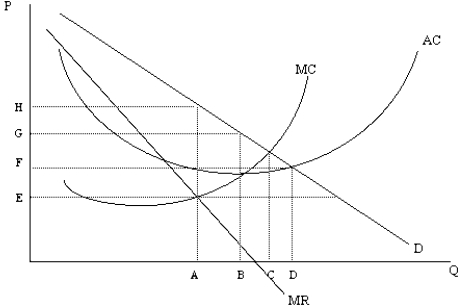 -In Figure 11-2, at what quantity would the monopolist maximize profit?
 (Multiple Choice)
4.8/5 (83)
(83) Discrepancies in profitability tempt rivals to charge the more profitable consumers somewhat lower prices in order to lure them away from the firm that is "overcharging" them.This practice is referred to as
(Multiple Choice)
4.7/5 (81)
(81) Figure 11-6
 -The profit-maximizing monopolist in Figure 11-6 will sell its output at
 (Multiple Choice)
4.9/5 (88)
(88) The South African diamond production monopoly is an example of monopoly through
(Multiple Choice)
5.0/5 (71)
(71) In the long run, profit-maximizing monopolists facing a downward-sloping demand curve
(Multiple Choice)
4.9/5 (76)
(76) Explain how each of the following industries practices price discrimination:
a.movie theaters
b.airlines
c.auto dealers
d.U.S.Postal Service
(Essay)
4.8/5 (77)
(77) A monopolist in the radio industry has two radio-making plants.The marginal cost of radio production by Plant A is $4Q (where Q is the number of radios produced) and the marginal cost of radio production by Plant B is always $16.If the demand curve for radios is downward sloping, the monopolist will
(Multiple Choice)
4.9/5 (72)
(72) Monopolies are always large firms with great economies of scale.
(True/False)
4.7/5 (70)
(70) Figure 11-8
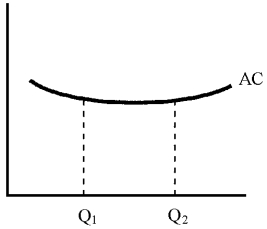 -Given the average cost curve shown in Figure 11-8 for dry cleaning, where Q₁ is the quantity demanded in a small town, and Q₂ for a larger town, you would expect dry cleaning to be a monopoly
 (Multiple Choice)
4.9/5 (72)
(72) Because a monopolist must cut its price to increase its sales by one unit,
(Multiple Choice)
4.9/5 (70)
(70) Figure 11-7
 -The firm in Figure 11-7 is an unregulated monopolist; it will produce which of the following?
 (Multiple Choice)
5.0/5 (72)
(72) 
Filters
- Essay(0)
- Multiple Choice(0)
- Short Answer(0)
- True False(0)
- Matching(0)