



 Chat with AI
Exam 11: Monopoly

Exam 1: What Is Economics?227 Questions
Exam 2: The Economy: Myth and Reality150 Questions
Exam 3: The Fundamental Economic Problem: Scarcity and Choice250 Questions
Exam 4: Supply and Demand: An Initial Look308 Questions
Exam 5: Consumer Choice: Individual and Market Demand202 Questions
Exam 6: Demand and Elasticity209 Questions
Exam 7: Production, Inputs, and Cost: Building Blocks for Supply Analysis216 Questions
Exam 8: Output, Price, and Profit: The Importance of Marginal Analysis189 Questions
Exam 9: Securities: Business Finance, and the Economy: The Tail that Wags the Dog?198 Questions
Exam 10: The Firm and the Industry under Perfect Competition208 Questions
Exam 11: Monopoly203 Questions
Exam 12: Between Competition and Monopoly225 Questions
Exam 13: Limiting Market Power: Regulation and Antitrust152 Questions
Exam 14: The Case for Free Markets I: The Price System220 Questions
Exam 15: The Shortcomings of Free Markets212 Questions
Exam 16: The Market's Prime Achievement: Innovation and Growth110 Questions
Exam 17: Externalities, the Environment, and Natural Resources217 Questions
Exam 18: Taxation and Resource Allocation219 Questions
Exam 19: Pricing the Factors of Production228 Questions
Exam 20: Labor and Entrepreneurship: The Human Inputs223 Questions
Exam 21: Poverty, Inequality, and Discrimination167 Questions
Exam 22: An Introduction to Macroeconomics211 Questions
Exam 23: The Goals of Macroeconomic Policy207 Questions
Exam 24: Economic Growth: Theory and Policy223 Questions
Exam 25: Aggregate Demand and the Powerful Consumer214 Questions
Exam 26: Demand-Side Equilibrium: Unemployment or Inflation?210 Questions
Exam 27: Bringing in the Supply Side: Unemployment and Inflation?223 Questions
Exam 28: Managing Aggregate Demand: Fiscal Policy205 Questions
Exam 29: Money and the Banking System219 Questions
Exam 30: Monetary Policy: Conventional and Unconventional205 Questions
Exam 31: The Financial Crisis and the Great Recession61 Questions
Exam 32: The Debate over Monetary and Fiscal Policy214 Questions
Exam 33: Budget Deficits in the Short and Long Run210 Questions
Exam 34: The Trade-Off between Inflation and Unemployment214 Questions
Exam 35: International Trade and Comparative Advantage226 Questions
Exam 36: The International Monetary System: Order or Disorder?213 Questions
Exam 37: Exchange Rates and the Macroeconomy214 Questions
Select questions type


In the long-run, a monopolist charges the same price as a perfectly competitive firm.
(True/False)
4.9/5  (79)
(79) Figure 11-3
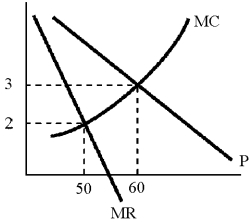 -In Figure 11-3, one can tell from the graph that the monopolist will earn a positive profit only if
 (Multiple Choice)
4.9/5 (93)
(93) Define the following terms and explain their importance to the study of economics.
a.pure monopoly
b.barriers to entry
c.patent
d.natural monopoly
e.sunk costs
(Essay)
4.7/5 (75)
(75) Figure 11-3
-Using the graph in Figure 11-3, the profit-maximizing monopolist will charge a price
-Using the graph in Figure 11-3, the profit-maximizing monopolist will charge a price (Multiple Choice)
5.0/5 (90)
(90) At a given output level, a monopolist earns a profit only if the
(Multiple Choice)
4.9/5 (60)
(60) Table 11-2
8 95 90 9 102 93 10 110 100 11 112 105 12 115 110
-In Table 11-2, the price at the profit-maximizing output is how much?
(Multiple Choice)
4.7/5 (77)
(77) Explain the source of monopoly power for DeBeers' Diamond Mine in South Africa, Microsoft (owned by Bill Gates), the American Medical Association (which licenses doctors), Polaroid's Instant Picture Cameras, USAir (which owns virtually all the gates at the airport in Charlotte, North Carolina), and electric utilities.
(Essay)
4.8/5 (69)
(69) The software industry has traits in common with monopoly markets.
(True/False)
4.7/5 (75)
(75) The marketing division of a firm has measured demand for its product and reports that it is 2Q = 24 - P, where Q is units and P is price per unit in dollars.The cost is given in the table below.Complete the table and determine the profit-maximizing level of output for this firm.
0 10 1 18 2 20 3 22 4 25 5 29 6 34 7 40 8 48
(Essay)
4.9/5 (79)
(79) There exist only two causes of monopoly: barriers to entry and government restrictions.
(True/False)
4.8/5 (81)
(81) In which of the following ways is a monopolist different from a perfect competitor?
(Multiple Choice)
4.9/5 (81)
(81) A price-discriminating firm will always maximize profit by following the condition that
(Multiple Choice)
4.8/5 (70)
(70) 
Filters
- Essay(0)
- Multiple Choice(0)
- Short Answer(0)
- True False(0)
- Matching(0)