



 Chat with AI
Exam 56: Conservation Biology and Global Change

Exam 1: Evolution, the Themes of Biology, and Scientific Inquiry51 Questions
Exam 2: The Chemical Context of Life61 Questions
Exam 3: Water and Life55 Questions
Exam 4: Carbon and the Molecular Diversity of Life58 Questions
Exam 5: The Structure and Function of Large Biological Molecules70 Questions
Exam 6: A Tour of the Cell66 Questions
Exam 7: Membrane Structure and Function68 Questions
Exam 8: An Introduction to Metabolism67 Questions
Exam 9: Cellular Respiration and Fermentation68 Questions
Exam 10: Photosynthesis65 Questions
Exam 11: Cell Communication65 Questions
Exam 12: The Cell Cycle66 Questions
Exam 13: Meiosis and Sexual Life Cycles64 Questions
Exam 14: Mendel and the Gene Idea62 Questions
Exam 15: The Chromosomal Basis of Inheritance58 Questions
Exam 16: The Molecular Basis of Inheritance65 Questions
Exam 17: Gene Expression: From Gene to Protein67 Questions
Exam 18: Regulation of Gene Expression66 Questions
Exam 19: Viruses54 Questions
Exam 20: DNA Tools and Biotechnology57 Questions
Exam 21: Genomes and Their Evolution44 Questions
Exam 22: Descent with Modification: A Darwinian View of Life60 Questions
Exam 23: The Evolution of Populations64 Questions
Exam 24: The Origin of Species67 Questions
Exam 25: The History of Life on Earth59 Questions
Exam 26: Phylogeny and the Tree of Life75 Questions
Exam 27: Bacteria and Archaea75 Questions
Exam 28: Protists79 Questions
Exam 29: Plant Diversity I: How Plants Colonized Land82 Questions
Exam 30: Plant Diversity II: The Evolution of Seed Plants80 Questions
Exam 31: Fungi75 Questions
Exam 32: An Overview of Animal Diversity67 Questions
Exam 33: An Introduction to Invertebrates83 Questions
Exam 34: The Origin and Evolution of Vertebrates82 Questions
Exam 35: Vascular Plant Structure, Growth, and Development65 Questions
Exam 36: Resource Acquisition and Transport in Vascular Plants74 Questions
Exam 37: Soil and Plant Nutrition52 Questions
Exam 38: Angiosperm Reproduction and Biotechnology60 Questions
Exam 39: Plant Responses to Internal and External Signals61 Questions
Exam 40: Basic Principles of Animal Form and Function68 Questions
Exam 41: Animal Nutrition64 Questions
Exam 42: Circulation and Gas Exchange67 Questions
Exam 43: The Immune System69 Questions
Exam 44: Osmoregulation and Excretion64 Questions
Exam 45: Hormones and the Endocrine System66 Questions
Exam 46: Animal Reproduction68 Questions
Exam 47: Animal Development70 Questions
Exam 48: Neurons, Synapses, and Signaling68 Questions
Exam 49: Nervous Systems65 Questions
Exam 50: Sensory and Motor Mechanisms67 Questions
Exam 51: Animal Behavior69 Questions
Exam 52: An Introduction to Ecology and the Biosphere68 Questions
Exam 53: Population Ecology69 Questions
Exam 54: Community Ecology71 Questions
Exam 55: Ecosystems and Restoration Ecology68 Questions
Exam 56: Conservation Biology and Global Change69 Questions
Select questions type


The main cause of the increase in the amount of CO₂ in Earth's atmosphere over the past 150 years is
(Multiple Choice)
4.7/5  (97)
(97) Which of the following factors causes extremely high levels of toxic chemicals in fish-eating birds?
(Multiple Choice)
4.8/5 (82)
(82) Use the following figure to answer the question.
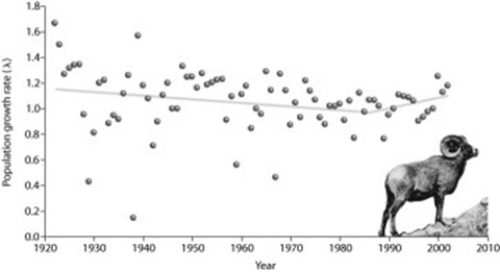 According to the figure, what is the most accurate explanation for the data after 1985?
 (Multiple Choice)
4.9/5 (74)
(74) Use the following figure to answer the question.
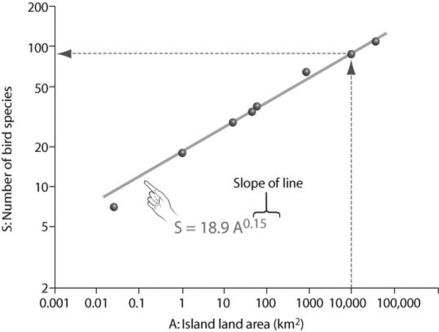 In looking at the species-area plot in the figure, what can be concluded?
 (Multiple Choice)
4.9/5 (91)
(91) The human impact that scientists determined has caused the most extinctions on record is ________, and beyond further losses from this impact, the other impact with the largest potential to cause future extinctions is ________.
(Multiple Choice)
4.8/5 (81)
(81) Ecosystem services include processes that increase the quality of the abiotic environment. Which of the following processes would fall under this category?
(Multiple Choice)
4.9/5 (87)
(87) Which of the following outcomes is caused by excessive nutrient runoff into aquatic ecosystems?
(Multiple Choice)
4.8/5 (81)
(81) Use the following figure to answer the question.
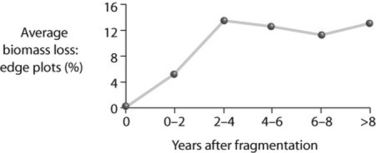 Looking at the figure showing the results of forest fragmentation, what can be said about edge effects?
 (Multiple Choice)
4.7/5 (61)
(61) Which of the following is a consequence of biological magnification?
(Multiple Choice)
4.9/5 (70)
(70) Of the following statements about protected areas that have been established to preserve biodiversity, which one is not correct?
(Multiple Choice)
4.8/5 (75)
(75) What is the biggest problem with selecting a site for a reserve?
(Multiple Choice)
4.8/5 (79)
(79) Managing southeastern forests specifically for the red-cockaded woodpecker ________.
(Multiple Choice)
4.7/5 (77)
(77) One characteristic that distinguishes a population in an extinction vortex from most other populations is that
(Multiple Choice)
4.7/5 (75)
(75) If all individuals in the last remaining population of a particular frog species were all highly related, which type of diversity would be of greatest concern when planning to prevent the species from going extinct?
(Multiple Choice)
4.8/5 (74)
(74) A parasitic fungus, Geomyces destructans, has decimated millions of bats in the United States since it was first observed in upstate New York in 2006. The disease has been named white-nose syndrome because of the white fungal hyphae that cover the bat upon infection. It is believed that this fungus was introduced from Europe by tourists entering into caves with hibernating bat populations. Which prediction most likely reflects changes that will occur in natural communities as a result of massive bat mortality?
(Multiple Choice)
4.8/5 (85)
(85) Which of the following threats to biodiversity is targeted at specific species rather than groups of species?
(Multiple Choice)
5.0/5 (77)
(77) Brown-headed cowbirds utilize fragmented forests effectively by ________.
(Multiple Choice)
4.9/5 (68)
(68) To better comprehend the magnitude of current extinctions, it will be necessary to ________.
(Multiple Choice)
4.9/5 (81)
(81) 
Filters
- Essay(0)
- Multiple Choice(0)
- Short Answer(0)
- True False(0)
- Matching(0)