



 Chat with AI
Exam 56: Conservation Biology and Global Change

Exam 1: Evolution, the Themes of Biology, and Scientific Inquiry51 Questions
Exam 2: The Chemical Context of Life61 Questions
Exam 3: Water and Life55 Questions
Exam 4: Carbon and the Molecular Diversity of Life58 Questions
Exam 5: The Structure and Function of Large Biological Molecules70 Questions
Exam 6: A Tour of the Cell66 Questions
Exam 7: Membrane Structure and Function68 Questions
Exam 8: An Introduction to Metabolism67 Questions
Exam 9: Cellular Respiration and Fermentation68 Questions
Exam 10: Photosynthesis65 Questions
Exam 11: Cell Communication65 Questions
Exam 12: The Cell Cycle66 Questions
Exam 13: Meiosis and Sexual Life Cycles64 Questions
Exam 14: Mendel and the Gene Idea62 Questions
Exam 15: The Chromosomal Basis of Inheritance58 Questions
Exam 16: The Molecular Basis of Inheritance65 Questions
Exam 17: Gene Expression: From Gene to Protein67 Questions
Exam 18: Regulation of Gene Expression66 Questions
Exam 19: Viruses54 Questions
Exam 20: DNA Tools and Biotechnology57 Questions
Exam 21: Genomes and Their Evolution44 Questions
Exam 22: Descent with Modification: A Darwinian View of Life60 Questions
Exam 23: The Evolution of Populations64 Questions
Exam 24: The Origin of Species67 Questions
Exam 25: The History of Life on Earth59 Questions
Exam 26: Phylogeny and the Tree of Life75 Questions
Exam 27: Bacteria and Archaea75 Questions
Exam 28: Protists79 Questions
Exam 29: Plant Diversity I: How Plants Colonized Land82 Questions
Exam 30: Plant Diversity II: The Evolution of Seed Plants80 Questions
Exam 31: Fungi75 Questions
Exam 32: An Overview of Animal Diversity67 Questions
Exam 33: An Introduction to Invertebrates83 Questions
Exam 34: The Origin and Evolution of Vertebrates82 Questions
Exam 35: Vascular Plant Structure, Growth, and Development65 Questions
Exam 36: Resource Acquisition and Transport in Vascular Plants74 Questions
Exam 37: Soil and Plant Nutrition52 Questions
Exam 38: Angiosperm Reproduction and Biotechnology60 Questions
Exam 39: Plant Responses to Internal and External Signals61 Questions
Exam 40: Basic Principles of Animal Form and Function68 Questions
Exam 41: Animal Nutrition64 Questions
Exam 42: Circulation and Gas Exchange67 Questions
Exam 43: The Immune System69 Questions
Exam 44: Osmoregulation and Excretion64 Questions
Exam 45: Hormones and the Endocrine System66 Questions
Exam 46: Animal Reproduction68 Questions
Exam 47: Animal Development70 Questions
Exam 48: Neurons, Synapses, and Signaling68 Questions
Exam 49: Nervous Systems65 Questions
Exam 50: Sensory and Motor Mechanisms67 Questions
Exam 51: Animal Behavior69 Questions
Exam 52: An Introduction to Ecology and the Biosphere68 Questions
Exam 53: Population Ecology69 Questions
Exam 54: Community Ecology71 Questions
Exam 55: Ecosystems and Restoration Ecology68 Questions
Exam 56: Conservation Biology and Global Change69 Questions
Select questions type


A land developer and several ecologists are discussing how a parcel of private land should be developed with housing while saving 20 hectares as natural habitat. The land developer suggests that the 20 hectares be divided into 20 separate 1-hectare areas, spread out across the area. The ecologists suggest that it would be better to have one intact parcel of 20 hectares on one side of the larger area. What is the significance of these different arrangements of the 20 hectares?
(Multiple Choice)
4.7/5  (74)
(74) Use the graphs to answer the question.
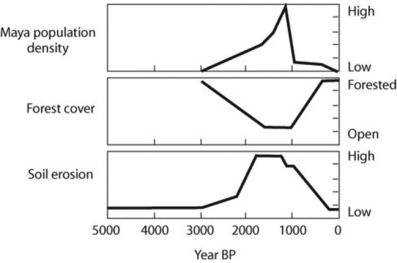 Archeological, fossil, and geological data provide information on the Mayan populations and their environment in Mexico, in the Caribbean state of Yucatán. The graphs depict population size, percentage of the land that was forested, and the amount of soil erosion. Based on the figure, what can you conclude about the history of land use in the southern Yucatán?
 (Multiple Choice)
4.7/5 (83)
(83) Which of the following statements regarding extinction is accurate?
(Multiple Choice)
4.8/5 (84)
(84) Erwin and Scott used an insecticidal fog to knock down insects from the top section of a L. seemannii tree. The researchers identified over 900 species of beetles among the individuals that fell. Erwin also projected that this entire tree from top to bottom is host to about 600 arthropod species that are unique to this tree species and not found on any other tree species. There are approximately 50,000 species of tropical trees. Although it could not be entirely accurate, what would be the best way to estimate the total number of arthropod species?
(Multiple Choice)
4.9/5 (71)
(71) Loss of biodiversity matters not only with regard to mammals or other vertebrates, but also microbes. Why are microbes worthy of discovery and protection from extinction?
(Multiple Choice)
5.0/5 (83)
(83) The main cause of the increase in the amount of carbon dioxide in Earth's atmosphere over the past 150 years is ________.
(Multiple Choice)
4.7/5 (66)
(66) Which of the following factors could cause the largest increase in the effective population size of a species?
(Multiple Choice)
4.9/5 (79)
(79) Which of the following strategies would most rapidly increase the genetic diversity of a population in an extinction vortex?
(Multiple Choice)
4.9/5 (83)
(83) Use the following figure to answer the question.
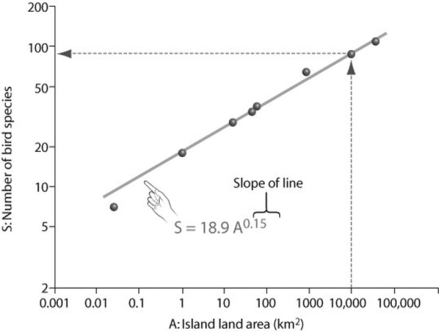 Based on the species-area plot in the figure, if habitable area on an island were reduced from 10,000 square kilometers (km²)to 1,000 km², roughly what percentage of the species would disappear?
 (Multiple Choice)
4.8/5 (80)
(80) Which of the following strategies would most rapidly increase the genetic diversity of a population in an extinction vortex?
(Multiple Choice)
4.9/5 (82)
(82) What is the biological significance of genetic diversity between populations?
(Multiple Choice)
4.8/5 (89)
(89) Use the following figure to answer the question.
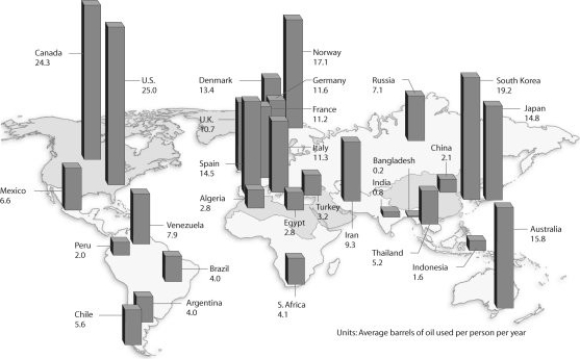 Examine the figure, which notes the average barrels of oil used per person per year in different countries. What can be concluded?
 (Multiple Choice)
4.8/5 (81)
(81) Easter Island is an extremely isolated island in the Pacific, about 3,500 km from South America. Although there are no forests on the island now, archeological studies, fossil pollen, and other data show that Easter Island was once home to forests containing giant palms and other trees. Some scientists think that the removal of the giant palms caused the forest ecosystem to collapse. Which of the following factors might have caused this collapse?
(Multiple Choice)
4.9/5 (79)
(79) What strategy was used to rescue Illinois prairie chickens from a recent extinction vortex?
(Multiple Choice)
4.9/5 (78)
(78) Which of the following observations provides the best evidence of a biodiversity crisis?
(Multiple Choice)
4.9/5 (72)
(72) Suppose you attend a town meeting at which some experts tell the audience that they have performed a cost-benefit analysis of a proposed transit system that would probably reduce overall air pollution and fossil fuel consumption. The analysis, however, reveals that ticket prices will not cover the cost of operating the system when fuel, wages, and equipment are taken into account. As a biologist, you know that if ecosystem services had been included in the analysis, the experts might have arrived at a different answer. Why are ecosystem services rarely included in economic analyses?
(Multiple Choice)
4.7/5 (74)
(74) Use the following figure to answer the question.
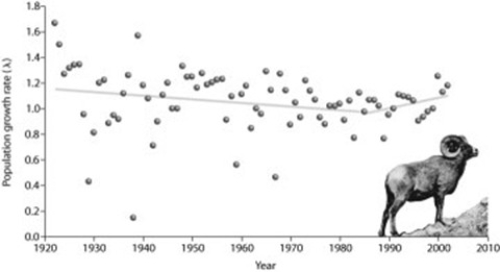 According to the figure, which two consecutive years had the largest change in the population growth rate?
 (Multiple Choice)
4.8/5 (74)
(74) Which of the following conditions is the most likely indicator of a population in an extinction vortex?
(Multiple Choice)
5.0/5 (82)
(82) 
Filters
- Essay(0)
- Multiple Choice(0)
- Short Answer(0)
- True False(0)
- Matching(0)