



 Chat with AI
Exam 50: Sensory and Motor Mechanisms

Exam 1: Evolution, the Themes of Biology, and Scientific Inquiry51 Questions
Exam 2: The Chemical Context of Life61 Questions
Exam 3: Water and Life55 Questions
Exam 4: Carbon and the Molecular Diversity of Life58 Questions
Exam 5: The Structure and Function of Large Biological Molecules70 Questions
Exam 6: A Tour of the Cell66 Questions
Exam 7: Membrane Structure and Function68 Questions
Exam 8: An Introduction to Metabolism67 Questions
Exam 9: Cellular Respiration and Fermentation68 Questions
Exam 10: Photosynthesis65 Questions
Exam 11: Cell Communication65 Questions
Exam 12: The Cell Cycle66 Questions
Exam 13: Meiosis and Sexual Life Cycles64 Questions
Exam 14: Mendel and the Gene Idea62 Questions
Exam 15: The Chromosomal Basis of Inheritance58 Questions
Exam 16: The Molecular Basis of Inheritance65 Questions
Exam 17: Gene Expression: From Gene to Protein67 Questions
Exam 18: Regulation of Gene Expression66 Questions
Exam 19: Viruses54 Questions
Exam 20: DNA Tools and Biotechnology57 Questions
Exam 21: Genomes and Their Evolution44 Questions
Exam 22: Descent with Modification: A Darwinian View of Life60 Questions
Exam 23: The Evolution of Populations64 Questions
Exam 24: The Origin of Species67 Questions
Exam 25: The History of Life on Earth59 Questions
Exam 26: Phylogeny and the Tree of Life75 Questions
Exam 27: Bacteria and Archaea75 Questions
Exam 28: Protists79 Questions
Exam 29: Plant Diversity I: How Plants Colonized Land82 Questions
Exam 30: Plant Diversity II: The Evolution of Seed Plants80 Questions
Exam 31: Fungi75 Questions
Exam 32: An Overview of Animal Diversity67 Questions
Exam 33: An Introduction to Invertebrates83 Questions
Exam 34: The Origin and Evolution of Vertebrates82 Questions
Exam 35: Vascular Plant Structure, Growth, and Development65 Questions
Exam 36: Resource Acquisition and Transport in Vascular Plants74 Questions
Exam 37: Soil and Plant Nutrition52 Questions
Exam 38: Angiosperm Reproduction and Biotechnology60 Questions
Exam 39: Plant Responses to Internal and External Signals61 Questions
Exam 40: Basic Principles of Animal Form and Function68 Questions
Exam 41: Animal Nutrition64 Questions
Exam 42: Circulation and Gas Exchange67 Questions
Exam 43: The Immune System69 Questions
Exam 44: Osmoregulation and Excretion64 Questions
Exam 45: Hormones and the Endocrine System66 Questions
Exam 46: Animal Reproduction68 Questions
Exam 47: Animal Development70 Questions
Exam 48: Neurons, Synapses, and Signaling68 Questions
Exam 49: Nervous Systems65 Questions
Exam 50: Sensory and Motor Mechanisms67 Questions
Exam 51: Animal Behavior69 Questions
Exam 52: An Introduction to Ecology and the Biosphere68 Questions
Exam 53: Population Ecology69 Questions
Exam 54: Community Ecology71 Questions
Exam 55: Ecosystems and Restoration Ecology68 Questions
Exam 56: Conservation Biology and Global Change69 Questions
Select questions type


Although some sharks close their eyes just before they bite, their bites are on target. Researchers have noted that sharks often misdirect their bites at metal objects and that they can find batteries buried under sand. This evidence suggests that sharks keep track of their prey during the split second before they bite in the same way that
(Multiple Choice)
4.8/5  (75)
(75) The blind spot in the human retina is the location that has the collected axons of ________.
(Multiple Choice)
4.8/5 (84)
(84) During an auditory transduction, ion flow varies across the ________.
(Multiple Choice)
4.8/5 (70)
(70) How could you genetically modify an animal so that it would distinguish more shades of green?
(Multiple Choice)
4.9/5 (75)
(75) Sensory transduction of light in the vertebrate retina is accomplished by ________.
(Multiple Choice)
4.8/5 (80)
(80) Experiments with genetically altered mice showed that the mice would consume abnormally high amounts of bitter-tasting compounds in water after their ________.
(Multiple Choice)
4.8/5 (87)
(87) In a mammalian visual system, visual information is integrated at ________.
I.the lens
II.the retina
III.the optic nerve
IV.the visual cortex
(Multiple Choice)
4.8/5 (72)
(72) A given photon of light may trigger an action potential with thousands of times more energy because the signal strength is amplified by ________.
(Multiple Choice)
4.9/5 (80)
(80) Lateral inhibition via horizontal cells in the mammalian retina ________.
(Multiple Choice)
4.7/5 (75)
(75) It can be very difficult to select an angle for sneaking up to a grasshopper to catch it because grasshoppers have ________.
(Multiple Choice)
4.9/5 (84)
(84) Use the figure to answer the following question.
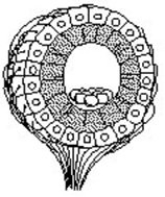 The structure diagrammed in the figure is the ________.
 (Multiple Choice)
5.0/5 (76)
(76) Most of the chemosensory neurons arising in the nasal cavity have axonal projections that terminate in the ________.
(Multiple Choice)
4.9/5 (82)
(82) Compared to oxidative skeletal muscle fibers, those classified as glycolytic typically have ________.
(Multiple Choice)
4.9/5 (83)
(83) Although some sharks close their eyes just before they bite, their bites are on target. Researchers have noted that sharks often misdirect their bites at metal objects and that they can find batteries buried under sand. This evidence suggests that sharks keep track of their prey during the split second before they bite in the same way that a ________.
(Multiple Choice)
4.8/5 (84)
(84) Action potentials in the heart move from one contractile cell to the next via ________.
(Multiple Choice)
4.8/5 (80)
(80) What structures would neurobiologists look for if they are interested in determining if an animal can see in color?
(Multiple Choice)
4.9/5 (83)
(83) 
Filters
- Essay(0)
- Multiple Choice(0)
- Short Answer(0)
- True False(0)
- Matching(0)