



 Chat with AI
Exam 47: Animal Development

Exam 1: Evolution, the Themes of Biology, and Scientific Inquiry51 Questions
Exam 2: The Chemical Context of Life61 Questions
Exam 3: Water and Life55 Questions
Exam 4: Carbon and the Molecular Diversity of Life58 Questions
Exam 5: The Structure and Function of Large Biological Molecules70 Questions
Exam 6: A Tour of the Cell66 Questions
Exam 7: Membrane Structure and Function68 Questions
Exam 8: An Introduction to Metabolism67 Questions
Exam 9: Cellular Respiration and Fermentation68 Questions
Exam 10: Photosynthesis65 Questions
Exam 11: Cell Communication65 Questions
Exam 12: The Cell Cycle66 Questions
Exam 13: Meiosis and Sexual Life Cycles64 Questions
Exam 14: Mendel and the Gene Idea62 Questions
Exam 15: The Chromosomal Basis of Inheritance58 Questions
Exam 16: The Molecular Basis of Inheritance65 Questions
Exam 17: Gene Expression: From Gene to Protein67 Questions
Exam 18: Regulation of Gene Expression66 Questions
Exam 19: Viruses54 Questions
Exam 20: DNA Tools and Biotechnology57 Questions
Exam 21: Genomes and Their Evolution44 Questions
Exam 22: Descent with Modification: A Darwinian View of Life60 Questions
Exam 23: The Evolution of Populations64 Questions
Exam 24: The Origin of Species67 Questions
Exam 25: The History of Life on Earth59 Questions
Exam 26: Phylogeny and the Tree of Life75 Questions
Exam 27: Bacteria and Archaea75 Questions
Exam 28: Protists79 Questions
Exam 29: Plant Diversity I: How Plants Colonized Land82 Questions
Exam 30: Plant Diversity II: The Evolution of Seed Plants80 Questions
Exam 31: Fungi75 Questions
Exam 32: An Overview of Animal Diversity67 Questions
Exam 33: An Introduction to Invertebrates83 Questions
Exam 34: The Origin and Evolution of Vertebrates82 Questions
Exam 35: Vascular Plant Structure, Growth, and Development65 Questions
Exam 36: Resource Acquisition and Transport in Vascular Plants74 Questions
Exam 37: Soil and Plant Nutrition52 Questions
Exam 38: Angiosperm Reproduction and Biotechnology60 Questions
Exam 39: Plant Responses to Internal and External Signals61 Questions
Exam 40: Basic Principles of Animal Form and Function68 Questions
Exam 41: Animal Nutrition64 Questions
Exam 42: Circulation and Gas Exchange67 Questions
Exam 43: The Immune System69 Questions
Exam 44: Osmoregulation and Excretion64 Questions
Exam 45: Hormones and the Endocrine System66 Questions
Exam 46: Animal Reproduction68 Questions
Exam 47: Animal Development70 Questions
Exam 48: Neurons, Synapses, and Signaling68 Questions
Exam 49: Nervous Systems65 Questions
Exam 50: Sensory and Motor Mechanisms67 Questions
Exam 51: Animal Behavior69 Questions
Exam 52: An Introduction to Ecology and the Biosphere68 Questions
Exam 53: Population Ecology69 Questions
Exam 54: Community Ecology71 Questions
Exam 55: Ecosystems and Restoration Ecology68 Questions
Exam 56: Conservation Biology and Global Change69 Questions
Select questions type


Use the following information to answer the question.
In order to test how sea urchin sperm bind to eggs, scientists isolated the egg receptor protein that binds to the sperm acrosomal protein called bindin. Plastic beads were coated with egg receptor for bindin (ERB1)from eggs of the sea urchin Strongylocentrotus purpuratus, and then the beads mixed with sperm from S. purpuratus or from the related species, S. franciscanus. The researchers counted how many sperm were bound to each bead. The results are shown in the graph below. (Adapted from Kamei and Glabe 2003)
Treatments:
A: S. purpuratus sperm mixed with S. purpuratus ERB1 beads
B: S. purpuratus sperm mixed with beads containing no ERB1 protein
C: S. franciscanus sperm mixed with S. purpuratus ERB1 beads
D: S. franciscanus sperm mixed with beads containing no ERB1 protein
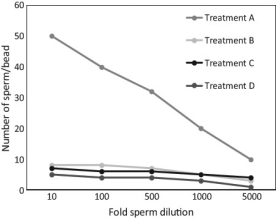 Based on the description of the experiment, which of the treatments would be considered a "control" treatment for S. purpuratus sperm binding?
 (Multiple Choice)
4.8/5  (89)
(89) From earliest to latest, the overall sequence of early development proceeds in which of the following sequences?
(Multiple Choice)
4.9/5 (83)
(83) Cells transplanted from the neural tube of a frog embryo to the ventral part of another embryo develop into nervous system tissues. This result indicates that the transplanted cells were
(Multiple Choice)
4.9/5 (73)
(73) The cortical reaction of sea urchin eggs functions directly in
(Multiple Choice)
4.9/5 (84)
(84) One primary factor in shaping the polarity of the body axes in chick embryos is ________.
(Multiple Choice)
4.8/5 (82)
(82) In sea urchins, the "fast block" and the longer lasting "slow block" to polyspermy, respectively, are ________.
(Multiple Choice)
4.9/5 (83)
(83) If an amphibian zygote is manipulated so that the first cleavage plane fails to divide the gray crescent, then ________.
(Multiple Choice)
4.9/5 (78)
(78) The archenteron of the developing sea urchin eventually develops into the ________.
(Multiple Choice)
4.9/5 (78)
(78) Which of the following correctly displays the sequence of developmental milestones?
(Multiple Choice)
4.7/5 (68)
(68) Cells move to new positions as an embryo establishes its three germ tissue layers during ________.
(Multiple Choice)
4.8/5 (80)
(80) The cortical reaction of sea urchin eggs functions directly in ________.
(Multiple Choice)
4.8/5 (75)
(75) In mammalian eggs, the receptors for sperm are found in the ________.
(Multiple Choice)
4.9/5 (69)
(69) Use the following information to answer the question.
In order to test how sea urchin sperm bind to eggs, scientists isolated the egg receptor protein that binds to the sperm acrosomal protein called bindin. Plastic beads were coated with egg receptor for bindin (ERB1)from eggs of the sea urchin Strongylocentrotus purpuratus, and then the beads mixed with sperm from S. purpuratus or from the related species, S. franciscanus. The researchers counted how many sperm were bound to each bead. The results are shown in the graph below. (Adapted from Kamei and Glabe 2003)
Treatments:
A: S. purpuratus sperm mixed with S. purpuratus ERB1 beads
B: S. purpuratus sperm mixed with beads containing no ERB1 protein
C: S. franciscanus sperm mixed with S. purpuratus ERB1 beads
D: S. franciscanus sperm mixed with beads containing no ERB1 protein
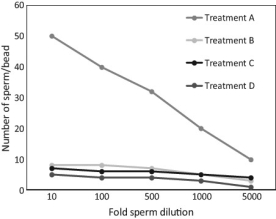 Based on the data in the graph, which of the following conclusions is supported?
 (Multiple Choice)
4.8/5 (74)
(74) Which of the following is common to the development of both birds and mammals?
(Multiple Choice)
4.9/5 (71)
(71) 
Filters
- Essay(0)
- Multiple Choice(0)
- Short Answer(0)
- True False(0)
- Matching(0)