Multiple Choice
Use the following information to answer the question.
In order to test how sea urchin sperm bind to eggs, scientists isolated the egg receptor protein that binds to the sperm acrosomal protein called bindin. Plastic beads were coated with egg receptor for bindin (ERB1) from eggs of the sea urchin Strongylocentrotus purpuratus, and then the beads mixed with sperm from S. purpuratus or from the related species, S. franciscanus. The researchers counted how many sperm were bound to each bead. The results are shown in the graph below. (Adapted from Kamei and Glabe 2003)
Treatments:
A: S. purpuratus sperm mixed with S. purpuratus ERB1 beads
B: S. purpuratus sperm mixed with beads containing no ERB1 protein
C: S. franciscanus sperm mixed with S. purpuratus ERB1 beads
D: S. franciscanus sperm mixed with beads containing no ERB1 protein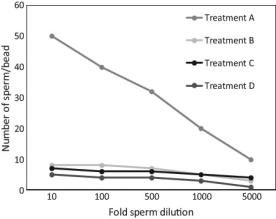
Based on the data in the graph, which of the following conclusions is supported?
A) Plastic beads will bind to sperm from both species of sea urchin.
B) ERB1 prevents S. franciscanus sperm from binding the beads.
C) Sperm from S. purpuratus bind to beads only if ERB1 is present.
D) S. franciscanus and S. purpuratus are actually the same species.
Correct Answer:

Verified
Correct Answer:
Verified
Q1: Cell migration occurs extensively during _.<br>A) organogenesis,
Q14: At the time of implantation, the human
Q19: In which of the following organisms does
Q20: Cells transplanted from the neural tube of
Q21: The cortical reaction of sea urchin eggs
Q44: In mammalian eggs, the receptors for sperm
Q47: The migratory neural crest cells _.<br>A) form
Q49: In a frog embryo, gastrulation _.<br>A) produces
Q59: In humans, identical twins are possible because
Q64: Which of the following is common to