



 Chat with AI
Exam 42: Circulation and Gas Exchange

Exam 1: Evolution, the Themes of Biology, and Scientific Inquiry51 Questions
Exam 2: The Chemical Context of Life61 Questions
Exam 3: Water and Life55 Questions
Exam 4: Carbon and the Molecular Diversity of Life58 Questions
Exam 5: The Structure and Function of Large Biological Molecules70 Questions
Exam 6: A Tour of the Cell66 Questions
Exam 7: Membrane Structure and Function68 Questions
Exam 8: An Introduction to Metabolism67 Questions
Exam 9: Cellular Respiration and Fermentation68 Questions
Exam 10: Photosynthesis65 Questions
Exam 11: Cell Communication65 Questions
Exam 12: The Cell Cycle66 Questions
Exam 13: Meiosis and Sexual Life Cycles64 Questions
Exam 14: Mendel and the Gene Idea62 Questions
Exam 15: The Chromosomal Basis of Inheritance58 Questions
Exam 16: The Molecular Basis of Inheritance65 Questions
Exam 17: Gene Expression: From Gene to Protein67 Questions
Exam 18: Regulation of Gene Expression66 Questions
Exam 19: Viruses54 Questions
Exam 20: DNA Tools and Biotechnology57 Questions
Exam 21: Genomes and Their Evolution44 Questions
Exam 22: Descent with Modification: A Darwinian View of Life60 Questions
Exam 23: The Evolution of Populations64 Questions
Exam 24: The Origin of Species67 Questions
Exam 25: The History of Life on Earth59 Questions
Exam 26: Phylogeny and the Tree of Life75 Questions
Exam 27: Bacteria and Archaea75 Questions
Exam 28: Protists79 Questions
Exam 29: Plant Diversity I: How Plants Colonized Land82 Questions
Exam 30: Plant Diversity II: The Evolution of Seed Plants80 Questions
Exam 31: Fungi75 Questions
Exam 32: An Overview of Animal Diversity67 Questions
Exam 33: An Introduction to Invertebrates83 Questions
Exam 34: The Origin and Evolution of Vertebrates82 Questions
Exam 35: Vascular Plant Structure, Growth, and Development65 Questions
Exam 36: Resource Acquisition and Transport in Vascular Plants74 Questions
Exam 37: Soil and Plant Nutrition52 Questions
Exam 38: Angiosperm Reproduction and Biotechnology60 Questions
Exam 39: Plant Responses to Internal and External Signals61 Questions
Exam 40: Basic Principles of Animal Form and Function68 Questions
Exam 41: Animal Nutrition64 Questions
Exam 42: Circulation and Gas Exchange67 Questions
Exam 43: The Immune System69 Questions
Exam 44: Osmoregulation and Excretion64 Questions
Exam 45: Hormones and the Endocrine System66 Questions
Exam 46: Animal Reproduction68 Questions
Exam 47: Animal Development70 Questions
Exam 48: Neurons, Synapses, and Signaling68 Questions
Exam 49: Nervous Systems65 Questions
Exam 50: Sensory and Motor Mechanisms67 Questions
Exam 51: Animal Behavior69 Questions
Exam 52: An Introduction to Ecology and the Biosphere68 Questions
Exam 53: Population Ecology69 Questions
Exam 54: Community Ecology71 Questions
Exam 55: Ecosystems and Restoration Ecology68 Questions
Exam 56: Conservation Biology and Global Change69 Questions
Select questions type


During aerobic exercise, the partial pressure of oxygen in muscle cells will ________, thus the rate of diffusion of oxygen into the muscle tissue from the blood will ________.
(Multiple Choice)
5.0/5  (90)
(90) You cut your finger, and after putting pressure on the wound for several minutes, you notice that it is still bleeding profusely. What may be the problem?
(Multiple Choice)
4.9/5 (75)
(75) A human red blood cell in an artery of the left arm is on its way to deliver oxygen to a cell in the thumb. To travel from the artery to the thumb and then back to the left ventricle, this red blood cell must pass through ________.
(Multiple Choice)
4.8/5 (93)
(93) ________ is a hormone that is released from the ________ to stimulate the production of red blood cells.
(Multiple Choice)
4.9/5 (70)
(70) Countercurrent exchange in the fish gill helps to maximize ________.
(Multiple Choice)
4.7/5 (75)
(75) To become bound to hemoglobin for transport in mammals, atmospheric molecules of oxygen must cross ________.
(Multiple Choice)
4.8/5 (77)
(77) Compared with the interstitial fluid that bathes active muscle cells, blood reaching these cells in arterioles has a
(Multiple Choice)
5.0/5 (70)
(70) The sun shining on a tidal pool during a hot day heats the water, causing some water to evaporate. Because the water has become warmer and saltier, ________.
(Multiple Choice)
4.9/5 (79)
(79) Compared to mammals that are not adapted for diving, diving mammals ________.
(Multiple Choice)
5.0/5 (80)
(80) A rabbit taken from a meadow near sea level and moved to a meadow high on a mountainside would have some trouble breathing. Why?
(Multiple Choice)
4.9/5 (80)
(80) Which of the following respiratory systems is not closely associated with a blood supply?
(Multiple Choice)
4.9/5 (84)
(84) The only vertebrates in which blood flows directly from respiratory organs to body tissues without first returning to the heart are the ________.
(Multiple Choice)
4.7/5 (79)
(79) Based on the graph, which of the following statements is correct?
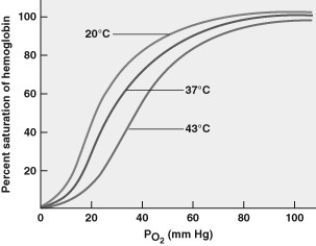
(Multiple Choice)
4.8/5 (70)
(70) Which of the following would you expect of a species that has a high resting cardiac output?
(Multiple Choice)
4.9/5 (89)
(89) While jogging, a person has a stroke volume of 130 ml/beat and a heart rate of 120 beats per minute. If their resting stroke volume was 70 ml/beat and resting heart rate was 60 beats per minute, how did this person's cardiac output change?
(Multiple Choice)
4.9/5 (83)
(83) When you hold your breath, which of the following blood gas changes first leads to the urge to breathe?
(Multiple Choice)
4.8/5 (83)
(83) Consider the following reaction. If the pH of the blood was decreased, then the ________.
CO₂ + H₂O  H₂CO₃
 HCO₃⁻ + H⁺
H₂CO₃ HCO₃⁻ + H⁺ (Multiple Choice)
4.8/5 (88)
(88) Although having evolved independently, the tracheal tubes of mammals and insects are both supported by rigid tissues. The trachea of a mammal is supported by cartilage, and the tracheae of an insect are supported by chitin. What selective pressure most likely led to the convergent evolution of these respiratory structures?
(Multiple Choice)
4.9/5 (94)
(94) During most daily activities, the human respiration rate is most closely linked to the blood levels of ________.
(Multiple Choice)
4.9/5 (79)
(79) 
Filters
- Essay(0)
- Multiple Choice(0)
- Short Answer(0)
- True False(0)
- Matching(0)