



 Chat with AI
Exam 29: Plant Diversity I: How Plants Colonized Land

Exam 1: Evolution, the Themes of Biology, and Scientific Inquiry51 Questions
Exam 2: The Chemical Context of Life61 Questions
Exam 3: Water and Life55 Questions
Exam 4: Carbon and the Molecular Diversity of Life58 Questions
Exam 5: The Structure and Function of Large Biological Molecules70 Questions
Exam 6: A Tour of the Cell66 Questions
Exam 7: Membrane Structure and Function68 Questions
Exam 8: An Introduction to Metabolism67 Questions
Exam 9: Cellular Respiration and Fermentation68 Questions
Exam 10: Photosynthesis65 Questions
Exam 11: Cell Communication65 Questions
Exam 12: The Cell Cycle66 Questions
Exam 13: Meiosis and Sexual Life Cycles64 Questions
Exam 14: Mendel and the Gene Idea62 Questions
Exam 15: The Chromosomal Basis of Inheritance58 Questions
Exam 16: The Molecular Basis of Inheritance65 Questions
Exam 17: Gene Expression: From Gene to Protein67 Questions
Exam 18: Regulation of Gene Expression66 Questions
Exam 19: Viruses54 Questions
Exam 20: DNA Tools and Biotechnology57 Questions
Exam 21: Genomes and Their Evolution44 Questions
Exam 22: Descent with Modification: A Darwinian View of Life60 Questions
Exam 23: The Evolution of Populations64 Questions
Exam 24: The Origin of Species67 Questions
Exam 25: The History of Life on Earth59 Questions
Exam 26: Phylogeny and the Tree of Life75 Questions
Exam 27: Bacteria and Archaea75 Questions
Exam 28: Protists79 Questions
Exam 29: Plant Diversity I: How Plants Colonized Land82 Questions
Exam 30: Plant Diversity II: The Evolution of Seed Plants80 Questions
Exam 31: Fungi75 Questions
Exam 32: An Overview of Animal Diversity67 Questions
Exam 33: An Introduction to Invertebrates83 Questions
Exam 34: The Origin and Evolution of Vertebrates82 Questions
Exam 35: Vascular Plant Structure, Growth, and Development65 Questions
Exam 36: Resource Acquisition and Transport in Vascular Plants74 Questions
Exam 37: Soil and Plant Nutrition52 Questions
Exam 38: Angiosperm Reproduction and Biotechnology60 Questions
Exam 39: Plant Responses to Internal and External Signals61 Questions
Exam 40: Basic Principles of Animal Form and Function68 Questions
Exam 41: Animal Nutrition64 Questions
Exam 42: Circulation and Gas Exchange67 Questions
Exam 43: The Immune System69 Questions
Exam 44: Osmoregulation and Excretion64 Questions
Exam 45: Hormones and the Endocrine System66 Questions
Exam 46: Animal Reproduction68 Questions
Exam 47: Animal Development70 Questions
Exam 48: Neurons, Synapses, and Signaling68 Questions
Exam 49: Nervous Systems65 Questions
Exam 50: Sensory and Motor Mechanisms67 Questions
Exam 51: Animal Behavior69 Questions
Exam 52: An Introduction to Ecology and the Biosphere68 Questions
Exam 53: Population Ecology69 Questions
Exam 54: Community Ecology71 Questions
Exam 55: Ecosystems and Restoration Ecology68 Questions
Exam 56: Conservation Biology and Global Change69 Questions
Select questions type


The 1-meter height attainable by Dawsonia moss is at the upper end of the size range reached by mosses. What accounts for the relative tallness of Dawsonia?
(Multiple Choice)
4.8/5  (92)
(92) If the kingdom Plantae is someday expanded to include the charophytes (stoneworts), then the shared derived characteristics of the kingdom will include ________.
(Multiple Choice)
4.9/5 (71)
(71) Which of the following characteristics of plants is absent in their closest relatives, the charophyte algae?
(Multiple Choice)
4.7/5 (83)
(83) According to the fossil record, plants colonized terrestrial habitats ________.
(Multiple Choice)
4.9/5 (79)
(79) Moss sporophytes are typically green when young, but turn brown when ready to release their spores. This observation would lead you to think that the ________.
(Multiple Choice)
4.8/5 (71)
(71) Assuming equal spore production rates, what is the likely consequence in a bryophyte with both asexual and sexual reproduction versus one with only sexual reproduction?
(Multiple Choice)
4.8/5 (80)
(80) Compared to nonvascular plants, the ancient relatives of vascular plants ________.
(Multiple Choice)
4.7/5 (79)
(79) According to our current knowledge of plant evolution, which group of organisms should feature cell division most similar to that of land plants?
(Multiple Choice)
4.9/5 (85)
(85) The structural integrity of bacteria is to peptidoglycan as the structural integrity of plant spores is to ________.
(Multiple Choice)
4.7/5 (77)
(77) Breeuwer et al. (2008)measured the effect of different temperature regimes on the growth of different Sphagnum species. The growth of S. fuscum at four temperatures is shown. Use the information in the graph to answer the following question.
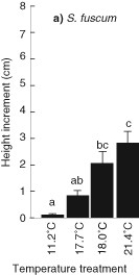 Which of the following statements accurately reflects the effect of temperature on the growth of S. fuscum?
 (Multiple Choice)
4.8/5 (78)
(78) If animals had alternation of generations like plants, ________.
(Multiple Choice)
4.9/5 (69)
(69) The fact that both charophytes and green plants contain chlorophylls a and b demonstrates which of the following?
(Multiple Choice)
5.0/5 (84)
(84) Assuming that they all belong to the same plant, which of the following sequences describes structures from largest to smallest?
(Multiple Choice)
4.9/5 (80)
(80) As you stroll through a moist forest, you are most likely to see a ________.
(Multiple Choice)
4.8/5 (84)
(84) About 450 million years ago, the terrestrial landscape on Earth would have ________.
(Multiple Choice)
4.8/5 (64)
(64) Why have biologists hypothesized that the first land plants had a low, sprawling growth habit?
(Multiple Choice)
4.9/5 (79)
(79) 
Filters
- Essay(0)
- Multiple Choice(0)
- Short Answer(0)
- True False(0)
- Matching(0)