



 Chat with AI
Exam 29: Plant Diversity I: How Plants Colonized Land

Exam 1: Evolution, the Themes of Biology, and Scientific Inquiry51 Questions
Exam 2: The Chemical Context of Life61 Questions
Exam 3: Water and Life55 Questions
Exam 4: Carbon and the Molecular Diversity of Life58 Questions
Exam 5: The Structure and Function of Large Biological Molecules70 Questions
Exam 6: A Tour of the Cell66 Questions
Exam 7: Membrane Structure and Function68 Questions
Exam 8: An Introduction to Metabolism67 Questions
Exam 9: Cellular Respiration and Fermentation68 Questions
Exam 10: Photosynthesis65 Questions
Exam 11: Cell Communication65 Questions
Exam 12: The Cell Cycle66 Questions
Exam 13: Meiosis and Sexual Life Cycles64 Questions
Exam 14: Mendel and the Gene Idea62 Questions
Exam 15: The Chromosomal Basis of Inheritance58 Questions
Exam 16: The Molecular Basis of Inheritance65 Questions
Exam 17: Gene Expression: From Gene to Protein67 Questions
Exam 18: Regulation of Gene Expression66 Questions
Exam 19: Viruses54 Questions
Exam 20: DNA Tools and Biotechnology57 Questions
Exam 21: Genomes and Their Evolution44 Questions
Exam 22: Descent with Modification: A Darwinian View of Life60 Questions
Exam 23: The Evolution of Populations64 Questions
Exam 24: The Origin of Species67 Questions
Exam 25: The History of Life on Earth59 Questions
Exam 26: Phylogeny and the Tree of Life75 Questions
Exam 27: Bacteria and Archaea75 Questions
Exam 28: Protists79 Questions
Exam 29: Plant Diversity I: How Plants Colonized Land82 Questions
Exam 30: Plant Diversity II: The Evolution of Seed Plants80 Questions
Exam 31: Fungi75 Questions
Exam 32: An Overview of Animal Diversity67 Questions
Exam 33: An Introduction to Invertebrates83 Questions
Exam 34: The Origin and Evolution of Vertebrates82 Questions
Exam 35: Vascular Plant Structure, Growth, and Development65 Questions
Exam 36: Resource Acquisition and Transport in Vascular Plants74 Questions
Exam 37: Soil and Plant Nutrition52 Questions
Exam 38: Angiosperm Reproduction and Biotechnology60 Questions
Exam 39: Plant Responses to Internal and External Signals61 Questions
Exam 40: Basic Principles of Animal Form and Function68 Questions
Exam 41: Animal Nutrition64 Questions
Exam 42: Circulation and Gas Exchange67 Questions
Exam 43: The Immune System69 Questions
Exam 44: Osmoregulation and Excretion64 Questions
Exam 45: Hormones and the Endocrine System66 Questions
Exam 46: Animal Reproduction68 Questions
Exam 47: Animal Development70 Questions
Exam 48: Neurons, Synapses, and Signaling68 Questions
Exam 49: Nervous Systems65 Questions
Exam 50: Sensory and Motor Mechanisms67 Questions
Exam 51: Animal Behavior69 Questions
Exam 52: An Introduction to Ecology and the Biosphere68 Questions
Exam 53: Population Ecology69 Questions
Exam 54: Community Ecology71 Questions
Exam 55: Ecosystems and Restoration Ecology68 Questions
Exam 56: Conservation Biology and Global Change69 Questions
Select questions type


Which taxon is essentially equivalent to the "embryophytes"?
(Multiple Choice)
4.8/5  (87)
(87) Breeuwer et al. (2008)measured the effect of different temperature regimes on the growth of different Sphagnum species. The growth of S. fuscum at four temperatures is shown. Use the information in the graph to answer the following question.
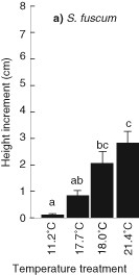 Based on the data shown, what additional conclusions can you draw?
 (Multiple Choice)
5.0/5 (72)
(72) Most moss gametophytes do not have a cuticle and are 1-2 cells thick. What does this imply about moss gametophytes and their structure?
(Multiple Choice)
4.8/5 (71)
(71) Which of the following environmental factors probably helped early plants to successfully colonize land?
(Multiple Choice)
4.9/5 (80)
(80) A student encounters a pondweed that appears to be a charophyte. Which of the following features would help the student determine whether the sample comes from a charophyte or from some other type of green alga?
(Multiple Choice)
4.9/5 (83)
(83) Two small, poorly drained lakes lie close to each other in a northern forest. The basins of both lakes are composed of the same geologic substratum. One lake is surrounded by a dense Sphagnum mat; the other is not. Compared to the pond with Sphagnum, the pond lacking the moss mat should have ________.
(Multiple Choice)
4.8/5 (74)
(74) Suppose an efficient conducting system evolved in a moss that could transport water and other materials as high as a tall tree. Which of the following statements about "trees" of such a species would be accurate?
(Multiple Choice)
4.8/5 (92)
(92) Arrange the following terms from most inclusive to least inclusive.
(Multiple Choice)
4.7/5 (97)
(97) Use the following information to answer the question.
Big Bend National Park in Texas is mostly Chihuahuan desert, where rainfall averages about 25 centimeters per year. Yet, it is not uncommon when hiking in this extremely arid zone to encounter mosses and ferns. One such plant is called "flower of stone." It is not a flowering plant, nor does it produce seeds. Under arid conditions, its leaflike structures curl up. However, when it rains, it unfurls its leaves, which form a bright green rosette on the desert floor. Consequently, it is sometimes called the "resurrection plant." At first glance, it could be a fern, a true moss, or a spike moss.
Which of the following features is most important for true mosses and ferns to reproduce in the desert?
(Multiple Choice)
4.9/5 (73)
(73) Use the following information to answer the question.
Big Bend National Park in Texas is mostly Chihuahuan desert, where rainfall averages about 25 centimeters per year. Yet, it is not uncommon when hiking in this extremely arid zone to encounter mosses and ferns. One such plant is called "flower of stone." It is not a flowering plant, nor does it produce seeds. Under arid conditions, its leaflike structures curl up. However, when it rains, it unfurls its leaves, which form a bright green rosette on the desert floor. Consequently, it is sometimes called the "resurrection plant." At first glance, it could be a fern, a true moss, or a spike moss.
Upon closer inspection of the leaves of "flower of stone," one can observe tiny, cone-like structures. Each cone-like structure emits spores of two different sizes. Further investigation also reveals that the roots of "flower of stone" branch only at the growing tip of the root, forming a Y-shaped structure. Based on these additional observations, which of the following can be properly inferred about "flower of stone"?
(Multiple Choice)
5.0/5 (90)
(90) Which of the following statements about the transition from ocean to land by plants is most likely to be accurate?
(Multiple Choice)
4.8/5 (83)
(83) The presence of vascular tissue allowed plants to ________.
(Multiple Choice)
4.9/5 (65)
(65) If you walk through an area with mosses and ferns, you are seeing ________.
(Multiple Choice)
4.8/5 (72)
(72) Which of the following could occur only after plants moved from the oceans to land?
(Multiple Choice)
4.9/5 (80)
(80) What evidence do paleobotanists look for that indicates the movement of plants from water to land?
(Multiple Choice)
4.7/5 (74)
(74) Which of the following statements about stomata is accurate?
(Multiple Choice)
4.9/5 (82)
(82) 
Filters
- Essay(0)
- Multiple Choice(0)
- Short Answer(0)
- True False(0)
- Matching(0)