



 Chat with AI
Exam 16: Externalities

Exam 1: First Principles233 Questions
Exam 2: Economic Models: Trade-Offs and Trade 25382 Questions
Exam 3: Supply and Demand290 Questions
Exam 4: Consumer and Producer Surplus224 Questions
Exam 5: Price Controls and Quotas: Meddling With Markets227 Questions
Exam 6: Elasticity300 Questions
Exam 7: Taxes298 Questions
Exam 8: International Trade272 Questions
Exam 9: Decision Making by Individuals Firms201 Questions
Exam 10: The Rational Consumer372 Questions
Exam 11: Behind the Supply Curve: Inputs and Costs362 Questions
Exam 12: Perfect Competition and the Supply Curve355 Questions
Exam 13: Monopoly350 Questions
Exam 14: Oligopoly294 Questions
Exam 15: Monopolistic Competition and Product Differentiation262 Questions
Exam 16: Externalities199 Questions
Exam 17: Public Goods Common Resources224 Questions
Exam 18: The Economics of the Welfare140 Questions
Exam 19: Factor Markets and the Distribution of Income369 Questions
Exam 20: Uncertainty, Risk, and Private Information202 Questions
Select questions type


Assume the federal government determines the total level of pollutants that can be discharged by city industries. A city is able to buy and sell the rights to this total discharge level with other cities. This is an:
(Multiple Choice)
4.7/5  (87)
(87) The idea that even in the presence of externalities an economy can reach an efficient solution as long as transaction costs of making a deal are low and property rights are well-defined is known as:
(Multiple Choice)
4.8/5 (91)
(91) Emissions taxes and tradable emissions permits both ensure that any given reduction in total pollution is achieved at the lowest possible cost. This is not the case for environmental standards, since they fail to ensure that those who can reduce pollution most cheaply are in fact the ones to do so.
(True/False)
4.7/5 (65)
(65) Use the following to answer questions:
Figure: Model of a Competitive Market 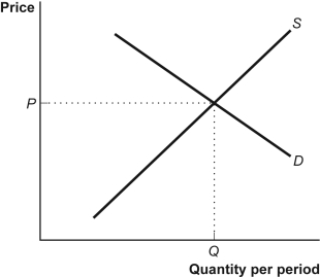 -(Figure: Model of a Competitive Market) Given the figure Model of a Competitive Market, if there are no external benefits or costs, the output at Q will be:
 (Multiple Choice)
4.8/5 (76)
(76) Use the following to answer questions:
Figure: The Socially Optimal Quantity of Pollution 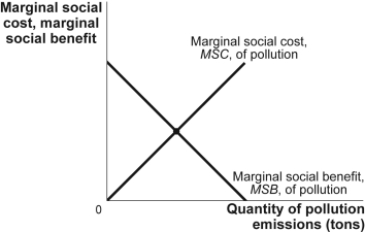 -(Figure: The Socially Optimal Quantity of Pollution) In the figure The Socially Optimal Quantity of Pollution, without government intervention:
 (Multiple Choice)
4.9/5 (88)
(88) An industry with production that generates external costs produces a quantity of output that is:
(Multiple Choice)
4.7/5 (79)
(79) Use the following to answer questions:
Figure: Efficiency and Pollution 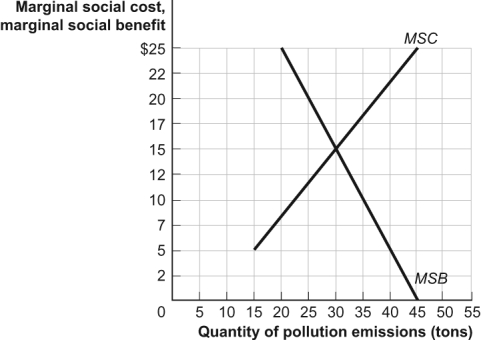 -(Figure: Efficiency and Pollution) Look at the figure Efficiency and Pollution. In the absence of government intervention, the marginal social cost of pollution will equal _____ and the marginal social benefit of pollution will equal _____.
 (Multiple Choice)
4.7/5 (78)
(78) External benefits are associated with the production of batteries. Without government regulation, the market will:
(Multiple Choice)
4.7/5 (87)
(87) Use the following to answer questions:
Figure: Efficiency and Pollution
-(Figure: Efficiency and Pollution) Look at the figure Efficiency and Pollution. If the government imposed an environmental standard that did NOT allow the quantity of pollution to exceed 40 tons, there would be:
-(Figure: Efficiency and Pollution) Look at the figure Efficiency and Pollution. If the government imposed an environmental standard that did NOT allow the quantity of pollution to exceed 40 tons, there would be: (Multiple Choice)
4.8/5 (80)
(80) Use the following to answer questions:
Figure: City with Two Polluters 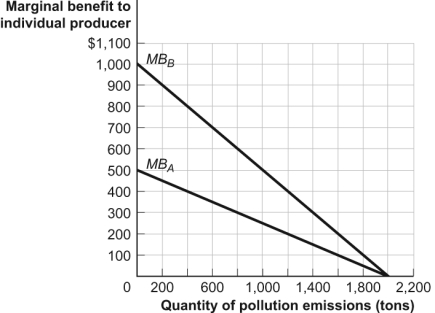 -(Figure: City with Two Polluters) Look at the figure City with Two Polluters. If the government issued licenses to emit a total of 1,600 tons of pollution, the market price to emit 1 ton of emissions would equal:
 (Multiple Choice)
4.8/5 (77)
(77) Flu vaccines often provide both private benefits to individuals and positive external benefits to other members of society. As a result, without government intervention one would find:
(Multiple Choice)
4.8/5 (84)
(84) Use the following to answer questions: 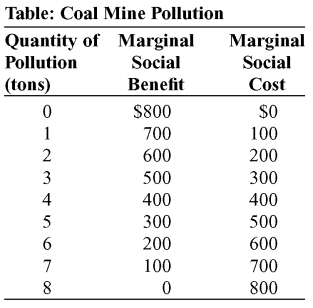 -(Table: Coal Mine Pollution) The table Coal Mine Pollution shows the marginal social benefit and cost of various amounts of pollution from a coal mine. If 5 tons of pollution is produced:
 (Multiple Choice)
4.8/5 (75)
(75) If the number of available tradable emissions permits increases, the equilibrium price of the permits _____ and the equilibrium quantity _____.
(Multiple Choice)
4.7/5 (82)
(82) The proposition that if bargaining is costless, the market can achieve an efficient outcome is the:
(Multiple Choice)
4.7/5 (88)
(88) The socially optimal amount of pollution occurs where the marginal social benefit of pollution is _____ the marginal social cost of pollution.
(Multiple Choice)
4.8/5 (81)
(81) Externalities exist when individuals impose costs or confer benefits on others but don't have an incentive to take those costs or benefits into account.
(True/False)
4.7/5 (82)
(82) 
Filters
- Essay(0)
- Multiple Choice(0)
- Short Answer(0)
- True False(0)
- Matching(0)