



 Chat with AI
Exam 16: Externalities

Exam 1: First Principles233 Questions
Exam 2: Economic Models: Trade-Offs and Trade 25382 Questions
Exam 3: Supply and Demand290 Questions
Exam 4: Consumer and Producer Surplus224 Questions
Exam 5: Price Controls and Quotas: Meddling With Markets227 Questions
Exam 6: Elasticity300 Questions
Exam 7: Taxes298 Questions
Exam 8: International Trade272 Questions
Exam 9: Decision Making by Individuals Firms201 Questions
Exam 10: The Rational Consumer372 Questions
Exam 11: Behind the Supply Curve: Inputs and Costs362 Questions
Exam 12: Perfect Competition and the Supply Curve355 Questions
Exam 13: Monopoly350 Questions
Exam 14: Oligopoly294 Questions
Exam 15: Monopolistic Competition and Product Differentiation262 Questions
Exam 16: Externalities199 Questions
Exam 17: Public Goods Common Resources224 Questions
Exam 18: The Economics of the Welfare140 Questions
Exam 19: Factor Markets and the Distribution of Income369 Questions
Exam 20: Uncertainty, Risk, and Private Information202 Questions
Select questions type


If at the current amount of pollution its marginal social benefit is greater than its marginal social cost, then there is too little pollution.
(True/False)
4.9/5  (87)
(87) Use the following to answer question:
Figure: Environmental Standards versus Emissions Taxes 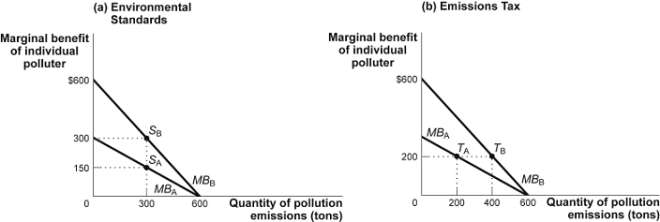 -(Figure: Environmental Standards versus Emissions Taxes) In the figure Environmental Standards versus Emissions Taxes, if the goal is to limit the total emissions of the two firms, A and B, to 600 tons, the most efficient solution is an _____, and total pollution would be _____ tons.
 (Multiple Choice)
4.9/5 (74)
(74) Use the following to answer questions:
Figure: Pollution and Efficiency  -(Figure: Pollution and Efficiency) Look at the figure Pollution and Efficiency. In this market, whose sulfur emission is a result of production, an efficient solution is one in which:
 (Multiple Choice)
4.9/5 (73)
(73) When tradable emissions permits are used, if the demand for goods that produce emissions shifts to the right, the equilibrium price of permits _____ and the equilibrium quantity _____.
(Multiple Choice)
4.9/5 (84)
(84) As the quantity of pollution rises, its marginal social cost:
(Multiple Choice)
4.9/5 (80)
(80) Given the general agreement that pollution is undesirable and social welfare is increased by reducing pollution, the optimal level of pollution in a society is:
(Multiple Choice)
4.9/5 (74)
(74) Use the following to answer questions:
Figure: Model of a Competitive Market 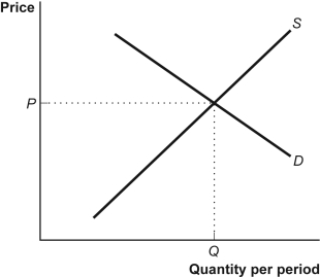 -(Figure: Model of a Competitive Market) Given the figure Model of a Competitive Market, if there are external costs, a tax imposed on sellers will:
 (Multiple Choice)
4.8/5 (86)
(86) According to the Coase theorem, when negative externalities are present, a market will:
(Multiple Choice)
4.9/5 (80)
(80) Use the following to answer questions: 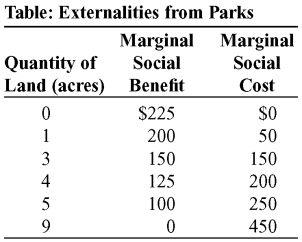 -(Table: Externalities from Parks) The table Externalities from Parks shows the marginal social benefit and the marginal social cost of preserving various amounts of land in a city for a public park. If the government wants to achieve the optimum amount of land for the park, it could use a Pigouvian _____ of _____.
 (Multiple Choice)
4.8/5 (72)
(72) If the number of available tradable emissions permits is decreased, the equilibrium price of the permits _____ and the equilibrium quantity of emissions _____.
(Multiple Choice)
4.8/5 (73)
(73) The marginal social benefit from pollution _____ as the quantity of pollution emissions _____.
(Multiple Choice)
5.0/5 (83)
(83) The principal government agency in the United States responsible for enforcing national environmental policies is the:
(Multiple Choice)
5.0/5 (72)
(72) Suppose each person in a community had to pay for his or her own education from kindergarten through high school. One would expect that:
(Multiple Choice)
4.7/5 (79)
(79) Use the following to answer questions:
-(Table: Externalities from Parks) The table Externalities from Parks shows the marginal social benefit and the marginal social cost of preserving various amounts of land in a city for a public park. Without government intervention, at the amount of land dedicated to the public park the marginal social benefit will be:
-(Table: Externalities from Parks) The table Externalities from Parks shows the marginal social benefit and the marginal social cost of preserving various amounts of land in a city for a public park. Without government intervention, at the amount of land dedicated to the public park the marginal social benefit will be: (Multiple Choice)
4.8/5 (79)
(79) The marginal social benefit received from pollution is equal to its marginal social cost in the market for highly polished glass. In this situation:
(Multiple Choice)
4.9/5 (79)
(79) If an activity generates external costs, the decision makers generating the activity will:
(Multiple Choice)
5.0/5 (76)
(76) 
Filters
- Essay(0)
- Multiple Choice(0)
- Short Answer(0)
- True False(0)
- Matching(0)