



 Chat with AI
Exam 13: Meiosis and Sexual Life Cycles

Exam 1: Evolution, the Themes of Biology, and Scientific Inquiry51 Questions
Exam 2: The Chemical Context of Life61 Questions
Exam 3: Water and Life55 Questions
Exam 4: Carbon and the Molecular Diversity of Life58 Questions
Exam 5: The Structure and Function of Large Biological Molecules70 Questions
Exam 6: A Tour of the Cell66 Questions
Exam 7: Membrane Structure and Function68 Questions
Exam 8: An Introduction to Metabolism67 Questions
Exam 9: Cellular Respiration and Fermentation68 Questions
Exam 10: Photosynthesis65 Questions
Exam 11: Cell Communication65 Questions
Exam 12: The Cell Cycle66 Questions
Exam 13: Meiosis and Sexual Life Cycles64 Questions
Exam 14: Mendel and the Gene Idea62 Questions
Exam 15: The Chromosomal Basis of Inheritance58 Questions
Exam 16: The Molecular Basis of Inheritance65 Questions
Exam 17: Gene Expression: From Gene to Protein67 Questions
Exam 18: Regulation of Gene Expression66 Questions
Exam 19: Viruses54 Questions
Exam 20: DNA Tools and Biotechnology57 Questions
Exam 21: Genomes and Their Evolution44 Questions
Exam 22: Descent with Modification: A Darwinian View of Life60 Questions
Exam 23: The Evolution of Populations64 Questions
Exam 24: The Origin of Species67 Questions
Exam 25: The History of Life on Earth59 Questions
Exam 26: Phylogeny and the Tree of Life75 Questions
Exam 27: Bacteria and Archaea75 Questions
Exam 28: Protists79 Questions
Exam 29: Plant Diversity I: How Plants Colonized Land82 Questions
Exam 30: Plant Diversity II: The Evolution of Seed Plants80 Questions
Exam 31: Fungi75 Questions
Exam 32: An Overview of Animal Diversity67 Questions
Exam 33: An Introduction to Invertebrates83 Questions
Exam 34: The Origin and Evolution of Vertebrates82 Questions
Exam 35: Vascular Plant Structure, Growth, and Development65 Questions
Exam 36: Resource Acquisition and Transport in Vascular Plants74 Questions
Exam 37: Soil and Plant Nutrition52 Questions
Exam 38: Angiosperm Reproduction and Biotechnology60 Questions
Exam 39: Plant Responses to Internal and External Signals61 Questions
Exam 40: Basic Principles of Animal Form and Function68 Questions
Exam 41: Animal Nutrition64 Questions
Exam 42: Circulation and Gas Exchange67 Questions
Exam 43: The Immune System69 Questions
Exam 44: Osmoregulation and Excretion64 Questions
Exam 45: Hormones and the Endocrine System66 Questions
Exam 46: Animal Reproduction68 Questions
Exam 47: Animal Development70 Questions
Exam 48: Neurons, Synapses, and Signaling68 Questions
Exam 49: Nervous Systems65 Questions
Exam 50: Sensory and Motor Mechanisms67 Questions
Exam 51: Animal Behavior69 Questions
Exam 52: An Introduction to Ecology and the Biosphere68 Questions
Exam 53: Population Ecology69 Questions
Exam 54: Community Ecology71 Questions
Exam 55: Ecosystems and Restoration Ecology68 Questions
Exam 56: Conservation Biology and Global Change69 Questions
Select questions type


During which of the following processes does independent assortment of chromosomes occur?
(Multiple Choice)
4.9/5  (76)
(76) For the following questions, match the key event of meiosis with the stages listed below.
I. Prophase I V. Prophase II
II. Metaphase I VI. Metaphase II
III. Anaphase I VII. Anaphase II
IV. Telophase I VIII. Telophase II
-Centromeres of sister chromatids disjoin and chromatids separate.
(Multiple Choice)
4.8/5 (78)
(78) Refer to the information and figure below to answer the following questions.
A certain (hypothetical) organism is diploid, has either blue or orange wings as the consequence of one of its genes on chromosome 12, and has either long or short antennae as the result of a second gene on chromosome 19, as shown in the figure.
 -A certain female's number 12 chromosomes both have the blue gene and number 19 chromosomes both have the long gene. As cells in her ovaries undergo meiosis, which of the following combinations of genes and chromosomes will her eggs have?
 (Multiple Choice)
4.9/5 (82)
(82) Which of the following processes might produce a human zygote with 45 chromosomes?
(Multiple Choice)
4.9/5 (68)
(68) During which of the following processes do sister chromatids separate from each other?
(Multiple Choice)
4.7/5 (90)
(90) DNA was isolated from three different cell types of the same organism, the relative DNA content for each type was determined, and the results were plotted on the graph shown in the figure below. Refer to the graph to answer the following questions.
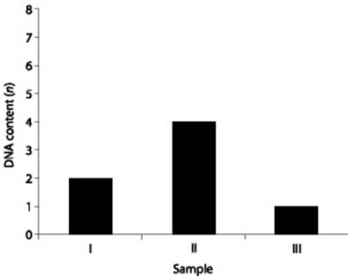 -Which sample of DNA might represent a zygote?
 (Multiple Choice)
4.9/5 (91)
(91) The somatic cells of a privet shrub each contain a total of 46 chromosomes. How do the chromosomes of this plant differ from the chromosomes of humans, who also have a total of 46?
(Multiple Choice)
4.8/5 (72)
(72) Which of the following events happens at the conclusion of meiosis I?
(Multiple Choice)
4.8/5 (81)
(81) If the DNA content of a diploid cell in the G₁ phase of the cell cycle is x, then the DNA content of the same cell at metaphase of meiosis I will be
(Multiple Choice)
4.9/5 (84)
(84) Eukaryotic sexual life cycles show tremendous variation. Which of the following characteristics do all sexual life cycles have in common?
I Alternation of generations
II Meiosis
III Fertilization
IV Gametes
V Spores
(Multiple Choice)
5.0/5 (77)
(77) Refer to the life cycles illustrated in the figure below to answer the following questions.
 -Which of the life cycles is typical for most fungi and some protists?
 (Multiple Choice)
4.9/5 (73)
(73) If a cell has completed meiosis I and the first cytokinesis, and is just beginning meiosis II, which of the following is an appropriate description of its genetic contents?
(Multiple Choice)
4.9/5 (73)
(73) Independent assortment of chromosomes is a result of which of the following processes?
(Multiple Choice)
4.8/5 (92)
(92) In a human karyotype, chromosomes are arranged in 23 pairs. If we choose one of these pairs, such as pair 14, which of the following do the two chromosomes of the pair have in common?
(Multiple Choice)
4.8/5 (92)
(92) If we continue to follow the cell lineage from question 4, then the DNA content of a single cell at metaphase of meiosis II will be
(Multiple Choice)
4.9/5 (76)
(76) For the following questions, match the key event of meiosis with the stages listed below.
I. Prophase I V. Prophase II
II. Metaphase I VI. Metaphase II
III. Anaphase I VII. Anaphase II
IV. Telophase I VIII. Telophase II
-Homologous chromosomes are aligned at the equator of the spindle.
(Multiple Choice)
4.9/5 (90)
(90) In eukaryotes, genetic information is passed to the next generation by processes that include mitosis or meiosis. Which of the following explanations correctly identifies the process and supports the claim that heritable information is passed from one generation to another?
(Multiple Choice)
4.8/5 (84)
(84) Refer to the life cycles illustrated in the figure below to answer the following questions.
-Which of the life cycles is typical for animals?
-Which of the life cycles is typical for animals? (Multiple Choice)
4.8/5 (72)
(72) A particular organism has 46 chromosomes in its karyotype. Which of the following statements is correct regarding this organism?
(Multiple Choice)
4.9/5 (68)
(68) 
Filters
- Essay(0)
- Multiple Choice(0)
- Short Answer(0)
- True False(0)
- Matching(0)