



 Chat with AI
Exam 2: The Chemical Context of Life

Exam 1: Evolution, the Themes of Biology, and Scientific Inquiry51 Questions
Exam 2: The Chemical Context of Life61 Questions
Exam 3: Water and Life55 Questions
Exam 4: Carbon and the Molecular Diversity of Life58 Questions
Exam 5: The Structure and Function of Large Biological Molecules70 Questions
Exam 6: A Tour of the Cell66 Questions
Exam 7: Membrane Structure and Function68 Questions
Exam 8: An Introduction to Metabolism67 Questions
Exam 9: Cellular Respiration and Fermentation68 Questions
Exam 10: Photosynthesis65 Questions
Exam 11: Cell Communication65 Questions
Exam 12: The Cell Cycle66 Questions
Exam 13: Meiosis and Sexual Life Cycles64 Questions
Exam 14: Mendel and the Gene Idea62 Questions
Exam 15: The Chromosomal Basis of Inheritance58 Questions
Exam 16: The Molecular Basis of Inheritance65 Questions
Exam 17: Gene Expression: From Gene to Protein67 Questions
Exam 18: Regulation of Gene Expression66 Questions
Exam 19: Viruses54 Questions
Exam 20: DNA Tools and Biotechnology57 Questions
Exam 21: Genomes and Their Evolution44 Questions
Exam 22: Descent with Modification: A Darwinian View of Life60 Questions
Exam 23: The Evolution of Populations64 Questions
Exam 24: The Origin of Species67 Questions
Exam 25: The History of Life on Earth59 Questions
Exam 26: Phylogeny and the Tree of Life75 Questions
Exam 27: Bacteria and Archaea75 Questions
Exam 28: Protists79 Questions
Exam 29: Plant Diversity I: How Plants Colonized Land82 Questions
Exam 30: Plant Diversity II: The Evolution of Seed Plants80 Questions
Exam 31: Fungi75 Questions
Exam 32: An Overview of Animal Diversity67 Questions
Exam 33: An Introduction to Invertebrates83 Questions
Exam 34: The Origin and Evolution of Vertebrates82 Questions
Exam 35: Vascular Plant Structure, Growth, and Development65 Questions
Exam 36: Resource Acquisition and Transport in Vascular Plants74 Questions
Exam 37: Soil and Plant Nutrition52 Questions
Exam 38: Angiosperm Reproduction and Biotechnology60 Questions
Exam 39: Plant Responses to Internal and External Signals61 Questions
Exam 40: Basic Principles of Animal Form and Function68 Questions
Exam 41: Animal Nutrition64 Questions
Exam 42: Circulation and Gas Exchange67 Questions
Exam 43: The Immune System69 Questions
Exam 44: Osmoregulation and Excretion64 Questions
Exam 45: Hormones and the Endocrine System66 Questions
Exam 46: Animal Reproduction68 Questions
Exam 47: Animal Development70 Questions
Exam 48: Neurons, Synapses, and Signaling68 Questions
Exam 49: Nervous Systems65 Questions
Exam 50: Sensory and Motor Mechanisms67 Questions
Exam 51: Animal Behavior69 Questions
Exam 52: An Introduction to Ecology and the Biosphere68 Questions
Exam 53: Population Ecology69 Questions
Exam 54: Community Ecology71 Questions
Exam 55: Ecosystems and Restoration Ecology68 Questions
Exam 56: Conservation Biology and Global Change69 Questions
Select questions type


What coefficients must be placed in the following blanks so that all atoms are accounted for in the products?
C₆H₁₂O₆ → ________ C₂H₆O + ________ CO₂
(Multiple Choice)
4.8/5  (89)
(89) Nitrogen (N)is more electronegative than hydrogen (H). Which of the following is a correct statement about the atoms in ammonia (NH₃)?
(Multiple Choice)
4.9/5 (77)
(77) The atomic number of chlorine is 17. The atomic number of magnesium is 12. What is the formula for magnesium chloride?
(Multiple Choice)
4.9/5 (84)
(84) In the following structure where A and B represent two different elements, the valency of A is ________ and B is ________.

(Multiple Choice)
4.7/5 (92)
(92) Refer to the following figure (first three rows of the periodic table) to answer the questions below.
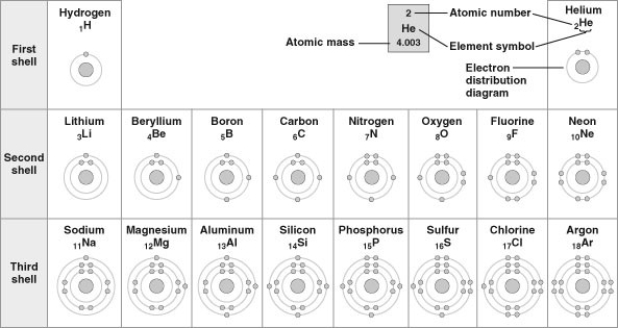 -What element does not prefer to react with other elements?
 (Multiple Choice)
4.9/5 (84)
(84) Refer to the following figure to answer the questions below.
 -Based on electron configuration, which of the elements in the figure would exhibit a chemical behavior most like that of oxygen?
 (Multiple Choice)
4.9/5 (94)
(94) The atomic number of nitrogen is 7. Nitrogen-15 has a greater mass number than nitrogen-14 because the atomic nucleus of nitrogen-15 contains ________.
(Multiple Choice)
5.0/5 (81)
(81) Refer to the following figure to answer the questions below.
-When the atoms involved in a covalent bond have the same electronegativity, what type of bond results?
-When the atoms involved in a covalent bond have the same electronegativity, what type of bond results? (Multiple Choice)
4.8/5 (87)
(87) A(n)________ has charge but negligible mass, whereas a(n)________ has mass but no charge.
(Multiple Choice)
4.8/5 (78)
(78) Refer to the following figure to answer the questions below.
3H₂ + N₂ 2NH₃
-Which of the following correctly describes chemical equilibrium?
(Multiple Choice)
4.9/5 (77)
(77) In a chemical reaction, the element ¹³Al will most preferably ________.
(Multiple Choice)
4.9/5 (75)
(75) Which one of the atoms shown would be most likely to form an anion with a charge of -1?
(Multiple Choice)
4.9/5 (66)
(66) 
Filters
- Essay(0)
- Multiple Choice(0)
- Short Answer(0)
- True False(0)
- Matching(0)