



 Chat with AI
Exam 7: Human Population Change and the Environment

Exam 1: The Environmental Challenges We Face76 Questions
Exam 2: Sustainability and Human Values70 Questions
Exam 3: Environmental History, Politics, and Economics81 Questions
Exam 4: Risk Analysis and Environmental Health Hazards78 Questions
Exam 5: How Ecosystems Work91 Questions
Exam 6: Ecosystems and Evolution94 Questions
Exam 7: Human Population Change and the Environment89 Questions
Exam 8: Air and Air Pollution80 Questions
Exam 9: Global Atmospheric Changes68 Questions
Exam 10: Freshwater Resources and Water Pollution96 Questions
Exam 11: The Ocean and Fisheries74 Questions
Exam 12: Mineral and Soil Resources98 Questions
Exam 13: Land Resources78 Questions
Exam 14: Agriculture and Food Resources69 Questions
Exam 15: Biodiversity and Conservation73 Questions
Exam 16: Solid and Hazardous Waste69 Questions
Exam 17: Nonrenewable Energy Resources68 Questions
Exam 18: Renewable Energy Resources70 Questions
Select questions type


What happens during the pre-industrial stage of the demographic transition?
(Multiple Choice)
4.8/5  (78)
(78) Which of the following factors affects the total fertility rate for human populations today?
(Multiple Choice)
4.8/5 (88)
(88) The accelerating population growth that occurs when optimal conditions allow a constant reproductive rate is known as ________.
(Short Answer)
4.9/5 (69)
(69) Immigration is when individuals leave a population and the population decreases in size.
(True/False)
4.8/5 (78)
(78) What conclusions can be drawn about the populations shown in the age structure pyramids below? 
(Multiple Choice)
4.8/5 (86)
(86) What is one way in which urban areas in developing nations differ from urban areas in highly developed nations?
(Multiple Choice)
4.8/5 (72)
(72) What happens to human population during a demographic transition?
(Multiple Choice)
4.7/5 (82)
(82) Which of the following statements about population ecology is TRUE?
(Multiple Choice)
4.9/5 (87)
(87) The graph below is a record of the population size of reindeer on one of the Pribilof Islands off the coast of Alaska where they were introduced in 1911. If it is known that the availability of winter forage determines the carrying capacity for reindeer, what can be interpreted from this graph? 
(Multiple Choice)
4.9/5 (90)
(90) Evaluate Curitiba, Brazil's performance as livable city in the developing world. Give a letter grade A+, A, A-, B+, B and so on in each of the following areas: pollution control, infrastructure, land-use planning, waste disposal and recycling. Give an example of each category that would justify your grading.
(Essay)
4.8/5 (72)
(72) Increasing educational opportunities especially for women results in a decrease in total fertility because it:
(Multiple Choice)
4.7/5 (71)
(71) During which of the four stages of demographic transition shown below does the population grow the most rapidly? 


(Multiple Choice)
4.9/5 (86)
(86) Which of the following statements about the graph shown is TRUE? 
(Multiple Choice)
4.9/5 (78)
(78) Which of the following factors has the LEAST effect on the death rates of a population?
(Multiple Choice)
4.9/5 (74)
(74) A city can be considered an ecosystem as shown in the figure below. What is not shown in the figure that would make the city more sustainable? 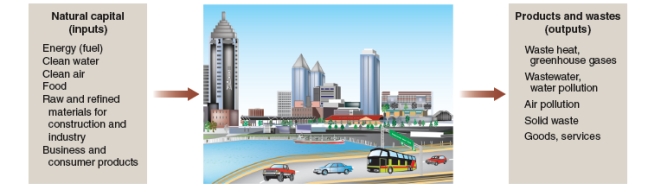
(Multiple Choice)
4.9/5 (86)
(86) Why does the death rate usually decline quickly during a demographic transition?
(Multiple Choice)
4.9/5 (73)
(73) In Sri Lanka, the average age at marriage is 25, and the average number of children born per woman is 2.0. In Bangladesh, the average age at marriage is 17, and the average number of children born per woman is 3.0. Which of the following conclusions is supported by these data?
(Multiple Choice)
4.7/5 (89)
(89) Family planning services affects total fertility rate because where family planning services are available:
(Multiple Choice)
4.9/5 (83)
(83) 
Filters
- Essay(0)
- Multiple Choice(0)
- Short Answer(0)
- True False(0)
- Matching(0)