



 Chat with AI
Exam 7: Human Population Change and the Environment

Exam 1: The Environmental Challenges We Face76 Questions
Exam 2: Sustainability and Human Values70 Questions
Exam 3: Environmental History, Politics, and Economics81 Questions
Exam 4: Risk Analysis and Environmental Health Hazards78 Questions
Exam 5: How Ecosystems Work91 Questions
Exam 6: Ecosystems and Evolution94 Questions
Exam 7: Human Population Change and the Environment89 Questions
Exam 8: Air and Air Pollution80 Questions
Exam 9: Global Atmospheric Changes68 Questions
Exam 10: Freshwater Resources and Water Pollution96 Questions
Exam 11: The Ocean and Fisheries74 Questions
Exam 12: Mineral and Soil Resources98 Questions
Exam 13: Land Resources78 Questions
Exam 14: Agriculture and Food Resources69 Questions
Exam 15: Biodiversity and Conservation73 Questions
Exam 16: Solid and Hazardous Waste69 Questions
Exam 17: Nonrenewable Energy Resources68 Questions
Exam 18: Renewable Energy Resources70 Questions
Select questions type


The current trends in human population growth suggest: 1. There has been a slight decline in global fertility rates.
2. The growth rate of human populations has increased from 1.2 in the 1960s to 2.2 today despite decreases in the fertility rate.
3. Population experts expect that the human population growth rate will attain zero population growth by the end of the 21st century.
(Multiple Choice)
4.9/5  (83)
(83) To date, all highly developed and moderately developed countries with more advanced economies have gone through a demographic transition. Describe the four steps in this process in terms of the impact birth and death rates have on population growth.
(Essay)
4.9/5 (80)
(80) Explain why cockroach populations will not expand indefinitely and take over the entire world. Include in your discussion appropriate definitions of population growth terminology such as: exponential growth, carrying capacity, and environmental resistant factors.
(Essay)
4.9/5 (85)
(85) The young age structure of urban areas can be attributed to:
(Multiple Choice)
4.9/5 (80)
(80) A dieback or population crash often occurs after a species ________ its environmental carrying capacity.
(Multiple Choice)
4.8/5 (80)
(80) Compact development in urban areas benefits the environment in all of the following ways EXCEPT:
(Multiple Choice)
4.8/5 (97)
(97) __________ is the applied branch of sociology that deals with population statistics.
(Short Answer)
4.7/5 (82)
(82) Which of the following is TRUE about Thomas Malthus? 1 Malthus was the first to point out that human population growth was not always desirable.
2 Malthus warned that the inevitable consequences of population growth would be famine, disease since human population can increase faster than its food supply.
3 Malthus has proven to be incorrect since human populations have increased to over 6 billion people without expanding our niche.
(Multiple Choice)
4.9/5 (68)
(68) Urbanization is the process by which people move from cities to rural areas.
(True/False)
4.7/5 (87)
(87) Who was the first scientist to sound the alarm about the growth of the human population and the ability of the earth to handle a large population of humans?
(Multiple Choice)
4.8/5 (80)
(80) What change in human population growth is predicted by the United Nation's population models?
(Multiple Choice)
4.8/5 (82)
(82) Cities with more than 10 million inhabitants are known as ________.
(Short Answer)
4.7/5 (74)
(74) Which of the following is an example of environmental resistance?
(Multiple Choice)
4.9/5 (87)
(87) Why is it impossible to precisely determine the Earth's carrying capacity for the human population?
(Essay)
4.8/5 (83)
(83) What is likely to happen to the population represented by the age structure pyramid labeled C? 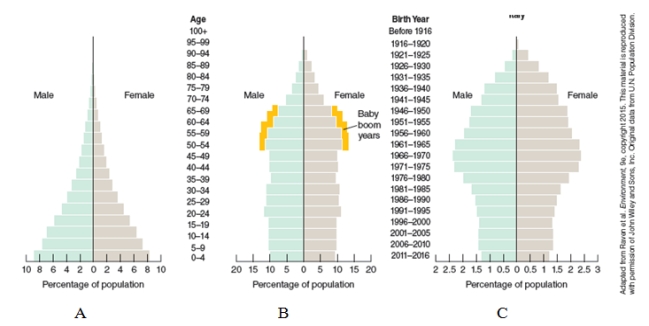
(Multiple Choice)
4.7/5 (84)
(84) What term or phrase do population ecologists use to describe the maximum number of individuals of a given species that a particular environment can support for an indefinite period, assuming there are no changes in the environment?
(Multiple Choice)
4.8/5 (64)
(64) The applied branch of sociology that deals with population statistics is:
(Multiple Choice)
4.9/5 (79)
(79) Who was Thomas Malthus and what were his ideas about human population growth? Was he correct or not? Justify your answer.
(Essay)
4.8/5 (89)
(89) 
Filters
- Essay(0)
- Multiple Choice(0)
- Short Answer(0)
- True False(0)
- Matching(0)