



 Chat with AI
Exam 9: Inventory Management

Exam 1: Using Operations to Create Value115 Questions
Exam 2: Process Strategy and Analysis239 Questions
Exam 3: Quality and Performance198 Questions
Exam 4: Capacity Planning120 Questions
Exam 5: Constraint Management136 Questions
Exam 6: Lean Systems166 Questions
Exam 7: Project Management139 Questions
Exam 8: Forecasting150 Questions
Exam 9: Inventory Management205 Questions
Exam 10: Operations Planning and Scheduling149 Questions
Exam 11: Resource Planning124 Questions
Exam 12: Supply Chain Design77 Questions
Exam 13: Supply Chain Logistic Networks114 Questions
Exam 14: Supply Chain Integration120 Questions
Exam 15: Supply Chain Sustainability78 Questions
Exam 16: Supplement A Decision Making107 Questions
Exam 17: Supplement J Operations Scheduling123 Questions
Exam 18: Supplement K Layout39 Questions
Exam 19: Supplement B Waiting Lines111 Questions
Exam 20: Supplement C Special Inventory Models53 Questions
Exam 21: Supplement D Linear Programming87 Questions
Exam 22: Supplement E Simulation54 Questions
Exam 23: Supplement F Financial Analysis55 Questions
Exam 24: Supplement G Acceptance Sampling Plans87 Questions
Exam 25: Supplement H Measuring Output Rates108 Questions
Exam 26: Supplement I Learning Curve Analysis50 Questions
Select questions type


Scenario 9.5
Tom Bergman, owner and operator of the Earplug Superstore, is reviewing the costs associated with the store's best-selling hearing aid, the BZ15. The data available to Dr. Bergman concerning this device follow.
Demand = 25 units/week
Order cost = $3/order
Holding cost = $1.50/unit/year
The Earplug Superstore operates 52 weeks a year.
-Use the information in Scenario 9.5. Tom cuts the ordering cost in half by implementing a streamlined processing system. How many fewer units should he now order each time he places an order?
(Multiple Choice)
4.8/5  (75)
(75) The number of setups (or orders) per year is determined by the annual demand and ________.
(Short Answer)
4.8/5 (75)
(75) Scenario 9.12
Demand = 100,000 units/year
Number of days per year = 250 weeks
Standard deviation of weekly demand = 50 units
Average lead time = 5 days
Standard deviation of lead time: 2 days
Cycle-service level = 99%
A continuous review system is used to control inventory.
-Use the information in Scenario 9.12. What safety stock should the firm use for this product?
(Multiple Choice)
4.9/5 (91)
(91) Items, such as components or assemblies, needed to manufacture a final product are called:
(Multiple Choice)
5.0/5 (90)
(90) Table 9.1
Inventory records show the following:
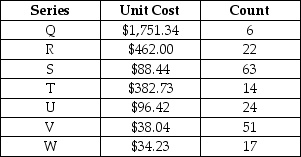 -In the context of an ABC inventory classification, use Table 9.1 to ascertain the veracity of this statement. Items in series U are the most C-like of all inventory SKUs.
 (True/False)
4.8/5 (81)
(81) Scenario 9.7
Cranium, Inc., purchases term papers from an overseas supplier under a continuous review system. The average demand for a popular mode is 300 units a day with a standard deviation of 30 units a day. It costs $60 to process each order and there is a five-day lead-time. The holding cost for a paper is $0.25 per year and the company policy is to maintain a 98% service level. Cranium operates 200 days per year.
-Use the information in Scenario 9.7. If lead-time increases by three days, what is the reorder point needed to maintain a 98% service level?
(Multiple Choice)
4.8/5 (88)
(88) When looking at inventory management, the term "lot size" refers to the physical dimensions of the area where the inventory is stored.
(True/False)
4.8/5 (82)
(82) A(n) ________ is an order that cannot be satisfied, resulting in the loss of a sale.
(Short Answer)
4.9/5 (67)
(67) Scenario 9.6
Consider the following data for an independent-demand item maintained by Angie Bonpensiero, the proprietor of a local auto repair shop:
Weekly demand = 50 units
Ordering cost = $8/order
Holding cost = $4/unit/year
Weeks in a year = 50
-Use the information in Scenario 9.6. If Bonpensiero uses the EOQ model, how frequently must she place orders for this item?
(Multiple Choice)
5.0/5 (85)
(85) Scenario 9.3
The Talbot Company uses electrical assemblies to produce an array of small appliances. One of its high cost / high volume assemblies, the XO-01, has an estimated annual demand of 8,000 units. Talbot estimates the cost to place an order is $50, and the holding cost for each assembly is $20 per year. The company operates 250 days per year.
-Use the information in Scenario 9.3. What is the total annual holding and ordering costs if Talbot orders using the EOQ quantity?
(Multiple Choice)
4.8/5 (78)
(78) Scenario 9.3
The Talbot Company uses electrical assemblies to produce an array of small appliances. One of its high cost / high volume assemblies, the XO-01, has an estimated annual demand of 8,000 units. Talbot estimates the cost to place an order is $50, and the holding cost for each assembly is $20 per year. The company operates 250 days per year.
-Use the information in Scenario 9.3. How many times per year must Talbot order the XO-01 when orders are placed using the EOQ quantity?
(Multiple Choice)
4.8/5 (73)
(73) In ABC analysis, class ________ SKUs represent the smallest number of SKUs but the greatest dollar usage.
(Multiple Choice)
4.8/5 (84)
(84) Independent-demand items are those items for which demand is influenced by market conditions and is not related to inventory decisions for any other items held in stock.
(True/False)
4.8/5 (55)
(55) Sensitivity analysis on the economic order quantity (EOQ) formula can help the operations manager answer several questions on how to manage inventories. Which one of the following questions is not answered by EOQ sensitivity analysis?
(Multiple Choice)
5.0/5 (79)
(79) If on-hand inventory = 100 units, scheduled receipts = 100 units and backorders = 100 units, the Inventory Position (IP) is the sum of the three, or 300 units.
(True/False)
5.0/5 (73)
(73) Scenario 9.4
The Mwongola Company is a small manufacturing company that uses gear assemblies to produce four different models of mountain bikes. One of these gear assemblies, the "Smooth Shifter", is used for the two most expensive of Burdell's four models, and has an estimated annual demand of 300 units. Burdell estimates the cost to place an order is $40, and the holding cost for each assembly is $60 per year. The company operates 250 days per year.
-Use the information in Scenario 9.4. What is the cycle length (time between orders) when orders are placed using the EOQ quantity?
(Multiple Choice)
4.7/5 (84)
(84) If on-hand inventory = 100 units, scheduled receipts = 100 units and backorders = 100 units, the Inventory Position (IP) is 100 units.
(True/False)
4.8/5 (78)
(78) 
Filters
- Essay(0)
- Multiple Choice(0)
- Short Answer(0)
- True False(0)
- Matching(0)