



 Chat with AI
Exam 9: Inventory Management

Exam 1: Using Operations to Create Value115 Questions
Exam 2: Process Strategy and Analysis239 Questions
Exam 3: Quality and Performance198 Questions
Exam 4: Capacity Planning120 Questions
Exam 5: Constraint Management136 Questions
Exam 6: Lean Systems166 Questions
Exam 7: Project Management139 Questions
Exam 8: Forecasting150 Questions
Exam 9: Inventory Management205 Questions
Exam 10: Operations Planning and Scheduling149 Questions
Exam 11: Resource Planning124 Questions
Exam 12: Supply Chain Design77 Questions
Exam 13: Supply Chain Logistic Networks114 Questions
Exam 14: Supply Chain Integration120 Questions
Exam 15: Supply Chain Sustainability78 Questions
Exam 16: Supplement A Decision Making107 Questions
Exam 17: Supplement J Operations Scheduling123 Questions
Exam 18: Supplement K Layout39 Questions
Exam 19: Supplement B Waiting Lines111 Questions
Exam 20: Supplement C Special Inventory Models53 Questions
Exam 21: Supplement D Linear Programming87 Questions
Exam 22: Supplement E Simulation54 Questions
Exam 23: Supplement F Financial Analysis55 Questions
Exam 24: Supplement G Acceptance Sampling Plans87 Questions
Exam 25: Supplement H Measuring Output Rates108 Questions
Exam 26: Supplement I Learning Curve Analysis50 Questions
Select questions type


A company governed by an EOQ system decides to move in a more lean direction and hopes to reduce their Q as much as possible. What specific steps might be taken to help them in their journey towards a Q = 1?
(Essay)
4.8/5  (92)
(92) Scenario 9.10
The Dolly Llama Farm keeps an average of 50 of those funny creatures on hand and each consumes a pound of grain a day, 365 days per year. Grain costs $12 for a 50 pound bag and it costs the farm $10 to make a run to the feed store to pick up an order, regardless of order size. It takes the feed store four days to acquire, mix, and bag the special blend of grains necessary to make the feed the Dolly Llama Farm prefers. Storage costs for the feed runs 15% of the unit cost as the cost of money, loss due to critters, and spoilage all add up.
-Refer to Scenario 9.10. There is some variability in how long it takes the feed store to whip up a batch of llama feed. The standard deviation of the feed prep is one day. The farm is willing to tolerate a 5% chance of running out of feed before they can get some more hauled in. The llamas would prefer a 0% chance, but they don't get a vote. What reorder point achieves the farm's objectives?
(Multiple Choice)
5.0/5 (78)
(78) Scenario 9.2
Shipments of Product X from a plant to a wholesaler are made in lots of 600. The wholesaler's average demand for X is 100 units per week. The lead time from the plant to the wholesaler is 4 weeks. The wholesaler pays for the shipments when they leave the plant.
-Refer to Scenario 9.2. What is the total of the wholesaler's current cycle plus pipeline inventories?
(Multiple Choice)
4.8/5 (85)
(85) The medical staff on Shudder Island uses an average of 60 vials of thorazine every day. This demand is normally distributed with a standard deviation of 15 vials. Since this is an important item, they have decided on a 98% service level. Ferries run infrequently, so the lead time for delivery is 12 days on average with a standard deviation of 2 days. Lead time is also normally distributed.
a. What is the expected demand during lead time?
b. What is the standard deviation of demand during lead time?
c. What is the average safety stock?
d. What is the reorder point?
e. If the company desired to lower the reorder point, which of these initiatives would lower it by the greatest amount - reducing the lead time by 10%, reducing the standard deviation of lead time by 10%, or reducing the service level by 10%?
(Essay)
4.7/5 (71)
(71) Scenario 9.6
Consider the following data for an independent-demand item maintained by Angie Bonpensiero, the proprietor of a local auto repair shop:
Weekly demand = 50 units
Ordering cost = $8/order
Holding cost = $4/unit/year
Weeks in a year = 50
-Use the information in Scenario 9.6. Due to new ordering procedures initiated by Bonpensiero, the ordering cost is drops to $4 per order. At the same time, the weekly demand increases to 64 units per week due to an increase in business. What effect do these changes have on the EOQ quantity for this item?
(Multiple Choice)
4.9/5 (79)
(79) A company operating under an EOQ policy enjoys rising annual demand for their products for three consecutive years. During this time their holding cost and ordering cost remain constant. Which statement is best?
(Multiple Choice)
4.8/5 (75)
(75) In an EOQ model, as the annual demand for an item increases, the EOQ for the item ________.
(Short Answer)
4.9/5 (86)
(86) Which one of the following is not an assumption of the EOQ model?
(Multiple Choice)
4.8/5 (73)
(73) A continuous review system is sometimes called a fixed interval reorder system.
(True/False)
4.8/5 (73)
(73) Scenario 9.7
Cranium, Inc., purchases term papers from an overseas supplier under a continuous review system. The average demand for a popular mode is 300 units a day with a standard deviation of 30 units a day. It costs $60 to process each order and there is a five-day lead-time. The holding cost for a paper is $0.25 per year and the company policy is to maintain a 98% service level. Cranium operates 200 days per year.
-Use the information in Scenario 9.7. What service level does a reorder point of 1,524 imply?
(Multiple Choice)
4.8/5 (73)
(73) Considering the EOQ model, smaller lots are justified when holding costs are decreased.
(True/False)
4.9/5 (75)
(75) Scenario 9.2
Shipments of Product X from a plant to a wholesaler are made in lots of 600. The wholesaler's average demand for X is 100 units per week. The lead time from the plant to the wholesaler is 4 weeks. The wholesaler pays for the shipments when they leave the plant.
-Refer to Scenario 9.2. If the plant reduces its shipment lot size from 600 to 400 units and keeps its 4 week lead time, what is the wholesaler's new total cycle plus pipeline inventories?
(Multiple Choice)
4.7/5 (90)
(90) Table 9.1
Inventory records show the following:
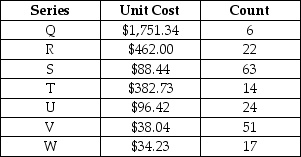 -What is generally True about class A SKUs in ABC analysis? They represent about:
 (Multiple Choice)
4.7/5 (86)
(86) A quantity discount is attractive because there is a drop in the price per unit when the order is sufficiently large.
(True/False)
4.8/5 (81)
(81) Inventory manager George Costanza knows too well that shrinkage occurs so he goes to the stock room every day to do a spot check of a few pre-selected items, physically counting them to verify that his count agrees with the number indicated by their computerized inventory system. This method of inventory control is known as ________.
(Short Answer)
4.9/5 (66)
(66) Vilas County Hospital consumed 400 boxes of bandages per week last year. The price of bandages was $80 per box, and the hospital operates 52 weeks per year. The cost of processing an order was $64, and the cost of holding one box throughout a full year was 20% of the value of the material. Last year the hospital ordered bandages, on average, once every two weeks, each time ordering 800 boxes. What extra cost did the hospital incur that could have been avoided if the EOQ concept had been applied?
(Multiple Choice)
5.0/5 (73)
(73) ABC analysis is a process for categorizing SKUs according to dollar usage so that managers can focus on items with the highest dollar value.
(True/False)
4.7/5 (68)
(68) The EOQ is the smallest lot size that a supplier will allow a customer to order.
(True/False)
4.9/5 (76)
(76) Scenario 9.10
The Dolly Llama Farm keeps an average of 50 of those funny creatures on hand and each consumes a pound of grain a day, 365 days per year. Grain costs $12 for a 50 pound bag and it costs the farm $10 to make a run to the feed store to pick up an order, regardless of order size. It takes the feed store four days to acquire, mix, and bag the special blend of grains necessary to make the feed the Dolly Llama Farm prefers. Storage costs for the feed runs 15% of the unit cost as the cost of money, loss due to critters, and spoilage all add up.
-Refer to Scenario 9.10. The actual usage for grain depends on which llamas show up at feeding time, thus there is an average need for 50 pounds of grain each day with a standard deviation of five pounds. The farm is willing to tolerate a 5% chance of running out of feed before they can get some more hauled in. The llamas would prefer a 0% chance, but they don't get a vote. What reorder point achieves the farm's objectives?
(Multiple Choice)
4.9/5 (94)
(94) The term ________ is used to refer to the quantity of inventory management either buys from a supplier or manufactures using internal processes.
(Short Answer)
4.9/5 (76)
(76) 
Filters
- Essay(0)
- Multiple Choice(0)
- Short Answer(0)
- True False(0)
- Matching(0)