



 Chat with AI
Exam 9: Inventory Management

Exam 1: Using Operations to Create Value115 Questions
Exam 2: Process Strategy and Analysis239 Questions
Exam 3: Quality and Performance198 Questions
Exam 4: Capacity Planning120 Questions
Exam 5: Constraint Management136 Questions
Exam 6: Lean Systems166 Questions
Exam 7: Project Management139 Questions
Exam 8: Forecasting150 Questions
Exam 9: Inventory Management205 Questions
Exam 10: Operations Planning and Scheduling149 Questions
Exam 11: Resource Planning124 Questions
Exam 12: Supply Chain Design77 Questions
Exam 13: Supply Chain Logistic Networks114 Questions
Exam 14: Supply Chain Integration120 Questions
Exam 15: Supply Chain Sustainability78 Questions
Exam 16: Supplement A Decision Making107 Questions
Exam 17: Supplement J Operations Scheduling123 Questions
Exam 18: Supplement K Layout39 Questions
Exam 19: Supplement B Waiting Lines111 Questions
Exam 20: Supplement C Special Inventory Models53 Questions
Exam 21: Supplement D Linear Programming87 Questions
Exam 22: Supplement E Simulation54 Questions
Exam 23: Supplement F Financial Analysis55 Questions
Exam 24: Supplement G Acceptance Sampling Plans87 Questions
Exam 25: Supplement H Measuring Output Rates108 Questions
Exam 26: Supplement I Learning Curve Analysis50 Questions
Select questions type


Jimmy's Egg is a specialty restaurant featuring 47 different kinds of omelettes in three different sizes. They use 60 dozen cases of eggs a day that they order from an egg factory with a lead time of five days. One fine day they stock their chiller and note that there are only 25 dozen cases of eggs remaining. They have a backorder of 15 cases and an open order of 200 cases. What is their inventory position? Should they place an order?
(Essay)
4.8/5  (73)
(73) Scenario 9.3
The Talbot Company uses electrical assemblies to produce an array of small appliances. One of its high cost / high volume assemblies, the XO-01, has an estimated annual demand of 8,000 units. Talbot estimates the cost to place an order is $50, and the holding cost for each assembly is $20 per year. The company operates 250 days per year.
-Use the information in Scenario 9.3. What is the economic order quantity for the XO-01?
(Multiple Choice)
4.9/5 (74)
(74) What production strategies should not employ an EOQ approach to ordering? Why?
(Essay)
4.9/5 (80)
(80) ________ are inventories needed for the production of goods and services; they are considered to be the inputs to the transformation process.
(Short Answer)
5.0/5 (83)
(83) Table 9.1
Inventory records show the following:
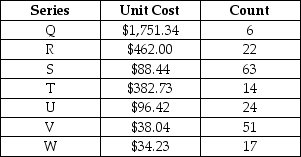 -Use Table 9.1 to identify the best statement.
 (Multiple Choice)
4.9/5 (81)
(81) Scenario 9.5
Tom Bergman, owner and operator of the Earplug Superstore, is reviewing the costs associated with the store's best-selling hearing aid, the BZ15. The data available to Dr. Bergman concerning this device follow.
Demand = 25 units/week
Order cost = $3/order
Holding cost = $1.50/unit/year
The Earplug Superstore operates 52 weeks a year.
-Use the information in Scenario 9.5. If Tom orders at the economic order quantity, how many units does he order at a time?
(Multiple Choice)
4.8/5 (79)
(79) When using ABC analysis, class C SKUs should be reviewed frequently.
(True/False)
4.9/5 (62)
(62) Scenario 9.5
Tom Bergman, owner and operator of the Earplug Superstore, is reviewing the costs associated with the store's best-selling hearing aid, the BZ15. The data available to Dr. Bergman concerning this device follow.
Demand = 25 units/week
Order cost = $3/order
Holding cost = $1.50/unit/year
The Earplug Superstore operates 52 weeks a year.
-Use the information in Scenario 9.5. If Tom orders such that his annual holding cost is twice what his annual ordering cost is, how many units at a time is he ordering?
(Multiple Choice)
4.8/5 (77)
(77) Scenario 9.2
Shipments of Product X from a plant to a wholesaler are made in lots of 600. The wholesaler's average demand for X is 100 units per week. The lead time from the plant to the wholesaler is 4 weeks. The wholesaler pays for the shipments when they leave the plant.
-Refer to Scenario 9.2. If the plant reduces its lead time from 4 to 2 weeks and keeps its 600 unit lot size, what is the wholesaler's new total cycle plus pipeline inventories?
(Multiple Choice)
4.7/5 (90)
(90) Repeatability is an undesirable feature of some orders because they must be repeated until the order is filled correctly.
(True/False)
4.8/5 (77)
(77) Scenario 9.3
The Talbot Company uses electrical assemblies to produce an array of small appliances. One of its high cost / high volume assemblies, the XO-01, has an estimated annual demand of 8,000 units. Talbot estimates the cost to place an order is $50, and the holding cost for each assembly is $20 per year. The company operates 250 days per year.
-Use the information in Scenario 9.3. What is the cycle length (time between orders) when orders are placed using the EOQ quantity?
(Multiple Choice)
4.9/5 (78)
(78) As the annual demand increases, other factors remaining constant, the EOQ also increases.
(True/False)
4.9/5 (85)
(85) Scenario 9.9
"Gollee those cats sure go through a lot of food," Geoff exclaimed as he saw the shopping list pad that had been pre-printed with the words "cat food" at the top. He pondered a different approach to shopping for the furry little darlings, reviewed his shopping records, and discovered the following. The price of cat food has held steady at 89 cents per can. Despite feigning indifference, each of the seven cats nibbles their way through an average of one can per day, three hundred sixty five days a year. The price of gasoline has held constant at $3.50 per gallon and his pickup uses a gallon each way to the cat food store. The cost to hold a can of cat food is 10% of the unit price.
-Use the information in Scenario 9.9 to determine the amount of time in-between trips to the cat food store if Geoff wisely elects to follow an EOQ policy for obtaining cat food.
(Multiple Choice)
4.9/5 (84)
(84) A store has collected the following information on one of its products:
Demand = 5,000 units/year
Ordering costs = $12/order
Holding costs = $4/unit/year
Lead-time = 5 days weeks
Unit cost = $748/unit
Number of weeks per year = 50 weeks
a. The firm currently orders 500 units per order. What is the total cost of ordering and holding these goods under this system?
b. Determine their economic order quantity and cost of ordering and holding goods using the EOQ.
c. Form the ratio of the order quantities under the old policy and EOQ. Form the ratio of the EOQ to the old order quantity. Then form the ratio of their total system costs under the two ordering policies. Average these two ratios and compare this number with the ratio of the old total cost with the total cost under an EOQ policy.
d. How do they compare?
(Essay)
4.8/5 (80)
(80) In an ABC analysis, class ________ SKUs, which typically make up ________% of the SKUs, account for only about 5% of the dollar usage.
(Short Answer)
4.8/5 (81)
(81) Scenario 9.8
A company operating under a continuous review system has an average demand of 50 units per week for the item it produces. The standard deviation in weekly demand is 20 units. The lead-time for the item is six weeks, and it costs the company $30 to process each order. The holding cost for each unit is $10 per year. The company operates 52 weeks per year.
-Use the information in Scenario 9.8. What is the economic order quantity (EOQ) for this item?
(Multiple Choice)
4.9/5 (84)
(84) Scenario 9.5
Tom Bergman, owner and operator of the Earplug Superstore, is reviewing the costs associated with the store's best-selling hearing aid, the BZ15. The data available to Dr. Bergman concerning this device follow.
Demand = 25 units/week
Order cost = $3/order
Holding cost = $1.50/unit/year
The Earplug Superstore operates 52 weeks a year.
-Use the information in Scenario 9.5. If Tom decides to order at the economic order quantity, what is the sum of the annual ordering cost and holding cost?
(Multiple Choice)
4.9/5 (75)
(75) A(n) ________ occurs when a customer order cannot be filled as promised or demanded but is filled later.
(Short Answer)
4.8/5 (78)
(78) ________ occurs when inventory is stolen by employees and customers or when the inventory cannot be sold at full value owing to model changes or low demand.
(Short Answer)
4.9/5 (77)
(77) 
Filters
- Essay(0)
- Multiple Choice(0)
- Short Answer(0)
- True False(0)
- Matching(0)