



 Chat with AI
Exam 9: Inventory Management

Exam 1: Using Operations to Create Value115 Questions
Exam 2: Process Strategy and Analysis239 Questions
Exam 3: Quality and Performance198 Questions
Exam 4: Capacity Planning120 Questions
Exam 5: Constraint Management136 Questions
Exam 6: Lean Systems166 Questions
Exam 7: Project Management139 Questions
Exam 8: Forecasting150 Questions
Exam 9: Inventory Management205 Questions
Exam 10: Operations Planning and Scheduling149 Questions
Exam 11: Resource Planning124 Questions
Exam 12: Supply Chain Design77 Questions
Exam 13: Supply Chain Logistic Networks114 Questions
Exam 14: Supply Chain Integration120 Questions
Exam 15: Supply Chain Sustainability78 Questions
Exam 16: Supplement A Decision Making107 Questions
Exam 17: Supplement J Operations Scheduling123 Questions
Exam 18: Supplement K Layout39 Questions
Exam 19: Supplement B Waiting Lines111 Questions
Exam 20: Supplement C Special Inventory Models53 Questions
Exam 21: Supplement D Linear Programming87 Questions
Exam 22: Supplement E Simulation54 Questions
Exam 23: Supplement F Financial Analysis55 Questions
Exam 24: Supplement G Acceptance Sampling Plans87 Questions
Exam 25: Supplement H Measuring Output Rates108 Questions
Exam 26: Supplement I Learning Curve Analysis50 Questions
Select questions type


A periodic review system is a system in which an item's inventory position is reviewed periodically rather than continuously.
(True/False)
4.9/5  (83)
(83) In an ABC analysis, class ________ SKUs, which typically make up about ________% of the SKUs, account for only about 15% of the dollar usage.
(Short Answer)
4.9/5 (74)
(74) Scenario 9.10
The Dolly Llama Farm keeps an average of 50 of those funny creatures on hand and each consumes a pound of grain a day, 365 days per year. Grain costs $12 for a 50 pound bag and it costs the farm $10 to make a run to the feed store to pick up an order, regardless of order size. It takes the feed store four days to acquire, mix, and bag the special blend of grains necessary to make the feed the Dolly Llama Farm prefers. Storage costs for the feed runs 15% of the unit cost as the cost of money, loss due to critters, and spoilage all add up.
-Refer to Scenario 9.10. What should the reorder point be if demand and lead time are invariant and the farm desires a 90% service level?
(Multiple Choice)
4.9/5 (85)
(85) Scenario 9.9
"Gollee those cats sure go through a lot of food," Geoff exclaimed as he saw the shopping list pad that had been pre-printed with the words "cat food" at the top. He pondered a different approach to shopping for the furry little darlings, reviewed his shopping records, and discovered the following. The price of cat food has held steady at 89 cents per can. Despite feigning indifference, each of the seven cats nibbles their way through an average of one can per day, three hundred sixty five days a year. The price of gasoline has held constant at $3.50 per gallon and his pickup uses a gallon each way to the cat food store. The cost to hold a can of cat food is 10% of the unit price.
-Use the information in Scenario 9.9 to determine the average number of orders per year if Geoff adopts an EOQ policy.
(Multiple Choice)
4.9/5 (76)
(76) Reducing setup costs will increase the pressure to keep large inventories.
(True/False)
4.8/5 (75)
(75) The ________ is the predetermined minimum level that an inventory position must reach before a fixed quantity (Q) is ordered.
(Short Answer)
4.9/5 (85)
(85) Scenario 9.4
The Mwongola Company is a small manufacturing company that uses gear assemblies to produce four different models of mountain bikes. One of these gear assemblies, the "Smooth Shifter", is used for the two most expensive of Burdell's four models, and has an estimated annual demand of 300 units. Burdell estimates the cost to place an order is $40, and the holding cost for each assembly is $60 per year. The company operates 250 days per year.
-Use the information in Scenario 9.4. What is the annual ordering costs if Mwongola orders using the EOQ quantity?
(Multiple Choice)
4.9/5 (86)
(86) A continuous review system is sometimes called a reorder point system.
(True/False)
4.8/5 (82)
(82) Scenario 9.11
Demand = 50,000 units/week
Standard deviation of weekly demand = 15,000 units
Average lead time = 8 weeks
Standard deviation of lead time: 3 weeks
Cycle-service level = 80%
A continuous review system is used to control inventory.
-Use the information in Scenario 9.11. What is the standard deviation of demand during lead time?
(Multiple Choice)
4.9/5 (86)
(86) What are the three types of inventory? For which inventory type is a stockout most critical?
(Essay)
4.7/5 (92)
(92) Scenario 9.1
Shipments of Product A from a distribution center to a retailer are made in lots of 350. The retailer's average demand for Product A is 75 units per week. The lead time from distributor to retailer is 3 weeks. The retailer pays for the shipments when they leave the distributor. The distributor has agreed to reduce the lead time to 2 weeks if the retailer will purchase quantities of 400 per shipment instead of 350 units per shipment.
-Refer to Scenario 9.1. With the change in lead time, the pipeline inventory will:
(Multiple Choice)
4.9/5 (82)
(82) Scenario 9.7
Cranium, Inc., purchases term papers from an overseas supplier under a continuous review system. The average demand for a popular mode is 300 units a day with a standard deviation of 30 units a day. It costs $60 to process each order and there is a five-day lead-time. The holding cost for a paper is $0.25 per year and the company policy is to maintain a 98% service level. Cranium operates 200 days per year.
-Use the information in Scenario 9.7. What combination of changes in lead-time and service level would result in exactly the same level of safety stock as indicated in the table?
(Multiple Choice)
4.8/5 (76)
(76) Table 9.1
Inventory records show the following:
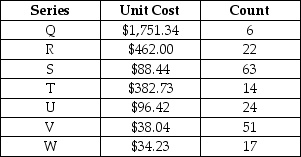 -What is generally True about class A SKUs in ABC analysis? They represent about:
 (Multiple Choice)
4.9/5 (83)
(83) ________ inventory is the portion of total inventory that varies directly with lot size.
(Short Answer)
4.8/5 (74)
(74) ________ are orders that have been placed but not yet received.
(Short Answer)
4.8/5 (72)
(72) Inventory management is the planning and controlling of inventories in order to meet the competitive priorities of the organization.
(True/False)
4.9/5 (81)
(81) Cycle counting is an inventory-control method whereby storeroom personnel physically count a small percent of the total number of items each day.
(True/False)
4.8/5 (68)
(68) 
Filters
- Essay(0)
- Multiple Choice(0)
- Short Answer(0)
- True False(0)
- Matching(0)