



 Chat with AI
Exam 4: Capacity Planning

Exam 1: Using Operations to Create Value115 Questions
Exam 2: Process Strategy and Analysis239 Questions
Exam 3: Quality and Performance198 Questions
Exam 4: Capacity Planning120 Questions
Exam 5: Constraint Management136 Questions
Exam 6: Lean Systems166 Questions
Exam 7: Project Management139 Questions
Exam 8: Forecasting150 Questions
Exam 9: Inventory Management205 Questions
Exam 10: Operations Planning and Scheduling149 Questions
Exam 11: Resource Planning124 Questions
Exam 12: Supply Chain Design77 Questions
Exam 13: Supply Chain Logistic Networks114 Questions
Exam 14: Supply Chain Integration120 Questions
Exam 15: Supply Chain Sustainability78 Questions
Exam 16: Supplement A Decision Making107 Questions
Exam 17: Supplement J Operations Scheduling123 Questions
Exam 18: Supplement K Layout39 Questions
Exam 19: Supplement B Waiting Lines111 Questions
Exam 20: Supplement C Special Inventory Models53 Questions
Exam 21: Supplement D Linear Programming87 Questions
Exam 22: Supplement E Simulation54 Questions
Exam 23: Supplement F Financial Analysis55 Questions
Exam 24: Supplement G Acceptance Sampling Plans87 Questions
Exam 25: Supplement H Measuring Output Rates108 Questions
Exam 26: Supplement I Learning Curve Analysis50 Questions
Select questions type


Scenario 4.8
The Summerville Vitamin Company manufactures bottles of animal-shaped chewable vitamins for children. This product line requires two work centers, tablet manufacturing and packaging. The tablet manufacturing work center has a current capacity of 140,000 bottles per month, and packaging is capable of 100,000 units per month. This year (year 0), monthly sales of the product line are expected to reach 100,000 units. Growth per month is projected at an additional 25,000 units through year 4 (i.e., 125,000 per month in year #1, 150,000 per month in year #2, etc.). Pre-tax profits are expected to be $5 per unit throughout the 4-year planning period. Two alternatives are being considered:
1) Expand both tablet manufacturing and packaging at the end of year 0 to a capacity of 200,000 units per month, at a total cost for both work centers of $2,250,000;
2) Expand packaging at the end of year 0 to 140,000 units per year, matching tablet manufacturing, at a cost of $1,200,000, then expanding both work centers to 200,000 units per month at the end of year 2, at an additional cost at that time of $1,400,000.
Summerville will not consider projects that don't show a 4th year positive net present value using a discount rate of 25%.
-Use the information in Scenario 4.8. What is the pre-tax cash flow (net present value) for alternative #2 compared to the base case of doing nothing for the next four years?
(Multiple Choice)
4.8/5  (68)
(68) Which one of the following factors usually calls for a larger capacity cushion?
(Multiple Choice)
4.8/5 (81)
(81) One reason economies of scale drive down cost is the spreading of fixed costs.
(True/False)
4.9/5 (77)
(77) A process's ________ is what its capacity should be for some future time period to meet the demand of its customers, allowing for the desired capacity cushion.
(Short Answer)
5.0/5 (69)
(69) Which one of the following factors usually motivates a smaller capacity cushion?
(Multiple Choice)
5.0/5 (80)
(80) The ________ is the act of doing nothing and losing orders from any demand that exceeds capacity, or incurs costs because capacity is too large.
(Short Answer)
4.8/5 (74)
(74) A well-educated operations manager used the capacity requirements equation to determine the number of crackerbox welders to purchase for the shop, given the standard time per unit, hours available per machine, among other relevant parameters. He studied the answer, 2.2, and concluded that:
(Multiple Choice)
4.9/5 (71)
(71) Scenario 4.8
The Summerville Vitamin Company manufactures bottles of animal-shaped chewable vitamins for children. This product line requires two work centers, tablet manufacturing and packaging. The tablet manufacturing work center has a current capacity of 140,000 bottles per month, and packaging is capable of 100,000 units per month. This year (year 0), monthly sales of the product line are expected to reach 100,000 units. Growth per month is projected at an additional 25,000 units through year 4 (i.e., 125,000 per month in year #1, 150,000 per month in year #2, etc.). Pre-tax profits are expected to be $5 per unit throughout the 4-year planning period. Two alternatives are being considered:
1) Expand both tablet manufacturing and packaging at the end of year 0 to a capacity of 200,000 units per month, at a total cost for both work centers of $2,250,000;
2) Expand packaging at the end of year 0 to 140,000 units per year, matching tablet manufacturing, at a cost of $1,200,000, then expanding both work centers to 200,000 units per month at the end of year 2, at an additional cost at that time of $1,400,000.
Summerville will not consider projects that don't show a 4th year positive net present value using a discount rate of 25%.
-Use the information in Scenario 4.8. What action, if any, should Summerville take?
(Multiple Choice)
4.9/5 (67)
(67) The Southeast Manufacturing Company is producing two types of products: A and B. Demand forecasts for next year and other production-related information are provided in the following table: 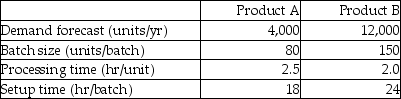 Both of these products are produced at the same workstation, called the Automatic Lathe. Currently, the company has 12 automatic lathes, and financial constraints prevent any expansion for the next year. It works 250 days per year with two 8-hour shifts and desires a 25 percent capacity cushion. Which one of the following alternatives will allow next year's demand to be fully covered?
 (Multiple Choice)
4.8/5 (90)
(90) It takes a service rep an average of two and a half minutes to take a customer's information. Over the course of a work week, the rep handles 160 calls a day during her eight hour shift. What is the service rep's capacity cushion?
(Multiple Choice)
4.8/5 (85)
(85) The ________ concept states that the average unit cost of a service or good can be reduced by increasing its output rate.
(Short Answer)
4.7/5 (84)
(84) Capacity planning requires a demand forecast for an extended period of time into the future. What concerns would you have regarding an extended forecast as a capacity planner?
(Essay)
4.8/5 (76)
(76) Table 4.1
The Union Manufacturing Company is producing two types of products: A and B. The demand forecasts, batch size, and time standards follow:
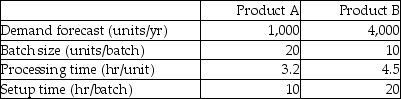 Both products are produced on the same machine, called Mark I.
-Using Table 4.1, what is the total number of hours required of Mark I equipment for the next year?
Both products are produced on the same machine, called Mark I.
-Using Table 4.1, what is the total number of hours required of Mark I equipment for the next year? (Multiple Choice)
4.8/5 (82)
(82) Larry's Wickets, Inc. is producing two types of products: A and B. Both are produced at the same machining operation. Because of demand uncertainties, the operations manager obtained three demand forecasts (pessimistic, expected, and optimistic). The demand forecasts, batch sizes (units/batch), processing times (hr/unit), and setup times (hr/batch) follow.
 The machines operate on two 8-hour shifts, 5 days per week, and 50 weeks per year. The manager wants to maintain a 20 percent capacity cushion.
a. What is the minimum number of hours required of the machining equipment for the next year?
b. How many hours of capacity can the company expect from each machine?
c. What is the minimum number of machines needed (assuming no reliance on short-term options)?
d. What is the maximum number of machines needed (assuming no reliance on short-term options)?
The machines operate on two 8-hour shifts, 5 days per week, and 50 weeks per year. The manager wants to maintain a 20 percent capacity cushion.
a. What is the minimum number of hours required of the machining equipment for the next year?
b. How many hours of capacity can the company expect from each machine?
c. What is the minimum number of machines needed (assuming no reliance on short-term options)?
d. What is the maximum number of machines needed (assuming no reliance on short-term options)? (Essay)
4.7/5 (80)
(80) A firm may preempt the expansion of competitive firms by using an expansionist capacity strategy and announcing a large capacity expansion.
(True/False)
4.9/5 (84)
(84) Scenario 4.7
The B. Sharp Company has a rapidly growing product line that requires two work centers, X and Y for manufacture. Work Center X has a current capacity of 50,000 units per year, and Work Center Y is capable of 55,000 units per year. This year (year 0), sales of the product line are expected to reach 50,000 units. Growth is projected at an additional 3,000 units each year through year 3. Pre-tax profits are expected to be $60 per unit throughout the 3-year planning period. Two alternatives are being considered:1) Expand both Work Centers X and Y at the end of year 0 to a capacity of 60,000 units per year, at a total cost for both Work Centers of $500,000;
2) Expand Work Center X at the end of year 0 to 55,000 units per year, matching Work Center Y, at a cost of $300,000, then expanding both Work Centers to 60,000 units per year at the end of year 2, at an additional cost at that time of $350,000.
The Sharp Company will not consider projects that don't show a 3rd year positive net present value using a discount rate of 20%.
-Use the information in Scenario 4.7. What is the pre-tax cash flow (net present value) for alternative #1 compared to the base case of doing nothing for the next five years?
(Multiple Choice)
4.7/5 (80)
(80) The seven-person maintenance function at a hospital performs both preventive and corrective maintenance on hundreds of items each month. All the workers are scheduled for 40 hours per week and there are four weeks in a month. It is the goal of the maintenance department to achieve 90% utilization with a mix of two-thirds preventive maintenance and one-third corrective maintenance. How many hours each month are spent performing corrective maintenance if they achieve their 90% utilization and correct/preventive mix targets?
(Essay)
4.9/5 (83)
(83) Long-term capacity decisions that confront managers include all of the following except:
(Multiple Choice)
5.0/5 (75)
(75) A capacity decision in a call center, such as the number of customer service representatives to answer the phone during a peak period, can be addressed using a(n) ________.
(Short Answer)
4.9/5 (79)
(79) 
Filters
- Essay(0)
- Multiple Choice(0)
- Short Answer(0)
- True False(0)
- Matching(0)