



 Chat with AI
Exam 4: Capacity Planning

Exam 1: Using Operations to Create Value115 Questions
Exam 2: Process Strategy and Analysis239 Questions
Exam 3: Quality and Performance198 Questions
Exam 4: Capacity Planning120 Questions
Exam 5: Constraint Management136 Questions
Exam 6: Lean Systems166 Questions
Exam 7: Project Management139 Questions
Exam 8: Forecasting150 Questions
Exam 9: Inventory Management205 Questions
Exam 10: Operations Planning and Scheduling149 Questions
Exam 11: Resource Planning124 Questions
Exam 12: Supply Chain Design77 Questions
Exam 13: Supply Chain Logistic Networks114 Questions
Exam 14: Supply Chain Integration120 Questions
Exam 15: Supply Chain Sustainability78 Questions
Exam 16: Supplement A Decision Making107 Questions
Exam 17: Supplement J Operations Scheduling123 Questions
Exam 18: Supplement K Layout39 Questions
Exam 19: Supplement B Waiting Lines111 Questions
Exam 20: Supplement C Special Inventory Models53 Questions
Exam 21: Supplement D Linear Programming87 Questions
Exam 22: Supplement E Simulation54 Questions
Exam 23: Supplement F Financial Analysis55 Questions
Exam 24: Supplement G Acceptance Sampling Plans87 Questions
Exam 25: Supplement H Measuring Output Rates108 Questions
Exam 26: Supplement I Learning Curve Analysis50 Questions
Select questions type


A capacity cushion is the amount of inventory that a firm maintains to handle sudden increases in demand or temporary loss of production capacity.
(True/False)
4.9/5  (79)
(79) Which of the following descriptions about waiting line models is best?
(Multiple Choice)
4.9/5 (81)
(81) Which one of the following statements concerning capacity cushions is best?
(Multiple Choice)
4.9/5 (86)
(86) Table 4.1
The Union Manufacturing Company is producing two types of products: A and B. The demand forecasts, batch size, and time standards follow:
 Both products are produced on the same machine, called Mark I.
-Use the information in Table 4.1. How many Mark I machines are required to produce Union Manufacturing's yearly production?
Both products are produced on the same machine, called Mark I.
-Use the information in Table 4.1. How many Mark I machines are required to produce Union Manufacturing's yearly production? (Multiple Choice)
4.8/5 (68)
(68) An expansionist capacity strategy involves large, infrequent jumps in capacity, where a wait-and-see strategy involves smaller, more frequent jumps.
(True/False)
5.0/5 (73)
(73) A ________ is the difference between demand and current capacity.
(Short Answer)
4.8/5 (86)
(86) Figure 4.1
 -A manager weighs three options for capacity cushion as depicted in Figure 4.1. If the dollar amounts expressed in the figure are cash flows, which option is optimal?
 (Multiple Choice)
4.9/5 (82)
(82) A larger capacity cushion can help firms uncover process inefficiencies, so they can find ways to correct them.
(True/False)
4.8/5 (67)
(67) If demand is increasing, and you also prefer to increase the time between capacity increments, then the size of increments should ________.
(Short Answer)
4.9/5 (90)
(90) Utilization is the degree to which equipment, space, or labor is currently being used.
(True/False)
4.9/5 (83)
(83) A standard work year is 2,000 hours at the Luther Mill and it takes about an hour and a half to fill a customer order. Last year saw 15,000 customer orders at the mill and the manager has a new John Deere in mind as a company car, so he hopes that there is an increase of 15% in customer orders for next year. If the manager hires fourteen workers, what is the capacity cushion?
(Multiple Choice)
4.8/5 (76)
(76) When a firm makes a long-term capacity decision, selecting the base case alternative means doing nothing and losing orders from any demand that exceeds current capacity, or incurring costs due to excess capacity.
(True/False)
4.8/5 (74)
(74) Extremely complex service capacity problems for which there are no optimizing equations should be analyzed using ________.
(Short Answer)
4.8/5 (87)
(87) A larger capacity cushion may be required due to variation in demand, changing product mix, or supply uncertainty.
(True/False)
4.8/5 (85)
(85) The capacity requirement for a year's output is inversely proportional to the total number of hours available from a single capacity unit per year.
(True/False)
4.8/5 (76)
(76) A process's capacity requirement states the future process capacity needed to meet projected customer demands, and includes an allowance for the desired capacity cushion.
(True/False)
4.9/5 (82)
(82) A printing company works on three types of printing jobs, each of which could be produced on the same model printing machine. The predicted annual demands and typical order sizes are shown in the table. The company has 2,000 production hours available each year and requires a 10% capacity cushion to allow for preventive maintenance, breakdowns, and other unforeseen circumstances. How many printing machines must they have under these circumstances?
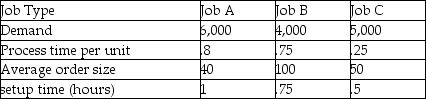
(Essay)
5.0/5 (75)
(75) Scenario 4.6
Burdell Labs is a diagnostic laboratory that does various tests (blood tests, urine tests, etc.) for doctors' offices in the Indianapolis area. Test specimens are picked up at the doctors' offices and are transported to the testing facility, with uniform arrivals throughout the day. All tests go through two testing centers in the testing facility, Test Center A and Test Center B. A has a current capacity of 1,000 units per week, and B is capable of 1,500 units per week. The facility operates 50 weeks per year. This year (year 0), test volumes are expected to reach 1,000 units per week. Growth per week is projected at an additional 200 units through year 5 (i.e., 1,200 per week in year #1, 1,400 per week in year #2, etc.). Pre-tax profits are expected to be $5 per test throughout the 5-year planning period. Two alternatives are being considered:
1) Expand both Test Centers A and B at the end of year 0 to a capacity of 2,000 units per week, at a total cost for both Test Centers of $300,000;
2) Expand Test Center A at the end of year 0 to 1,500 units per week, matching Test Center B, at a cost of $100,000, then expanding both Test Centers to 2,000 units per year at the end of year 3, at an additional cost at that time of $250,000.
Burdell Labs will not consider projects that don't show a 5th year positive net present value using a discount rate of 15%.
-Use the information in Scenario 4.6. What is the pre-tax cash flow (net present value) for alternative #2 compared to the base case of doing nothing for the next five years?
(Multiple Choice)
4.8/5 (102)
(102) 
Filters
- Essay(0)
- Multiple Choice(0)
- Short Answer(0)
- True False(0)
- Matching(0)