



 Chat with AI
Exam 4: Capacity Planning

Exam 1: Using Operations to Create Value115 Questions
Exam 2: Process Strategy and Analysis239 Questions
Exam 3: Quality and Performance198 Questions
Exam 4: Capacity Planning120 Questions
Exam 5: Constraint Management136 Questions
Exam 6: Lean Systems166 Questions
Exam 7: Project Management139 Questions
Exam 8: Forecasting150 Questions
Exam 9: Inventory Management205 Questions
Exam 10: Operations Planning and Scheduling149 Questions
Exam 11: Resource Planning124 Questions
Exam 12: Supply Chain Design77 Questions
Exam 13: Supply Chain Logistic Networks114 Questions
Exam 14: Supply Chain Integration120 Questions
Exam 15: Supply Chain Sustainability78 Questions
Exam 16: Supplement A Decision Making107 Questions
Exam 17: Supplement J Operations Scheduling123 Questions
Exam 18: Supplement K Layout39 Questions
Exam 19: Supplement B Waiting Lines111 Questions
Exam 20: Supplement C Special Inventory Models53 Questions
Exam 21: Supplement D Linear Programming87 Questions
Exam 22: Supplement E Simulation54 Questions
Exam 23: Supplement F Financial Analysis55 Questions
Exam 24: Supplement G Acceptance Sampling Plans87 Questions
Exam 25: Supplement H Measuring Output Rates108 Questions
Exam 26: Supplement I Learning Curve Analysis50 Questions
Select questions type


Figure 4.1
 -A manager weighs three options for capacity cushion as depicted in Figure 4.1. If the dollar amounts expressed in the figure are cash flows, what is the value of the optimal decision?
 (Multiple Choice)
4.8/5  (78)
(78) ________ occurs when the average cost per unit increases as the facility's size increases.
(Short Answer)
5.0/5 (62)
(62) Which one of the following statements about capacity cushions is best?
(Multiple Choice)
5.0/5 (90)
(90) A well-educated operations manager used the capacity requirements equation to determine the number of crackerbox welders to purchase for the shop, given the standard time per unit, hours available per machine, among other relevant parameters. He studied the answer, 12.6, and concluded that:
(Multiple Choice)
4.8/5 (74)
(74) What information would managers use to choose the best cost-effective capacity to balance customer service with the cost of adding capacity?
(Multiple Choice)
4.8/5 (89)
(89) Regarding the measurement of capacity, when a firm provides a relatively small number of standardized products and services:
(Multiple Choice)
4.8/5 (72)
(72) Define each of the following capacity strategies: expansionist, wait-and-see, and follow-the-leader.
(Essay)
4.9/5 (76)
(76) Although the fire marshal had declared the capacity of the classroom at 55 students, the introduction to operations management class was so popular, the average attendance was 75 students, literally standing room only. Squeals of excitement accompanied the successful solution of problems such as this: What is the utilization of the operations management professor?
(Multiple Choice)
4.9/5 (86)
(86) The T. H. King Company has introduced a new product line that requires two work centers, A and B for manufacture. Work Center A has a current capacity of 10,000 units per year, and Work Center B is capable of 12,500 units per year. This year (year 0), sales of the new product line are expected to reach 10,000 units. Growth is projected at an additional 1,000 units each year through year 5. Pre-tax profits are expected to be $30 per unit throughout the 5-year planning period. Two alternatives are being considered:
1) Expand both Work Centers A and B at the end of year 0 to a capacity of 15,000 units per year, at a total cost for both Work Centers of $200,000;
2) Expand Work Center A at the end of year 0 to 12,500 units per year, matching Work Center B, at a cost of $100,000, then expanding both Work Centers to 15,000 units per year at the end of year 3, at an additional cost at that time of $200,000.
The King Company will not consider projects that don't show a 5th year positive net present value using a discount rate of 15%. What are the pre-tax cash flows for the two alternatives compared to the base case of doing nothing for the next five years, and what action, if any, should the company take?
(Essay)
5.0/5 (91)
(91) The degree to which equipment, space, or labor is being used is commonly referred to as:
(Multiple Choice)
4.9/5 (82)
(82) A manufacturing plant is capable of producing 10 tons of product per day when it runs three shifts with no breakdowns and plenty of raw materials. Over the past week, the plant has produced an average of 7.3 tons per day because the third shift has devoted much of their time to preventive maintenance. What is the utilization of the plant?
(Multiple Choice)
4.9/5 (81)
(81) A standard work year is 2,000 hours at the Luther Mill and it takes about an hour and a half to fill a customer order. The manager at the mill is always concerned about employee idle time, so he aims for a capacity cushion of two percent. Last year saw 15,000 customer orders at the mill and the manager has a new John Deere in mind as a company car, so he hopes that there is an increase of 15% in customer orders for next year. How many workers will the manager need to have at the mill next year?
(Multiple Choice)
4.8/5 (79)
(79) ________ is the amount of reserve capacity that a firm maintains to handle a sudden increase in demand or temporary losses of production capacity.
(Short Answer)
4.9/5 (72)
(72) What factors should be considered when selecting the appropriate capacity cushion? How does the choice of capacity cushion relate to other decisions in operations management? To other functional areas?
(Essay)
4.9/5 (86)
(86) A planning horizon is defined as the set of consecutive time periods considered for planning purposes.
(True/False)
4.9/5 (86)
(86) Scenario 4.6
Burdell Labs is a diagnostic laboratory that does various tests (blood tests, urine tests, etc.) for doctors' offices in the Indianapolis area. Test specimens are picked up at the doctors' offices and are transported to the testing facility, with uniform arrivals throughout the day. All tests go through two testing centers in the testing facility, Test Center A and Test Center B. A has a current capacity of 1,000 units per week, and B is capable of 1,500 units per week. The facility operates 50 weeks per year. This year (year 0), test volumes are expected to reach 1,000 units per week. Growth per week is projected at an additional 200 units through year 5 (i.e., 1,200 per week in year #1, 1,400 per week in year #2, etc.). Pre-tax profits are expected to be $5 per test throughout the 5-year planning period. Two alternatives are being considered:
1) Expand both Test Centers A and B at the end of year 0 to a capacity of 2,000 units per week, at a total cost for both Test Centers of $300,000;
2) Expand Test Center A at the end of year 0 to 1,500 units per week, matching Test Center B, at a cost of $100,000, then expanding both Test Centers to 2,000 units per year at the end of year 3, at an additional cost at that time of $250,000.
Burdell Labs will not consider projects that don't show a 5th year positive net present value using a discount rate of 15%.
-Use the information in Scenario 4.6. What action, if any, should the Burdell Labs take?
(Multiple Choice)
4.7/5 (64)
(64) Table 4.1
The Union Manufacturing Company is producing two types of products: A and B. The demand forecasts, batch size, and time standards follow:
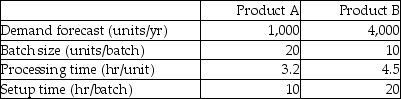 Both products are produced on the same machine, called Mark I.
-Use the information in Table 4.1. The company works 250 days per year and operates two shifts, each covering 8 hours. If a 15 percent capacity cushion is maintained, how many hours of capacity can the company expect from each of its Mark I machines?
Both products are produced on the same machine, called Mark I.
-Use the information in Table 4.1. The company works 250 days per year and operates two shifts, each covering 8 hours. If a 15 percent capacity cushion is maintained, how many hours of capacity can the company expect from each of its Mark I machines? (Multiple Choice)
4.9/5 (70)
(70) Although the fire marshal had declared the capacity of the classroom at 45 students, the introduction to operations management class was so popular, the average attendance was 55 students, literally standing room only. Shouts of "You the man!" accompanied the successful solution of problems such as this: What is the utilization of the operations management professor?
(Multiple Choice)
4.8/5 (77)
(77) 
Filters
- Essay(0)
- Multiple Choice(0)
- Short Answer(0)
- True False(0)
- Matching(0)