



 Chat with AI
Exam 4: Capacity Planning

Exam 1: Using Operations to Create Value115 Questions
Exam 2: Process Strategy and Analysis239 Questions
Exam 3: Quality and Performance198 Questions
Exam 4: Capacity Planning120 Questions
Exam 5: Constraint Management136 Questions
Exam 6: Lean Systems166 Questions
Exam 7: Project Management139 Questions
Exam 8: Forecasting150 Questions
Exam 9: Inventory Management205 Questions
Exam 10: Operations Planning and Scheduling149 Questions
Exam 11: Resource Planning124 Questions
Exam 12: Supply Chain Design77 Questions
Exam 13: Supply Chain Logistic Networks114 Questions
Exam 14: Supply Chain Integration120 Questions
Exam 15: Supply Chain Sustainability78 Questions
Exam 16: Supplement A Decision Making107 Questions
Exam 17: Supplement J Operations Scheduling123 Questions
Exam 18: Supplement K Layout39 Questions
Exam 19: Supplement B Waiting Lines111 Questions
Exam 20: Supplement C Special Inventory Models53 Questions
Exam 21: Supplement D Linear Programming87 Questions
Exam 22: Supplement E Simulation54 Questions
Exam 23: Supplement F Financial Analysis55 Questions
Exam 24: Supplement G Acceptance Sampling Plans87 Questions
Exam 25: Supplement H Measuring Output Rates108 Questions
Exam 26: Supplement I Learning Curve Analysis50 Questions
Select questions type


Scenario 4.5
The T. H. King Company has introduced a new product line that requires two work centers, A and B for manufacture. Work Center A has a current capacity of 10,000 units per year, and Work Center B is capable of 12,500 units per year. This year (year 0), sales of the new product line are expected to reach 10,000 units. Growth is projected at an additional 1,000 units each year through year 5. Pre-tax profits are expected to be $30 per unit throughout the 5-year planning period. Two alternatives are being considered:
1) Expand both Work Centers A and B at the end of year 0 to a capacity of 15,000 units per year, at a total cost for both Work Centers of $200,000;
2) Expand Work Center A at the end of year 0 to 12,500 units per year, matching Work Center B, at a cost of $100,000, then expanding both Work Centers to 15,000 units per year at the end of year 3, at an additional cost at that time of $200,000.
The King Company will not consider projects that don't show a 5th year positive net present value using a discount rate of 15%.
-Use the information in Scenario 4.5. What is the pre-tax cash flow (net present value) for alternative #2 compared to the base case of doing nothing for the next five years?
(Multiple Choice)
4.9/5  (82)
(82) ________ are more appropriate measures of capacity in situations where a task that is initially difficult and time-consuming to perform becomes second-nature and short in duration.
(Short Answer)
4.7/5 (64)
(64) A smaller capacity cushion may be preferred if a process is highly capital intensive.
(True/False)
4.8/5 (87)
(87) Scenario 4.6
Burdell Labs is a diagnostic laboratory that does various tests (blood tests, urine tests, etc.) for doctors' offices in the Indianapolis area. Test specimens are picked up at the doctors' offices and are transported to the testing facility, with uniform arrivals throughout the day. All tests go through two testing centers in the testing facility, Test Center A and Test Center B. A has a current capacity of 1,000 units per week, and B is capable of 1,500 units per week. The facility operates 50 weeks per year. This year (year 0), test volumes are expected to reach 1,000 units per week. Growth per week is projected at an additional 200 units through year 5 (i.e., 1,200 per week in year #1, 1,400 per week in year #2, etc.). Pre-tax profits are expected to be $5 per test throughout the 5-year planning period. Two alternatives are being considered:
1) Expand both Test Centers A and B at the end of year 0 to a capacity of 2,000 units per week, at a total cost for both Test Centers of $300,000;
2) Expand Test Center A at the end of year 0 to 1,500 units per week, matching Test Center B, at a cost of $100,000, then expanding both Test Centers to 2,000 units per year at the end of year 3, at an additional cost at that time of $250,000.
Burdell Labs will not consider projects that don't show a 5th year positive net present value using a discount rate of 15%.
-Use the information in Scenario 4.6. What is the pre-tax cash flow (net present value) for alternative #1 compared to the base case of doing nothing for the next five years?
(Multiple Choice)
4.8/5 (91)
(91) Sleep Tight Motel has the opportunity to purchase an adjacent plot of land. Building on this land would increase their capacity from the current sales level of $515,000/year to $600,000/year. Sleep Tight experiences a 20 percent before-tax profit margin. It wishes to estimate the additional before-tax profits that the expansion will produce. Using the following information, how much more before-tax cash flow would be realized just in year 10 alone? 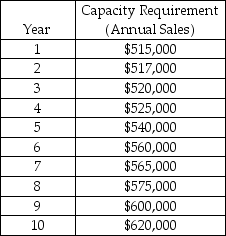
(Multiple Choice)
4.8/5 (77)
(77) Kristen made a batch of chocolate chip cookie dough and then had to clean the utensils and mixing bowl before she made a batch of oatmeal raisin cookie dough. The time spent cleaning the bowl and utensils is an example of setup time.
(True/False)
4.8/5 (78)
(78) ________ are useful capacity analysis tools when the future is uncertain and capacity decisions can be made in a sequential fashion.
(Short Answer)
4.7/5 (75)
(75) As the desired capacity cushion increases, the processing hours required for a year's demand decrease.
(True/False)
4.8/5 (68)
(68) A process's ________ is the length of time it takes to switch from making one type of product to another.
(Short Answer)
4.9/5 (85)
(85) Scenario 4.5
The T. H. King Company has introduced a new product line that requires two work centers, A and B for manufacture. Work Center A has a current capacity of 10,000 units per year, and Work Center B is capable of 12,500 units per year. This year (year 0), sales of the new product line are expected to reach 10,000 units. Growth is projected at an additional 1,000 units each year through year 5. Pre-tax profits are expected to be $30 per unit throughout the 5-year planning period. Two alternatives are being considered:
1) Expand both Work Centers A and B at the end of year 0 to a capacity of 15,000 units per year, at a total cost for both Work Centers of $200,000;
2) Expand Work Center A at the end of year 0 to 12,500 units per year, matching Work Center B, at a cost of $100,000, then expanding both Work Centers to 15,000 units per year at the end of year 3, at an additional cost at that time of $200,000.
The King Company will not consider projects that don't show a 5th year positive net present value using a discount rate of 15%.
-Use the information in Scenario 4.5. What action, if any, should the King Company take?
(Multiple Choice)
4.9/5 (78)
(78) Output measures are used for estimating capacity requirements when product variety and process divergence are high.
(True/False)
4.8/5 (77)
(77) The seven-person maintenance function at a hospital performs both preventive and corrective maintenance on hundreds of items each month. All the workers are scheduled for 40 hours per week and there are four weeks in a month. It is the goal of the maintenance department to achieve 90% utilization with a mix of two-thirds preventive maintenance and one-third corrective maintenance. How many hours each month are spent performing preventive maintenance if they achieve their 90% utilization and correct/preventive mix targets?
(Essay)
4.8/5 (74)
(74) Cash flow is the difference between the flows of funds into and out of an organization over a period of time.
(True/False)
4.8/5 (79)
(79) Figure 4.1
 -A manager weighs three options for capacity cushion as depicted in Figure 4.1. If the dollar amounts expressed in the figure are costs, what is the optimal decision?
 (Multiple Choice)
4.8/5 (71)
(71) The ________ is the set of consecutive time periods considered for planning purposes.
(Short Answer)
4.8/5 (78)
(78) 
Filters
- Essay(0)
- Multiple Choice(0)
- Short Answer(0)
- True False(0)
- Matching(0)