



 Chat with AI
Exam 16: Sound and Hearing

Exam 2: Motion Along a Straight Line55 Questions
Exam 3: Motion in Two or Three Dimensions59 Questions
Exam 4: Newtons Laws of Motion50 Questions
Exam 5: Applying Newtons Laws139 Questions
Exam 6: Work and Kinetic Energy109 Questions
Exam 7: Potential Energy and Energy Conservation50 Questions
Exam 8: Momentum, Impulse, and Collisions99 Questions
Exam 9: Rotation of Rigid Bodies26 Questions
Exam 10: Dynamics of Rotational Motion49 Questions
Exam 11: Equilibrium and Elasticity50 Questions
Exam 12: Fluid Mechanics54 Questions
Exam 13: Gravitation52 Questions
Exam 14: Periodic Motion109 Questions
Exam 15: Mechanical Waves50 Questions
Exam 16: Sound and Hearing121 Questions
Exam 17: Temperature and Heat60 Questions
Exam 18: Thermal Properties of Matter41 Questions
Exam 19: The First Law of Thermodynamics55 Questions
Exam 20: The Second Law of Thermodynamics52 Questions
Exam 21: Electric Charge and Electric Field54 Questions
Exam 22: Gausss Law54 Questions
Exam 23: Electric Potential88 Questions
Exam 24: Capacitance and Dielectrics70 Questions
Exam 25: Current, Resistance, and Electromotive Force44 Questions
Exam 26: Direct-Current Circuits51 Questions
Exam 27: Magnetic Field and Magnetic Forces105 Questions
Exam 28: Sources of Magnetic Field82 Questions
Exam 29: Electromagnetic Induction51 Questions
Exam 30: Inductance88 Questions
Exam 31: Alternating Current51 Questions
Exam 32: Electromagnetic Waves Optics53 Questions
Exam 33: The Nature and Propagation of Light31 Questions
Exam 34: Geometric Optics89 Questions
Exam 35: Interference59 Questions
Select questions type


Ideal gas law: A hot air balloon has a volume of 2.00 × 10³ m3 when fully inflated, and the air inside the balloon is always at atmospheric pressure of 1.01 × 10⁵ Pa because of the large opening used to fill the balloon and heat the air inside it. What is the mass of hot air inside the balloon if its temperature is 120°C? The universal gas constant is 8.314 J/mol ∙ K. (Assume a molecular weight of 28.8 g/mol for air.)
(Multiple Choice)
4.8/5  (75)
(75) Thermal expansion: A rod has a length 2.00000 m at 10.0°C. The length of the rod increases to 2.00060 m when the temperature increases to 30.0°C. What is the coefficient of linear expansion of the material from which the rod is made?
(Multiple Choice)
4.8/5 (97)
(97) Conduction of heat: A solid concrete wall 4.0 m by 2.4 m and 30 cm thick, with a thermal conductivity of 1.3 W/(m ∙ K), separates a basement at 18°C from the ground outside at 6°C. Under steady state conditions, how much heat flows through the wall in one hour?
(Multiple Choice)
4.9/5 (76)
(76) Thermal expansion: Suppose that a steel bridge, 1000 m long, was built without any expansion joints and that only one end of the bridge was held fixed. What would the difference in the length of the bridge be between winter and summer, taking a typical winter temperature as 0.00°C, and a typical summer temperature as 40°C? The coefficient of thermal expansion of steel is 10.5 × 10⁻⁶ K-1.
(Multiple Choice)
4.8/5 (84)
(84) Molecular speeds: A container is filled with a mixture of helium (light molecules) and oxygen (heavy molecules) gases. A thermometer in the container reads 22°C. Which gas molecules have the greater average speed?
(Multiple Choice)
4.9/5 (79)
(79) Ideal gas law: A vertical tube that is closed at the upper end and open at the lower end contains an air pocket. The open end of the tube is under the water of a lake, as shown in the figure. When the lower end of the tube is just under the surface of the lake, where the temperature is 37°C and the pressure is 1.0 × 10⁵ Pa, the air pocket occupies a volume of  . Suppose now that the lower end of the tube is at a depth of 86 m in the lake, where the temperature is 7.0°C. What is the volume of the air pocket under these conditions? The density of the water in the lake is 1000 kg/m3.
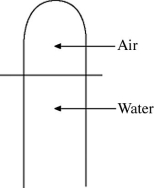
. Suppose now that the lower end of the tube is at a depth of 86 m in the lake, where the temperature is 7.0°C. What is the volume of the air pocket under these conditions? The density of the water in the lake is 1000 kg/m3. (Essay)
5.0/5 (77)
(77) Ideal gas law: 2.0 L of an ideal nitrogen gas (N2) are at 0.00°C and 1.0 atm. The ideal gas constant is R = 8.314 J/mol · K = 0.0821 L ∙ atm/mol ∙ K, Avogadro's number is 6.022 × 10²³ molecules/mol, and the ATOMIC mass of nitrogen is 14 g/mol.
(a) Determine the number of moles of N2.
(b) How many molecules of N2 are present?
(c) What is the mass of this gas?
(Essay)
4.8/5 (84)
(84) Conduction of heat: An architect is interested in estimating the heat loss (in kcal/s) through a sheet of insulating material as a function of the thickness of the sheet. Assuming fixed temperatures on the two faces of the sheet, which one of the graphs in the figure best represents the rate of heat transfer as a function of the thickness of the insulating sheet? 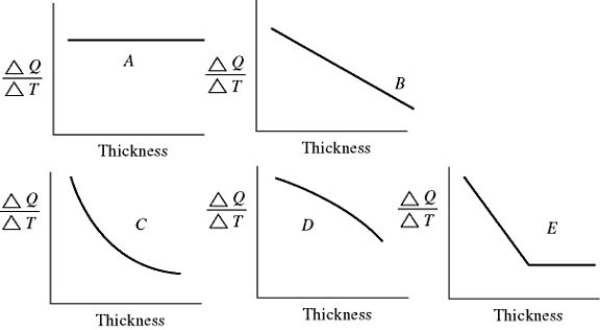
(Multiple Choice)
4.8/5 (77)
(77) Phase changes: Heat is added to a pure substance in a closed container at a constant rate. The figure shows a graph of the temperature of the substance as a function of time. If Lf = latent heat of fusion and Lv = latent heat of vaporization, what is the value of the ratio Lv / Lf for this substance? 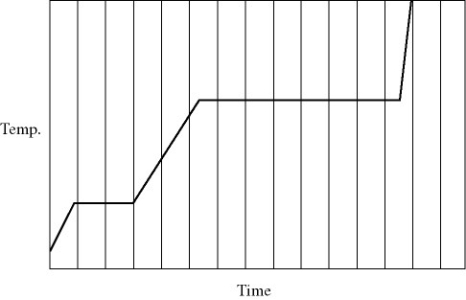
(Multiple Choice)
4.9/5 (86)
(86) Thermal expansion: Two steel spheres are made of the same material and have the same diameter, but one is solid and the other is hollow. If their temperature is increased by the same amount,
(Multiple Choice)
4.8/5 (80)
(80) Ideal gas law: The interior of a refrigerator has a volume of 0.600 m3. The temperature inside the refrigerator in 282 K, and the pressure is 101 kPa. If the molecular weight of air is 29 g/mol, what is the mass of air inside the refrigerator? The ideal gas constant is R = 8.314 J/mol ∙ K = 0.0821 L ∙ atm/mol ∙ K.
(Multiple Choice)
4.8/5 (75)
(75) Calorimetry: A copper cylinder with a mass of 125 g and temperature of 345°C is cooled by dropping it into a glass beaker containing 565 g of water initially at 20.0°C. The mass of the beaker is 50.0 g and the specific heat of the glass is 840 J/kg ∙ K. What is the final equilibrium temperature of the system, assuming the cooling takes place very quickly, so that no energy is lost to the air? The specific heat of copper is 385 J/kg ∙ K and that of water is 4190 J/kg ∙ K.
(Short Answer)
4.9/5 (68)
(68) Calorimetry: A 400-g piece of metal at 120.0°C is dropped into a cup containing 450 g of water at 15.0°C. The final temperature of the system is measured to be 40.0°C. What is the specific heat of the metal, assuming no heat is exchanged with the surroundings or the cup? The specific heat of water is 4190 J/(kg ∙ K).
(Multiple Choice)
4.8/5 (74)
(74) Conduction of heat: The walls of an ice chest are made of 2.00-mm-thick insulation having a thermal conductivity 0.00300 W/m∙K. The total surface area of the ice chest is 1.20 m2. If 4.00 kg of ice at 0.00°C are placed in the chest and the temperature of the outside surface of the chest is 20.0°C, how long does it take the ice to melt under steady state conditions? The latent heat of fusion of water is 79.6 cal/g = 334 kJ/kg.
(Multiple Choice)
4.7/5 (74)
(74) Molecular speeds: An ideal gas is kept in a rigid container that expands negligibly when heated. The gas starts at a temperature of 20.0°C, and heat is added to increase its temperature. At what temperature will its root-mean-square speed (thermal speed) be double its value at 20.0°C?
(Multiple Choice)
4.9/5 (81)
(81) Radiation: A radiating body originally has a Kelvin temperature To, and its surroundings are at 500K (To > 500K). If the Kelvin temperature of the radiating body is increased to  , the net rate at which the body radiates increases by a factor of 333. What was the original temperature
 ?
, the net rate at which the body radiates increases by a factor of 333. What was the original temperature ? (Short Answer)
4.8/5 (74)
(74) Radiation: A cube at 100°C radiates heat at a rate of 80.0 J/s. If its surface temperature is increased to 200°C, the rate at which it will now radiate is closest to
(Multiple Choice)
4.9/5 (85)
(85) Mean free path: The mean free path of an oxygen molecule is 2.0 × 10⁻⁵ m, when the gas is at a pressure of 120 Pa and a temperature of 275 K. The molecular mass of oxygen is 32.0 g/mol and the Boltzmann constant is 1.38 × 10⁻²³ J/K, Avogadro's number is 6.02 × 10²³ molecules/mole, and the ideal gas constant is R = 8.314 J/mol ∙ K = 0.0821 L ∙ atm/mol ∙ K. Assuming that the molecules are moving at their root-mean-square speeds, the average time interval between collisions of an oxygen molecule is closest to
(Multiple Choice)
5.0/5 (71)
(71) Molecular speeds: The root-mean-square speed (thermal speed) of a certain sample of carbon dioxide molecules, with a molecular weight of 44 g/mol, is 396 m/s. What is the root-mean-square speed (thermal speed) of water vapor molecules, with a molecular weight of 18 g/mol, at the same temperature?
(Multiple Choice)
4.8/5 (79)
(79) 
Filters
- Essay(0)
- Multiple Choice(0)
- Short Answer(0)
- True False(0)
- Matching(0)