



 Chat with AI
Exam 16: Sound and Hearing

Exam 2: Motion Along a Straight Line55 Questions
Exam 3: Motion in Two or Three Dimensions59 Questions
Exam 4: Newtons Laws of Motion50 Questions
Exam 5: Applying Newtons Laws139 Questions
Exam 6: Work and Kinetic Energy109 Questions
Exam 7: Potential Energy and Energy Conservation50 Questions
Exam 8: Momentum, Impulse, and Collisions99 Questions
Exam 9: Rotation of Rigid Bodies26 Questions
Exam 10: Dynamics of Rotational Motion49 Questions
Exam 11: Equilibrium and Elasticity50 Questions
Exam 12: Fluid Mechanics54 Questions
Exam 13: Gravitation52 Questions
Exam 14: Periodic Motion109 Questions
Exam 15: Mechanical Waves50 Questions
Exam 16: Sound and Hearing121 Questions
Exam 17: Temperature and Heat60 Questions
Exam 18: Thermal Properties of Matter41 Questions
Exam 19: The First Law of Thermodynamics55 Questions
Exam 20: The Second Law of Thermodynamics52 Questions
Exam 21: Electric Charge and Electric Field54 Questions
Exam 22: Gausss Law54 Questions
Exam 23: Electric Potential88 Questions
Exam 24: Capacitance and Dielectrics70 Questions
Exam 25: Current, Resistance, and Electromotive Force44 Questions
Exam 26: Direct-Current Circuits51 Questions
Exam 27: Magnetic Field and Magnetic Forces105 Questions
Exam 28: Sources of Magnetic Field82 Questions
Exam 29: Electromagnetic Induction51 Questions
Exam 30: Inductance88 Questions
Exam 31: Alternating Current51 Questions
Exam 32: Electromagnetic Waves Optics53 Questions
Exam 33: The Nature and Propagation of Light31 Questions
Exam 34: Geometric Optics89 Questions
Exam 35: Interference59 Questions
Select questions type


Mean free path: What is the mean free path of a gas of randomly-moving hard spheres of radius 2.00 × 10⁻⁹ m when the density of spheres is 3.00 × 10¹⁹ per cubic meter?
(Multiple Choice)
4.8/5  (72)
(72) Phase changes: A substance has a melting point of 20°C and a heat of fusion of 3.5 × 10⁴ J/kg. The boiling point is 150°C and the heat of vaporization is 7.0 × 10⁴ J/kg at a pressure of 1.0 atm. The specific heats for the solid, liquid, and gaseous phases are 600 J/(kg ∙ K), 1000 J/(kg ∙ K), and 400 J/(kg ∙ K), respectively. The quantity of heat given up by 0.50 kg of the substance when it is cooled from 170°C to 88°C, at a pressure of 1.0 atmosphere, is closest to
(Multiple Choice)
4.8/5 (78)
(78) Thermal expansion: You want to insert an aluminum rod, which at 20°C has a radius of 1.000200 cm into a copper tube which has a radius of 1.000100 cm at the same temperature. You decide to put both of them in the refrigerator. At what temperature will the rod just fit if both are cooled to the same temperature? The coefficient of thermal expansion for aluminum is 2.4 × 10⁻⁵ K-1, and that of copper is 1.7 × 10⁻⁵ K-1.
(Multiple Choice)
4.9/5 (88)
(88) Molecular speeds: The average molecular kinetic energy of a gas can be determined by knowing
(Multiple Choice)
4.9/5 (73)
(73) Ideal gas law: How many moles of water (H2O) molecules are in a 4.00 m3 container at a pressure 8.00 × 10⁵ N/m2 and temperature 600°C? The ideal gas constant is R = 8.314 J/mol ∙ K = 0.0821 L ∙ atm/mol ∙ K.
(Multiple Choice)
4.8/5 (86)
(86) Thermal expansion: A brass rod is 40.1 cm long and an aluminum rod is 79.3 cm long when both rods are at an initial temperature of 0°C. The rods are placed in line with a gap of 0.60 cm between them, as shown in the figure. The distance between the far ends of the rods is maintained at 120.0 cm throughout. The temperature of both rods is raised until the two rods are barely in contact. The coefficients of linear expansion of brass and aluminum are 2.0 × 10⁻⁵ K-1 and 2.4 × 10⁻⁵ K-1, respectively. The temperature at which contact of the rods barely occurs is closest to 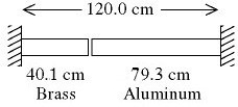
(Multiple Choice)
4.8/5 (77)
(77) Quantity of heat: A 648-g empty iron kettle is put on a stove. How much heat. in joules. must it absorb to raise its temperature from  to
 (The specific heat for iron is 113 cal/kg ∙ °C, 1 cal = 4.190 J)
to (The specific heat for iron is 113 cal/kg ∙ °C, 1 cal = 4.190 J) (Multiple Choice)
4.8/5 (85)
(85) Molecular speeds: A cubic box with sides of 20.0 cm contains 2.00 × 10²³ molecules of helium with a root-mean-square speed (thermal speed) of 200 m/s. The mass of a helium molecule is 3.40 × 10⁻²⁷ kg. What is the average pressure exerted by the molecules on the walls of the container? The Boltzmann constant is 1.38 × 10⁻²³ J/K and the ideal gas constant is R = 8.314 J/mol ∙ K = 0.0821 L ∙ atm/mol ∙ K.
(Multiple Choice)
4.9/5 (82)
(82) Mean free path: What is the mean free path for the molecules in an ideal gas when the pressure is 100 kPa and the temperature is 300 K given that the collision cross-section for the molecules of that gas is 2.0 × 10⁻²⁰ m2? The Boltzmann constant is 1.38 × 10⁻²³ J/K, Avogadro's number is 6.02 × 10²³ molecules/mole, and the ideal gas constant is R = 8.314 J/mol ∙ K = 0.0821 L ∙ atm/mol ∙ K.
(Multiple Choice)
4.8/5 (79)
(79) Radiation: A spherical object 25.0 cm in diameter having an emissivity of 0.800 is held at a temperature of 275°C by an internal heater. This object is embedded in a very large vat of water at 100.0°C and atmospheric pressure. At what maximum rate (in g/min) is the water evaporating in the vat due to the radiated heat it receives from the object? You can ignore any heat radiated by the water. The latent heat of fusion for water is 33,400 J/kg, its latent heat of vaporization is 2.26 × 10⁶ J/kg, and the Stefan-Boltzmann constant is 5.670 × 10⁻⁸ W/m2 · K4.
(Short Answer)
4.9/5 (66)
(66) Molecular speeds: The root-mean-square speed (thermal speed) of the molecules of a gas is 200 m/s at 23.0°C. At 227°C the root-mean-square speed (thermal speed) of the molecules will be closest to
(Multiple Choice)
4.9/5 (70)
(70) Calorimetry: Two experimental runs are performed to determine the calorimetric properties of an alcohol that has a melting point of -10°C. In the first run, a 200-g cube of frozen alcohol, at the melting point, is added to 300 g of water at 20°C in a styrofoam container. When thermal equilibrium is reached, the alcohol-water solution is at a temperature of 5.0°C. In the second run, an identical cube of alcohol is added to 500 g of water at 20°C and the temperature at thermal equilibrium is 10°C. The specific heat of water is 4190 J/kg · K. Assume that no heat is exchanged with the styrofoam container and with the surroundings. The heat of fusion of the alcohol is closest to
(Multiple Choice)
4.8/5 (73)
(73) Ideal gas law: A sealed 26-  tank is filled with 2000 moles of oxygen gas (O2) at an initial temperature of 270 K. The gas is heated to a final temperature of 460 K. The ATOMIC mass of oxygen is 16.0 g/mol, and the ideal gas constant is R = 8.314 J/mol · K = 0.0821 L · atm/mol · K. The final pressure of the gas is closest to
 (Multiple Choice)
4.9/5 (81)
(81) Molecular speeds: At 50.0°C, the average translational kinetic energy of a gas molecule is K. If the temperature is now increased to 100.0°C, the average translational kinetic energy of a molecule will be closest to
(Multiple Choice)
4.7/5 (65)
(65) Ideal gas law: A sealed container holds 0.020 moles of nitrogen (N2) gas, at a pressure of 1.5 atmospheres and a temperature of 290 K. The atomic mass of nitrogen is 14.0 g/mol. The Boltzmann constant is 1.38 × 10⁻²³ J/K and the ideal gas constant is R = 8.314 J/mol · K = 0.0821 L · atm/mol · K. The mass density of the gas is closest to
(Multiple Choice)
4.7/5 (64)
(64) Ideal gas law: For a fixed amount of gas, if the absolute temperature of the gas is doubled, what happens to the pressure of the gas?
(Multiple Choice)
4.8/5 (78)
(78) Thermal expansion: If the temperature of an iron sphere is increased,
(Multiple Choice)
5.0/5 (77)
(77) Conduction of heat: A heat conducting rod, 0.90 m long, is made of an aluminum section that is 0.10 m long, and a copper section that is  long. Both sections have cross-sectional areas of
 The aluminum end is maintained at a temperature of
 and the copper end is at
 . The thermal conductivity of aluminum is 205 W/m ∙ K and of copper is 385 W/m ∙ K. Steady state has been reached, and no heat is lost through the well-insulated sides of the rod. The temperature of the aluminum-copper junction in the rod is closest to
long. Both sections have cross-sectional areas of The aluminum end is maintained at a temperature of and the copper end is at . The thermal conductivity of aluminum is 205 W/m ∙ K and of copper is 385 W/m ∙ K. Steady state has been reached, and no heat is lost through the well-insulated sides of the rod. The temperature of the aluminum-copper junction in the rod is closest to (Multiple Choice)
4.9/5 (69)
(69) Ideal gas law: A fixed amount of ideal gas is held in a rigid container that expands negligibly when heated. At 20°C the gas pressure is p. If we add enough heat to increase the temperature from 20°C to 40°C, the pressure will be
(Multiple Choice)
4.8/5 (91)
(91) Thermal expansion: 1.000 L of water at 20.00°C will occupy what volume if it is heated to 80.00°C? Water has a volume expansion coefficient of 210 × 10-6/°C. (Express your answer to 4 significant figures.)
(Multiple Choice)
4.7/5 (71)
(71) 
Filters
- Essay(0)
- Multiple Choice(0)
- Short Answer(0)
- True False(0)
- Matching(0)