



 Chat with AI
Exam 16: Sound and Hearing

Exam 2: Motion Along a Straight Line55 Questions
Exam 3: Motion in Two or Three Dimensions59 Questions
Exam 4: Newtons Laws of Motion50 Questions
Exam 5: Applying Newtons Laws139 Questions
Exam 6: Work and Kinetic Energy109 Questions
Exam 7: Potential Energy and Energy Conservation50 Questions
Exam 8: Momentum, Impulse, and Collisions99 Questions
Exam 9: Rotation of Rigid Bodies26 Questions
Exam 10: Dynamics of Rotational Motion49 Questions
Exam 11: Equilibrium and Elasticity50 Questions
Exam 12: Fluid Mechanics54 Questions
Exam 13: Gravitation52 Questions
Exam 14: Periodic Motion109 Questions
Exam 15: Mechanical Waves50 Questions
Exam 16: Sound and Hearing121 Questions
Exam 17: Temperature and Heat60 Questions
Exam 18: Thermal Properties of Matter41 Questions
Exam 19: The First Law of Thermodynamics55 Questions
Exam 20: The Second Law of Thermodynamics52 Questions
Exam 21: Electric Charge and Electric Field54 Questions
Exam 22: Gausss Law54 Questions
Exam 23: Electric Potential88 Questions
Exam 24: Capacitance and Dielectrics70 Questions
Exam 25: Current, Resistance, and Electromotive Force44 Questions
Exam 26: Direct-Current Circuits51 Questions
Exam 27: Magnetic Field and Magnetic Forces105 Questions
Exam 28: Sources of Magnetic Field82 Questions
Exam 29: Electromagnetic Induction51 Questions
Exam 30: Inductance88 Questions
Exam 31: Alternating Current51 Questions
Exam 32: Electromagnetic Waves Optics53 Questions
Exam 33: The Nature and Propagation of Light31 Questions
Exam 34: Geometric Optics89 Questions
Exam 35: Interference59 Questions
Select questions type


Conduction of heat: Two metal rods, one silver and the other copper, are both attached to a steam chamber as shown in the figure, with a temperature of 100°C, at one end, and an ice water bath, with a temperature of 0°C, at the other. The rods are 5.0 cm long and have a square cross-section, 2.0 cm on a side. When steady state has been reached, how much heat flows through the two rods in 1.0 min? The thermal conductivity of silver is 417 W/(m ∙ K), and that of copper is 395 W/(m ∙ K). No heat is exchanged between the rods and the surroundings, except at their ends. 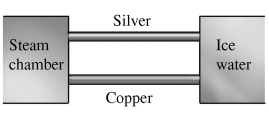
(Multiple Choice)
4.9/5  (68)
(68) Conduction of heat: A heat conducting rod, 1.40 m long, is made of an aluminum section that is 0.50 m long and a copper section that is  long. Both sections have cross-sectional areas of
 The aluminum end and the copper end are maintained at temperatures of
 and
 respectively. The thermal conductivity of aluminum is 205 W/m ∙ K of copper is 385 W/m ∙ K. The rate at which heat is conducted in the rod is closest to
long. Both sections have cross-sectional areas of The aluminum end and the copper end are maintained at temperatures of and respectively. The thermal conductivity of aluminum is 205 W/m ∙ K of copper is 385 W/m ∙ K. The rate at which heat is conducted in the rod is closest to (Multiple Choice)
4.9/5 (78)
(78) Ideal gas law: A weather balloon contains 12.0 m3 of hydrogen gas when the balloon is released from a location at which the temperature is 22.0°C and the pressure is 101 kPa. The balloon rises to a location where the temperature is -30.0°C and the pressure is 20.0 kPa. If the balloon is free to expand so that the pressure of the gas inside is equal to the ambient pressure, what is the new volume of the balloon? Assume that in both cases the hydrogen gas is in thermal equilibrium with the outside air.
(Multiple Choice)
4.7/5 (76)
(76) Mean free path: The mean free path of an oxygen molecule is 2.0 × 10⁻⁵ m, when the gas is at a pressure of 120 Pa and a temperature of 275 K. The atomic mass of oxygen is 16.0 g/mol, the Boltzmann constant is 1.38 × 10⁻²³ J/K, Avogadro's number is 6.02 × 10²³ molecules/mole, and the ideal gas constant is J/mol ∙ K = 0.0821 L ∙ atm/mol ∙ K. The radius of an oxygen molecule is closest to
(Multiple Choice)
4.9/5 (68)
(68) Calorimetry: A person pours 330 g of water at 45°C into an 855-g aluminum container with an initial temperature of 10°C. The specific heat of aluminum is 900 J/(kg ∙ K) and that of water is 4190 J/(kg ∙ K). What is the final temperature of the system, assuming no heat is exchanged with the surroundings?
(Multiple Choice)
4.9/5 (87)
(87) Ideal gas law: If a certain sample of an ideal gas has a temperature of 109°C and exerts a pressure of  on the walls of its container, how many gas molecules are present in each cubic centimeter of volume? The ideal gas constant is 8.314 J/mol · K and Avogadro's number is 6.022 × 10²³ molecules/mol.
 (Short Answer)
4.8/5 (77)
(77) Phase changes: If 2.0 g of water at 0.00°C is to be vaporized, how much heat must be added to it? The specific heat of water is 1.0 cal/g ∙ K, its heat of fusion is 80 cal/g, and its heat of vaporization is 539 cal/g.
(Multiple Choice)
4.8/5 (61)
(61) Thermal expansion: A machinist needs to remove a tight fitting pin of material A from a hole in a block made of material B. The machinist heats both the pin and the block to the same high temperature and removes the pin easily. What statement relates the coefficient of thermal expansion of material A to that of material B?
(Multiple Choice)
4.9/5 (75)
(75) Ideal gas law: A sealed 89-  tank is filled with 6000 moles of oxygen gas (O2) at an initial temperature of 270 K. The gas is heated to a final temperature of 350 K. The ATOMIC mass of oxygen is 16.0 g/mol, and the ideal gas constant is R = 8.314 J/mol · K = 0.0821 L · atm/mol · K. The initial pressure of the gas is closest to
 (Multiple Choice)
4.9/5 (78)
(78) Phase changes: Heat is added to a 2.0 kg piece of ice at a rate of  How long will it take for the ice to melt if it was initially at 0.00°C? (The latent heat of fusion for water is 334 kJ/kg and its latent heat of vaporization is 2260 kJ/kg.)
 (Multiple Choice)
4.7/5 (87)
(87) Quantity of heat: A 905-g meteor impacts the earth at a speed of 1629 m/s. If all of its energy is entirely converted to heat in the meteor, what will be the resulting temperature rise of the meteor, assuming it does not melt? The specific heat for the meteor material is 472 J/kg ∙ K, which is about the same as that of iron.
(Multiple Choice)
4.7/5 (79)
(79) Thermal expansion: The exterior of a supersonic airplane is made of aluminum, which has a coefficient of linear expansion of 24 × 10-6 K-1. At 15°C, the plane measures 62.1 m in length. When the plane is in flight, friction with the air increases the temperature of the exterior skin to 200°C. What is the change in the length of the outer skin of the plane?
(Multiple Choice)
4.7/5 (68)
(68) Molecular speeds: A 5.0-liter gas tank holds 1.4 moles of helium (He) and 0.70 moles of oxygen (O2), at a temperature of 260 K. The atomic masses of helium and oxygen are 4.0 g/mol and 16.0 g/mol, respectively. Avogadro's number is 6.022 × 10²³ molecules/mol and the Boltzmann constant is 1.38 × 10⁻²³ J/K. The total random translational kinetic energy of the gas in the tank is closest to
(Multiple Choice)
4.9/5 (79)
(79) Conduction of heat: What is the steady state rate of heat flow through a pane of glass that is 40.0 cm by 30.0 cm with a thickness of 4.00 mm when the outside temperature of the glass is -10.0°C and its inside temperature is 25.0°C? The thermal conductivity of glass is 0.105 W/(m∙K), the specific heat of glass is 0.180 cal/(g ∙ °C), and 1 cal = 4.190 J.
(Multiple Choice)
4.8/5 (76)
(76) Thermal expansion: A glass flask has a volume of 500 mL at a temperature of 20°C. The flask contains  of mercury at
 The temperature of the mercury and flask is raised until the mercury reaches the
 reference mark. The coefficients of volume expansion of mercury and glass are 18 × 10-5 K-1 and 2.0 × 10⁻⁵ K-1, respectively. The temperature at which this occurs is closest to
of mercury at The temperature of the mercury and flask is raised until the mercury reaches the reference mark. The coefficients of volume expansion of mercury and glass are 18 × 10-5 K-1 and 2.0 × 10⁻⁵ K-1, respectively. The temperature at which this occurs is closest to (Multiple Choice)
4.8/5 (84)
(84) Molecular speeds: At what temperature would the root-mean-square speed (thermal speed) of oxygen molecules be 13.0 m/s? Assume that oxygen approximates an ideal gas. The mass of one O2 molecule is 5.312 × 10⁻²⁶ kg. The Boltzmann constant is 1.38 × 10⁻²³ J/K.
(Multiple Choice)
4.8/5 (85)
(85) Molecular speeds: The root-mean-square speed (thermal speed) of the molecules of a gas is 200 m/s at a temperature 23.0°C. What is the mass of the individual molecules? The Boltzmann constant is 1.38 × 10⁻²³ J/K.
(Multiple Choice)
4.8/5 (65)
(65) Calorimetry: Two experimental runs are performed to determine the calorimetric properties of an alcohol that has a melting point of -10°C. In the first run, a 200-g cube of frozen alcohol, at the melting point, is added to 300 g of water at 20°C in a styrofoam container. When thermal equilibrium is reached, the alcohol-water solution is at a temperature of 5.0°C. In the second run, an identical cube of alcohol is added to 500 g of water at 20°C and the temperature at thermal equilibrium is 10°C. The specific heat of water is 4190 J/kg · K. Assume that no heat is exchanged with the styrofoam container and with the surroundings. The specific heat of the alcohol is closest to
(Multiple Choice)
4.7/5 (81)
(81) Molecular speeds: What is the total translational kinetic energy in a test chamber filled with nitrogen (N2) at  and
 The dimensions of the chamber are
 The ATOMIC weight of nitrogen is 28.0 g/mol, Avogadro's number is 6.022 × 10²³ molecules/mol and the Boltzmann constant is 1.38 × 10⁻²³ J/K.
and The dimensions of the chamber are The ATOMIC weight of nitrogen is 28.0 g/mol, Avogadro's number is 6.022 × 10²³ molecules/mol and the Boltzmann constant is 1.38 × 10⁻²³ J/K. (Short Answer)
4.7/5 (83)
(83) 
Filters
- Essay(0)
- Multiple Choice(0)
- Short Answer(0)
- True False(0)
- Matching(0)