



 Chat with AI
Exam 16: Sound and Hearing

Exam 2: Motion Along a Straight Line55 Questions
Exam 3: Motion in Two or Three Dimensions59 Questions
Exam 4: Newtons Laws of Motion50 Questions
Exam 5: Applying Newtons Laws139 Questions
Exam 6: Work and Kinetic Energy109 Questions
Exam 7: Potential Energy and Energy Conservation50 Questions
Exam 8: Momentum, Impulse, and Collisions99 Questions
Exam 9: Rotation of Rigid Bodies26 Questions
Exam 10: Dynamics of Rotational Motion49 Questions
Exam 11: Equilibrium and Elasticity50 Questions
Exam 12: Fluid Mechanics54 Questions
Exam 13: Gravitation52 Questions
Exam 14: Periodic Motion109 Questions
Exam 15: Mechanical Waves50 Questions
Exam 16: Sound and Hearing121 Questions
Exam 17: Temperature and Heat60 Questions
Exam 18: Thermal Properties of Matter41 Questions
Exam 19: The First Law of Thermodynamics55 Questions
Exam 20: The Second Law of Thermodynamics52 Questions
Exam 21: Electric Charge and Electric Field54 Questions
Exam 22: Gausss Law54 Questions
Exam 23: Electric Potential88 Questions
Exam 24: Capacitance and Dielectrics70 Questions
Exam 25: Current, Resistance, and Electromotive Force44 Questions
Exam 26: Direct-Current Circuits51 Questions
Exam 27: Magnetic Field and Magnetic Forces105 Questions
Exam 28: Sources of Magnetic Field82 Questions
Exam 29: Electromagnetic Induction51 Questions
Exam 30: Inductance88 Questions
Exam 31: Alternating Current51 Questions
Exam 32: Electromagnetic Waves Optics53 Questions
Exam 33: The Nature and Propagation of Light31 Questions
Exam 34: Geometric Optics89 Questions
Exam 35: Interference59 Questions
Select questions type


Radiation: What is the net power that a person loses through radiation if her surface area is 1.20 m2, if her emissivity is 0.895, if her skin temperature is 300 K, and if she is in a room that is at a temperature of 17°C? The Stefan-Boltzmann constant is 5.670 × 10⁻⁸ W/m2 · K4.
(Multiple Choice)
5.0/5  (75)
(75) Temperature scales: (a) Internal human body temperature is often stated to be normal at 98.6°F. What is this temperature on the Celsius and Kelvin scales?
(b) Gallium boils at 2205°C. What is the corresponding temperature in the Fahrenheit and Kelvin scales?
(c) The boiling point of liquid nitrogen is 77.0 K. What is the corresponding temperature in the Fahrenheit and Celsius scales?
(Essay)
4.9/5 (91)
(91) Radiation: The filament in a light bulb has a diameter of 0.050 mm and an emissivity of 1.0. The temperature of the filament is 3000°C. What should be the length of the filament so it will radiate 60 W of power? The Stefan-Boltzmann constant is 5.670 × 10⁻⁸ W/m2 · K4.
(Multiple Choice)
4.9/5 (82)
(82) Ideal gas law: What is the mass density of argon gas at pressure 1.00 × 10⁵ N/m2 and at temperature 300 K? The mean atomic mass of argon is 39.948 g/mol and the ideal gas constant is R = 8.314 J/mol ∙ K = 0.0821 L ∙ atm/mol ∙ K.
(Multiple Choice)
4.9/5 (81)
(81) Ideal gas law: The number of molecules in one mole of a substance
(Multiple Choice)
5.0/5 (75)
(75) Molecular speeds: A mole of oxygen (O2) molecules and a mole of carbon dioxide (CO2) molecules at the same temperature and pressure have
(Multiple Choice)
4.8/5 (76)
(76) Quantity of heat: If we use 67 W of power to heat 148 g of water, how long will it take to raise the temperature of the water from 15°C to 25°C? The specific heat of water is 4190 J/kg ∙ K.
(Multiple Choice)
4.8/5 (78)
(78) Mean free path: What is the mean free path of molecules in an ideal gas in which the mean collision time is 3.00 × 10⁻¹⁰ s, the temperature is 300 K, and the mass of the molecules is 6.00 × 10⁻²⁵ kg? Assume that the molecules are moving at their root-mean-square speeds. The Boltzmann constant is 1.38 × 10⁻²³ J/K.
(Multiple Choice)
4.8/5 (74)
(74) Conduction of heat: A rod, with sides insulated to prevent heat loss, has one end immersed in boiling water 100°C and the other end in a water-ice mixture at 0.00°C. The rod has uniform cross-sectional area of  and length of
 Under steady state conditions, the heat conducted by the rod melts the ice at a rate of
 every 34 seconds. What is the thermal conductivity of the rod? (The heat of fusion of water is
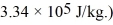
and length of Under steady state conditions, the heat conducted by the rod melts the ice at a rate of every 34 seconds. What is the thermal conductivity of the rod? (The heat of fusion of water is (Short Answer)
5.0/5 (72)
(72) Mean free path: On a hot summer day, the temperature is 40.0°C and the pressure is 1.01 × 10⁵ Pa. Let us model the air as all nitrogen of molecular mass 28.0 g/mol having molecules of diameter 0.500 nm that are moving at their root-mean-square speed. Avogadro's number is 6.02 × 10²³ molecules/mol, the ideal gas constant is 8.31 J/mol ∙· K, and the Boltzmann constant is 1.38 × 10⁻²³ J/K. Calculate reasonable estimates for
(a) the root-mean-square speed of the nitrogen molecules.
(b) the average distance a typical molecule travels between collisions.
(c) the average time a molecule travels between collisions, assuming that the molecules are moving at their root-mean-square speeds.
(d) the number of collisions an average molecule undergoes per second.
(Essay)
4.9/5 (92)
(92) Molecular speeds: Dust particles are pulverized rock, which has density 2500 kg/m3. They are approximately spheres 20 μm in diameter. Treating dust as an ideal gas, what is the root-mean-square speed (thermal speed) of a dust particle at  (The Boltzmann constant is 1.38 × 10⁻²³ J/K.)
 (Multiple Choice)
4.8/5 (78)
(78) Thermal expansion: The coefficient of linear expansion of aluminum is 24 × 10-6 K-1 and the coefficient of volume expansion of olive oil is 0.68 × 10⁻³ K-1. A novice cook, in preparation for deep-frying some potatoes, fills a 1.00-L aluminum pot to the brim and heats the oil and the pot from an initial temperature of 15°C to 190°C. To his consternation some olive oil spills over the top. How much?
(Multiple Choice)
4.9/5 (75)
(75) Radiation: A blacksmith is flattening a steel plate that measures 10 cm × 15 cm × 1 mm. He has heated the plate to 900 K. If the emissivity of the plate is 0.75, what is the total rate at which it radiates energy? The Stefan-Boltzmann constant is 5.670 × 10⁻⁸ W/m2 · K4. Ignore any heat it receives from the surroundings.
(Multiple Choice)
4.8/5 (80)
(80) Molecular speeds: An oxygen molecule falls in a vacuum. From what height must it fall so that its kinetic energy at the bottom equals the average energy of an oxygen molecule at 800 K? (The Boltzmann constant is 1.38 × 10⁻²³ J/K, the molecular weight of oxygen is 32.0 g/mol, and Avogadro's number is 6.022 × 10²³ molecules/mol.)
(Multiple Choice)
4.9/5 (76)
(76) Ideal gas law: A 3.2-L volume of neon gas (Ne) is at a pressure of 3.3 atm and a temperature of 330 K. The atomic mass of neon is 20.2 g/mol, Avogadro's number is 6.022 × 10²³ molecules/mol, and the ideal gas constant is R = 8.314 J/mol · K = 0.0821 L · atm/mol · K. The mass of the neon gas is closest to
(Multiple Choice)
4.8/5 (69)
(69) Radiation: A cube at 100.0°C radiates heat at a rate of 80.0 J/s. If the length of each side is cut in half, the rate at which it will now radiate is closest to
(Multiple Choice)
4.7/5 (79)
(79) Ideal gas law: 3.00 moles of an ideal gas at a pressure of 250 kPa are held in a container of volume of 25.0 L. The ideal gas constant is R = 8.314 J/mol ∙ K = 0.0821 L ∙ atm/mol ∙ K, and 1 atm = 1.01 × 10⁵ Pa. The temperature of this gas is closest to
(Multiple Choice)
4.7/5 (86)
(86) Calorimetry: A 200-g metal container, insulated on the outside, holds 100 g of water in thermal equilibrium at  A 21-g ice cube, at the melting point, is dropped into the water, and when thermal equilibrium is reached the temperature is 15.00°C. Assume there is no heat exchange with the surroundings. For water, the specific heat is 4190 J/kg · K and the heat of fusion is 3.34 × 10⁵ J/kg. The specific heat for the metal is closest to
 (Multiple Choice)
4.8/5 (78)
(78) Quantity of heat: It is a well-known fact that water has a higher specific heat than iron. Now, consider equal masses of water and iron that are initially in thermal equilibrium. The same amount of heat, 30 calories, is added to each one. Which statement is true?
(Multiple Choice)
4.9/5 (79)
(79) Thermal expansion: A certain metal has a coefficient of linear expansion of 2.00 × 10⁻⁵ K-1. It has been kept in a laboratory oven at 325°C for a long time. It is now removed from the oven and placed in a freezer at -145°C. After it has reached freezer temperature, the percent change in its density during this process is closest to
(Multiple Choice)
4.9/5 (93)
(93) 
Filters
- Essay(0)
- Multiple Choice(0)
- Short Answer(0)
- True False(0)
- Matching(0)