



 Chat with AI
Exam 18: Superposition and Standing Waves

Exam 1: Physics and Measurement25 Questions
Exam 2: Motion in One Dimension66 Questions
Exam 3: Vectors47 Questions
Exam 4: Motion in Two Dimensions79 Questions
Exam 5: The Laws of Motion113 Questions
Exam 6: Circular Motion and Other Applications of Newtons Laws55 Questions
Exam 7: Energy of a System74 Questions
Exam 8: Conservation of Energy84 Questions
Exam 9: Linear Momentum and Collisions89 Questions
Exam 10: Rotation of a Rigid Object About a Fixed Axis82 Questions
Exam 11: Angular Momentum46 Questions
Exam 12: Static Equilibrium and Elasticity34 Questions
Exam 13: Universal Gravitation47 Questions
Exam 14: Fluid Mechanics53 Questions
Exam 15: Oscillatory Motion41 Questions
Exam 16: Wave Motion82 Questions
Exam 18: Superposition and Standing Waves72 Questions
Exam 19: Temperature47 Questions
Exam 20: The First Law of Thermodynamics61 Questions
Exam 21: The Kinetic Theory of Gases38 Questions
Exam 22: Heat Engines, Entropy, and the Second Law of Thermodynamics55 Questions
Exam 23: Electric Fields67 Questions
Exam 24: Gausss Law82 Questions
Exam 25: Electric Potential111 Questions
Exam 26: Capacitance and Dielectrics63 Questions
Exam 27: Current and Resistance34 Questions
Exam 28: Direct-Current Circuits84 Questions
Exam 29: Magnetic Fields80 Questions
Exam 30: Sources of the Magnetic Field95 Questions
Exam 31: Faradays Law62 Questions
Exam 32: Inductance23 Questions
Exam 33: Alternating-Current Circuits65 Questions
Exam 34: Electromagnetic Waves40 Questions
Exam 35: The Nature of Light and the Principles of Ray Optics37 Questions
Exam 36: Image Formation43 Questions
Exam 37: Wave Optics48 Questions
Exam 38: Diffraction Patterns and Polarization47 Questions
Exam 39: Relativity34 Questions
Exam 40: Introduction to Quantum Physics48 Questions
Exam 41: Quantum Mechanics33 Questions
Exam 42: Atomic Physics59 Questions
Exam 43: Molecules and Solids46 Questions
Exam 44: Nuclear Structure89 Questions
Exam 46: Particle Physics and Cosmology34 Questions
Select questions type


A microphone in the ocean is sensitive to the sounds emitted by porpoises. To produce a usable signal, sound waves striking the microphone must have an intensity of 1.02 × 10⁻¹¹ W/m2. If porpoises emit sounds with a power of 0.049 9 W, how far away can a porpoise be and still be heard? Disregard absorption of sound waves by the water.
(Short Answer)
4.7/5  (78)
(78) Two pulses are traveling towards each other at 10 cm/s on a long string at t = 0 s, as shown below. 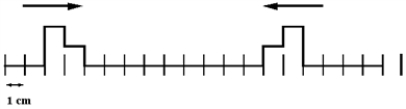 Which diagram below correctly shows the shape of the string at 0.5 s?
 (Multiple Choice)
4.9/5 (68)
(68) An organ pipe open at both ends is 1.5 m long. A second organ pipe that is closed at one end and open at the other is 0.75 m long. The speed of sound in the room is 330 m/s. Which of the following sets of frequencies consists of frequencies which can be produced by both pipes?
(Multiple Choice)
4.7/5 (84)
(84) Exhibit 18-1
The figure below shows wave crests after a stone is thrown into a pond. 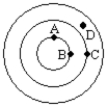 Use this exhibit to answer the following question(s).
-Refer to Exhibit 18-1. The phase difference in radians between points A and C is
Use this exhibit to answer the following question(s).
-Refer to Exhibit 18-1. The phase difference in radians between points A and C is (Multiple Choice)
4.9/5 (75)
(75) A harmonic longitudinal wave propagating down a tube filled with a compressible gas has the form s(x, t) = sm cos (kx − ωt). Its velocity can be obtained from
(Multiple Choice)
4.8/5 (89)
(89) Two harmonic waves traveling in opposite directions interfere to produce a standing wave described by y = 4 sin (5x) cos (6t) where x is in m and t is in s. What is the approximate frequency of the interfering waves?
(Multiple Choice)
4.8/5 (73)
(73) Two identical strings have the same length and same mass per unit length. String B is stretched with four times as great a tension as that applied to string A. Which statement is correct for all n harmonics on the two strings, n = 1, 2, 3...?
(Multiple Choice)
4.9/5 (91)
(91) Two waves are described by y1 = 6 cos 180t and y2 = 6 cos 186t, (both in meters).
What effective frequency does the resultant vibration have at a point?
(Multiple Choice)
4.8/5 (79)
(79) A fire engine approaches a wall at 5 m/s while the siren emits a tone of 500 Hz frequency. At the time, the speed of sound in air is 340 m/s. How many beats per second do the people on the fire engine hear?
(Multiple Choice)
4.8/5 (90)
(90) A bat, flying at 5.00 m/s, emits a chirp at 40.0 kHz. If this sound pulse is reflected by a wall, what is the frequency of the echo received by the bat? (vsound = 340 m/s.)
(Short Answer)
4.9/5 (69)
(69) In a standing wave, not necessarily at the fundamental frequency, on a string of length L, the distance between nodes is
(Multiple Choice)
4.9/5 (91)
(91) The superposition of two waves, 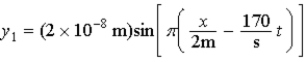 and
 , results in a wave with a frequency of
and , results in a wave with a frequency of (Multiple Choice)
4.8/5 (94)
(94) 
Filters
- Essay(0)
- Multiple Choice(0)
- Short Answer(0)
- True False(0)
- Matching(0)