



 Chat with AI
Exam 18: Superposition and Standing Waves

Exam 1: Physics and Measurement25 Questions
Exam 2: Motion in One Dimension66 Questions
Exam 3: Vectors47 Questions
Exam 4: Motion in Two Dimensions79 Questions
Exam 5: The Laws of Motion113 Questions
Exam 6: Circular Motion and Other Applications of Newtons Laws55 Questions
Exam 7: Energy of a System74 Questions
Exam 8: Conservation of Energy84 Questions
Exam 9: Linear Momentum and Collisions89 Questions
Exam 10: Rotation of a Rigid Object About a Fixed Axis82 Questions
Exam 11: Angular Momentum46 Questions
Exam 12: Static Equilibrium and Elasticity34 Questions
Exam 13: Universal Gravitation47 Questions
Exam 14: Fluid Mechanics53 Questions
Exam 15: Oscillatory Motion41 Questions
Exam 16: Wave Motion82 Questions
Exam 18: Superposition and Standing Waves72 Questions
Exam 19: Temperature47 Questions
Exam 20: The First Law of Thermodynamics61 Questions
Exam 21: The Kinetic Theory of Gases38 Questions
Exam 22: Heat Engines, Entropy, and the Second Law of Thermodynamics55 Questions
Exam 23: Electric Fields67 Questions
Exam 24: Gausss Law82 Questions
Exam 25: Electric Potential111 Questions
Exam 26: Capacitance and Dielectrics63 Questions
Exam 27: Current and Resistance34 Questions
Exam 28: Direct-Current Circuits84 Questions
Exam 29: Magnetic Fields80 Questions
Exam 30: Sources of the Magnetic Field95 Questions
Exam 31: Faradays Law62 Questions
Exam 32: Inductance23 Questions
Exam 33: Alternating-Current Circuits65 Questions
Exam 34: Electromagnetic Waves40 Questions
Exam 35: The Nature of Light and the Principles of Ray Optics37 Questions
Exam 36: Image Formation43 Questions
Exam 37: Wave Optics48 Questions
Exam 38: Diffraction Patterns and Polarization47 Questions
Exam 39: Relativity34 Questions
Exam 40: Introduction to Quantum Physics48 Questions
Exam 41: Quantum Mechanics33 Questions
Exam 42: Atomic Physics59 Questions
Exam 43: Molecules and Solids46 Questions
Exam 44: Nuclear Structure89 Questions
Exam 46: Particle Physics and Cosmology34 Questions
Select questions type


Tuning forks #1, #2, and #3 each have slightly different frequencies.When #1 and #2 are sounded together, a beat frequency of 3 Hz results. When #2 and #3 are sounded together, a beat frequency of 5 Hz results. If the frequency of #1 is 100 Hz, which of the following cannot be the frequency of #3?
(Multiple Choice)
4.9/5  (70)
(70) A string is stretched and fixed at both ends, 200 cm apart. If the density of the string is 0.015 g/cm, and its tension is 600 N, what is the wavelength (in cm) of the first harmonic?
(Multiple Choice)
4.9/5 (90)
(90) A length of organ pipe is closed at one end. If the speed of sound is 344 m/s, what length of pipe (in cm) is needed to obtain a fundamental frequency of 50 Hz?
(Multiple Choice)
4.7/5 (78)
(78) Two harmonic waves are described by 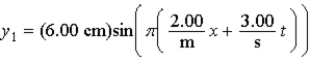
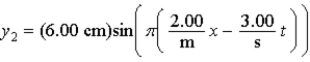 What is the magnitude of the displacement (in cm) of this wave at x = 3 cm and t = 5 sec?
 (Multiple Choice)
4.8/5 (72)
(72) Which of the following wavelengths could NOT be present as a harmonic on a 2 m long string?
(Multiple Choice)
4.9/5 (76)
(76) Two harmonic waves are described by 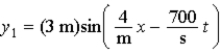
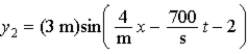 What is the amplitude of the resultant wave?
 (Multiple Choice)
4.8/5 (78)
(78) Two harmonic waves are described by 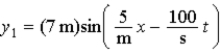
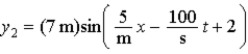 What is the phase (in rad) of the resultant wave when x = t = 0?
 (Multiple Choice)
4.7/5 (79)
(79) The superposition of two waves 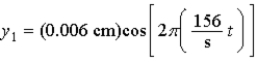 and
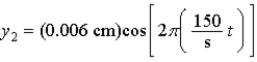 at the location x = 0 in space results in
and at the location x = 0 in space results in (Multiple Choice)
4.9/5 (70)
(70) Which of the following frequencies could NOT be present as a standing wave in a 2m long organ pipe open at both ends? The fundamental frequency is 85 Hz.
(Multiple Choice)
4.8/5 (93)
(93) A speaker is producing 30 W of sound. At which of the following frequencies would it sound the loudest?
(Multiple Choice)
4.8/5 (86)
(86) An organ pipe open at both ends has a radius of 4.0 cm and a length of 6.0 m. What is the frequency (in Hz) of the third harmonic? (Assume the velocity of sound is 344 m/s.)
(Multiple Choice)
4.8/5 (86)
(86) When two organ pipes each closed at one end sound a perfect fifth, such as two notes with fundamental frequencies at 440 Hz and 660 Hz, both pipes produce overtones. Which choice below correctly describes overtones present in both pipes?
(Multiple Choice)
4.8/5 (80)
(80) If a plane is flying at a speed so that the apex half-angle of its shockwave is 30°, what is its speed if the speed of sound is 320 m/s?
(Multiple Choice)
4.9/5 (71)
(71) The figure below shows the positions of particles in a longitudinal standing wave. One quarter period later the particle distribution is shown in 
(Multiple Choice)
4.8/5 (83)
(83) A string with a fixed frequency vibrator at one end is undergoing resonance with 4 antinodes when under tension T1. When the tension is slowly increased the resonance condition disappears until tension T2 is reached, there being no resonances occurring between these two tensions. How many antinodes are there in this new resonance?
(Multiple Choice)
4.8/5 (69)
(69) The superposition of two waves, 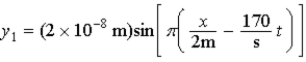 and
 , results in a wave with a wavelength of
and , results in a wave with a wavelength of (Multiple Choice)
4.9/5 (80)
(80) Exhibit 18-1
The figure below shows wave crests after a stone is thrown into a pond. 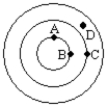 Use this exhibit to answer the following question(s).
-Refer to Exhibit 18-1. The phase difference in radians between points A and D is
Use this exhibit to answer the following question(s).
-Refer to Exhibit 18-1. The phase difference in radians between points A and D is (Multiple Choice)
4.9/5 (89)
(89) On a day when the speed of sound in the upper air is 320 m/s, you fly coast to coast in the United States, a distance of about 4 850 km, in about one hour, if the Mach number for the speed of your airplane is about
(Multiple Choice)
4.8/5 (94)
(94) Two organ pipes, a pipe of fundamental frequency 440 Hz, closed at one end, and a pipe of fundamental frequency 660 Hz, open at both ends, produce overtones. Which choice below correctly describes overtones present in both pipes?
(Multiple Choice)
4.8/5 (88)
(88) 
Filters
- Essay(0)
- Multiple Choice(0)
- Short Answer(0)
- True False(0)
- Matching(0)